




The animal which does not belong to Chelicerata is
A. Spider
B. Tick
C. Scorpion
D. Termite
Answer
 Verified
650.7k+ views
Hint: Chelicerata is a large group of aggressive arthropods belonging to the phylum of Arthropods. Some of them have been found to possess venom.
Complete answer: Chelicerata is a group under the phylum of Arthropoda. Like all arthropods, they are characterized by the segmented body and jointed appendages. The body of the organisms belonging to this group is divided into two parts namely, the cephalothorax and the abdomen.
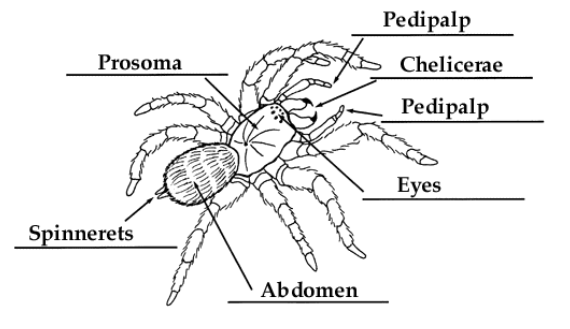
The cephalothorax is formed by the fusion of the head and the thorax. There are 6 pairs of appendages and each pair is attached to the six segments of the cephalothorax. They have a characteristic claw-like structure called chelicerae, which act as a sensory organ and help in defense and feeding.
Arthropods like spiders, ticks, and scorpions all belong to this group whereas termites belong to the subphylum Hexapoda.
Given below is the diagram of spider which is one of the most common chelicerates:
Therefore, the correct answer is option D. Termite.
Note: Chelicerates living in a marine habitat have gills, and the air-breathing forms generally have both book lungs and tracheae.
Complete answer: Chelicerata is a group under the phylum of Arthropoda. Like all arthropods, they are characterized by the segmented body and jointed appendages. The body of the organisms belonging to this group is divided into two parts namely, the cephalothorax and the abdomen.
The cephalothorax is formed by the fusion of the head and the thorax. There are 6 pairs of appendages and each pair is attached to the six segments of the cephalothorax. They have a characteristic claw-like structure called chelicerae, which act as a sensory organ and help in defense and feeding.
Arthropods like spiders, ticks, and scorpions all belong to this group whereas termites belong to the subphylum Hexapoda.
Given below is the diagram of spider which is one of the most common chelicerates:
Therefore, the correct answer is option D. Termite.
Note: Chelicerates living in a marine habitat have gills, and the air-breathing forms generally have both book lungs and tracheae.
Recently Updated Pages
Master Class 11 Social Science: Engaging Questions & Answers for Success

Master Class 11 English: Engaging Questions & Answers for Success
Master Class 11 Accountancy: Engaging Questions & Answers for Success
Master Class 11 Physics: Engaging Questions & Answers for Success
Master Class 11 Computer Science: Engaging Questions & Answers for Success
Master Class 11 Business Studies: Engaging Questions & Answers for Success
Trending doubts
Find the value of the expression given below sin 30circ class 11 maths CBSE
One Metric ton is equal to kg A 10000 B 1000 C 100 class 11 physics CBSE
Draw a diagram of nephron and explain its structur class 11 biology CBSE
10 examples of friction in our daily life
Proton was discovered by A Thomson B Rutherford C Chadwick class 11 chemistry CBSE
The teeth used for biting and cutting food are called class 11 biology CBSE