




The angle of elevation of the top of a vertical tower from a point P on the horizontal ground was observed to be $\alpha $. After moving a distance of 2 meters from P towards the foot of the tower, the angle of elevation changes to $\beta $. Then the height (in meters) of the tower is:
(A) $\dfrac{{\cos \left( {\beta - \alpha } \right)}}{{\sin \alpha \sin \beta }}$ (B) $\dfrac{{2\sin \left( {\beta - \alpha } \right)}}{{\sin \alpha \sin \beta }}$ (C) $\dfrac{{2\sin \alpha \sin \beta }}{{\sin \left( {\beta - \alpha } \right)}}$ (D) $\dfrac{{\sin \alpha \sin \beta }}{{\cos \left( {\beta - \alpha } \right)}}$
Answer
 Verified
618.6k+ views
Hint: Analyze the situation with a diagram. Use trigonometric ratios to find the distance of point P from the foot of the tower in both cases. And then compare both values to get the desired result.
Complete step-by-step answer:
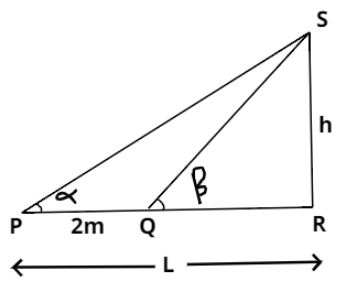
Consider the above figure, let L be the initial distance of the foot of the tower from point P and h be the height of the tower.
As per the information given in the question, $\alpha $ is the angle of elevation of the top of the tower from point P.
From $\Delta PRS$ shown above:
$
\Rightarrow \tan \alpha = \dfrac{{SR}}{{PR}} \\
\Rightarrow \tan \alpha = \dfrac{h}{L} \\
\Rightarrow L = \dfrac{h}{{\tan \alpha }} .....(i) \\
$
Now, after moving 2 meters towards the tower we reach another point Q. Then the distance between the foot of the tower and point Q is $L - 2$. And the angle of elevation of the top of the tower from point Q is given in the question as $\beta $. So in $\Delta QSR$ in the above figure:
$
\Rightarrow \tan \beta = \dfrac{{SR}}{{QR}} \\
\Rightarrow \tan \beta = \dfrac{h}{{L - 2}}, \\
\Rightarrow L - 2 = \dfrac{h}{{\tan \beta }}, \\
\Rightarrow L = \dfrac{h}{{\tan \beta }} + 2 .....(ii) \\
$
Now, comparing equation $(i)$ and $(ii)$, we have:
$
\Rightarrow \dfrac{h}{{\tan \alpha }} = \dfrac{h}{{\tan \beta }} + 2, \\
\Rightarrow h\left( {\dfrac{1}{{\tan \alpha }} - \dfrac{1}{{\tan \beta }}} \right) = 2, \\
$
Taking $\tan \alpha \tan \beta $ as LCM, we’ll get:
$
\Rightarrow h\left( {\dfrac{{\tan \alpha - \tan \beta }}{{\tan \alpha \tan \beta }}} \right) = 2, \\
\Rightarrow h = \dfrac{{2\tan \alpha \tan \beta }}{{\tan \alpha - \tan \beta }} \\
$
Now we know that, $\tan \theta = \dfrac{{\sin \theta }}{{\cos \theta }}$, applying this we’ll get:
\[
\Rightarrow h = \dfrac{{2 \times \dfrac{{\sin \alpha }}{{\cos \alpha }} \times \dfrac{{\sin \beta }}{{\cos \beta }}}}{{\dfrac{{\sin \alpha }}{{\cos \alpha }} - \dfrac{{\sin \beta }}{{\cos \beta }}}}, \\
\Rightarrow h = \dfrac{{2 \times \dfrac{{\sin \alpha \sin \beta }}{{\cos \alpha \cos \beta }}}}{{\dfrac{{\sin \alpha \cos \beta - \cos \alpha \sin \beta }}{{\cos \alpha \cos \beta }}}}, \\
\Rightarrow h = \dfrac{{2\sin \alpha \sin \beta }}{{\sin \alpha \cos \beta - \cos \alpha \sin \beta }} \\
\]
We know that, $\sin A\cos B - \cos A\sin B = \sin \left( {A - B} \right)$, applying this formula, we’ll get:
\[ \Rightarrow h = \dfrac{{2\sin \alpha \sin \beta }}{{\sin \left( {\alpha - \beta } \right)}}\]
Therefore, the height of the tower is \[\dfrac{{2\sin \alpha \sin \beta }}{{\sin \left( {\alpha - \beta } \right)}}\]. Option (C) is correct.
Note: We can use any of the trigonometric ratios to get the end results. But in this case, perpendicular and base are known for the given angles so it is convenient to use either $\tan \theta {\text{ or }}\cot \theta $. If we want to use any other trigonometric ratios, then we have to determine hypotenuse first by using Pythagoras theorem.
Complete step-by-step answer:
Consider the above figure, let L be the initial distance of the foot of the tower from point P and h be the height of the tower.
As per the information given in the question, $\alpha $ is the angle of elevation of the top of the tower from point P.
From $\Delta PRS$ shown above:
$
\Rightarrow \tan \alpha = \dfrac{{SR}}{{PR}} \\
\Rightarrow \tan \alpha = \dfrac{h}{L} \\
\Rightarrow L = \dfrac{h}{{\tan \alpha }} .....(i) \\
$
Now, after moving 2 meters towards the tower we reach another point Q. Then the distance between the foot of the tower and point Q is $L - 2$. And the angle of elevation of the top of the tower from point Q is given in the question as $\beta $. So in $\Delta QSR$ in the above figure:
$
\Rightarrow \tan \beta = \dfrac{{SR}}{{QR}} \\
\Rightarrow \tan \beta = \dfrac{h}{{L - 2}}, \\
\Rightarrow L - 2 = \dfrac{h}{{\tan \beta }}, \\
\Rightarrow L = \dfrac{h}{{\tan \beta }} + 2 .....(ii) \\
$
Now, comparing equation $(i)$ and $(ii)$, we have:
$
\Rightarrow \dfrac{h}{{\tan \alpha }} = \dfrac{h}{{\tan \beta }} + 2, \\
\Rightarrow h\left( {\dfrac{1}{{\tan \alpha }} - \dfrac{1}{{\tan \beta }}} \right) = 2, \\
$
Taking $\tan \alpha \tan \beta $ as LCM, we’ll get:
$
\Rightarrow h\left( {\dfrac{{\tan \alpha - \tan \beta }}{{\tan \alpha \tan \beta }}} \right) = 2, \\
\Rightarrow h = \dfrac{{2\tan \alpha \tan \beta }}{{\tan \alpha - \tan \beta }} \\
$
Now we know that, $\tan \theta = \dfrac{{\sin \theta }}{{\cos \theta }}$, applying this we’ll get:
\[
\Rightarrow h = \dfrac{{2 \times \dfrac{{\sin \alpha }}{{\cos \alpha }} \times \dfrac{{\sin \beta }}{{\cos \beta }}}}{{\dfrac{{\sin \alpha }}{{\cos \alpha }} - \dfrac{{\sin \beta }}{{\cos \beta }}}}, \\
\Rightarrow h = \dfrac{{2 \times \dfrac{{\sin \alpha \sin \beta }}{{\cos \alpha \cos \beta }}}}{{\dfrac{{\sin \alpha \cos \beta - \cos \alpha \sin \beta }}{{\cos \alpha \cos \beta }}}}, \\
\Rightarrow h = \dfrac{{2\sin \alpha \sin \beta }}{{\sin \alpha \cos \beta - \cos \alpha \sin \beta }} \\
\]
We know that, $\sin A\cos B - \cos A\sin B = \sin \left( {A - B} \right)$, applying this formula, we’ll get:
\[ \Rightarrow h = \dfrac{{2\sin \alpha \sin \beta }}{{\sin \left( {\alpha - \beta } \right)}}\]
Therefore, the height of the tower is \[\dfrac{{2\sin \alpha \sin \beta }}{{\sin \left( {\alpha - \beta } \right)}}\]. Option (C) is correct.
Note: We can use any of the trigonometric ratios to get the end results. But in this case, perpendicular and base are known for the given angles so it is convenient to use either $\tan \theta {\text{ or }}\cot \theta $. If we want to use any other trigonometric ratios, then we have to determine hypotenuse first by using Pythagoras theorem.
Recently Updated Pages
Master Class 11 Business Studies: Engaging Questions & Answers for Success

Master Class 11 Computer Science: Engaging Questions & Answers for Success
Master Class 11 Economics: Engaging Questions & Answers for Success
Master Class 11 Social Science: Engaging Questions & Answers for Success
Master Class 11 English: Engaging Questions & Answers for Success
Master Class 11 Chemistry: Engaging Questions & Answers for Success
Trending doubts
Draw a diagram of nephron and explain its structur class 11 biology CBSE
Explain zero factorial class 11 maths CBSE
Chemical formula of Bleaching powder is A Ca2OCl2 B class 11 chemistry CBSE
Name the part of the brain responsible for the precision class 11 biology CBSE
The growth of tendril in pea plants is due to AEffect class 11 biology CBSE
One Metric ton is equal to kg A 10000 B 1000 C 100 class 11 physics CBSE