




The angle of elevation of the top of a vertical tower AB from a point X on the ground is $60{}^\circ $ . At a point Y, 40m vertically above X, the angle of elevation of the top is $45{}^\circ $ . Calculate the height of the tower.
Answer
 Verified
617.7k+ views
Hint: First draw a rough diagram of the given conditions. Now, assume that the height of the pole is ‘h’ and its distance from the tower is ‘d’. Form two equations in ‘h’ and ‘d’ using the information provided and solve these two equations to get the value of ‘h’ and ‘d’. Use $\tan \theta =\dfrac{\text{perpendicular}}{\text{base}}$ to form the equations in the right angle triangle.
Complete step-by-step answer:
Let us assume that X is the bottom of the pole and Y is the top of the pole. It is given that the top of the tower is denoted by B and bottom as A. So, let us draw the diagram of the given situation.
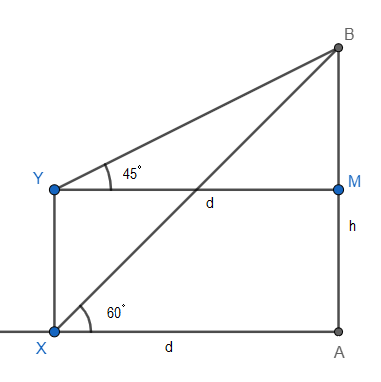
From the above figure, we have,
In right angle triangle XAB,
AX = d, AB = h
\[\angle AXB=60{}^\circ \]
Therefore, using $\tan \theta =\dfrac{\text{perpendicular}}{\text{base}}$, we have,
$\begin{align}
& \tan 60{}^\circ =\dfrac{AB}{AX} \\
& \Rightarrow \tan 60{}^\circ =\dfrac{h}{d} \\
& \Rightarrow h=d\tan 60{}^\circ ........................(i) \\
\end{align}$
Now, in right angle triangle BYM,
YM = AX = d, as they are the opposite sides of the rectangle PAMQ.
BM = AB – AM = h-AM , because it is given that the height of the tower is h m and here we have assumed the tower as AB.
Also, \[\angle BYM=45{}^\circ \] , as from the figure we can see that angle of depression of the top of the pole are alternate interior angles, and alternate interior angles are equal.
Therefore, using $\tan \theta =\dfrac{\text{perpendicular}}{\text{base}}$, we have,
$\begin{align}
& \tan 45{}^\circ =\dfrac{BM}{YM} \\
& \Rightarrow \tan 45{}^\circ =\dfrac{h-AM}{d} \\
& \Rightarrow h-AM=d\tan 45{}^\circ \\
\end{align}$
$\Rightarrow h=d\tan 45{}^\circ +AM$
From equations (i) and (ii) we get,
$d\tan 60{}^\circ =d\tan 45{}^\circ +AM$
We know that $\tan 60{}^\circ =\sqrt{3}\text{ and tan45}{}^\circ \text{=1}$ .
$\therefore \sqrt{3}d=d+AM$
As AMXY is a rectangle. AM=XY=40
$\Rightarrow \left( \sqrt{3}-1 \right)d=40$
$\Rightarrow d=\dfrac{40}{\left( \sqrt{3}-1 \right)}$
Substituting the value of d in equation (i), we get,
$h=\dfrac{40}{\sqrt{3}-1}\tan 60{}^\circ =\dfrac{40\sqrt{3}}{\sqrt{3}-1}$
Therefore, the height of the tower is $\dfrac{40\sqrt{3}}{\sqrt{3}-1}meters$ .
Note: We must substitute and eliminate the variables properly otherwise we may get confused while solving the equations. Here, in the above question we have used the tangent of the given angle because we have to find both, height of the tower and its distance from the post. So, the function relating these two variables is tangent of the angle.
Complete step-by-step answer:
Let us assume that X is the bottom of the pole and Y is the top of the pole. It is given that the top of the tower is denoted by B and bottom as A. So, let us draw the diagram of the given situation.
From the above figure, we have,
In right angle triangle XAB,
AX = d, AB = h
\[\angle AXB=60{}^\circ \]
Therefore, using $\tan \theta =\dfrac{\text{perpendicular}}{\text{base}}$, we have,
$\begin{align}
& \tan 60{}^\circ =\dfrac{AB}{AX} \\
& \Rightarrow \tan 60{}^\circ =\dfrac{h}{d} \\
& \Rightarrow h=d\tan 60{}^\circ ........................(i) \\
\end{align}$
Now, in right angle triangle BYM,
YM = AX = d, as they are the opposite sides of the rectangle PAMQ.
BM = AB – AM = h-AM , because it is given that the height of the tower is h m and here we have assumed the tower as AB.
Also, \[\angle BYM=45{}^\circ \] , as from the figure we can see that angle of depression of the top of the pole are alternate interior angles, and alternate interior angles are equal.
Therefore, using $\tan \theta =\dfrac{\text{perpendicular}}{\text{base}}$, we have,
$\begin{align}
& \tan 45{}^\circ =\dfrac{BM}{YM} \\
& \Rightarrow \tan 45{}^\circ =\dfrac{h-AM}{d} \\
& \Rightarrow h-AM=d\tan 45{}^\circ \\
\end{align}$
$\Rightarrow h=d\tan 45{}^\circ +AM$
From equations (i) and (ii) we get,
$d\tan 60{}^\circ =d\tan 45{}^\circ +AM$
We know that $\tan 60{}^\circ =\sqrt{3}\text{ and tan45}{}^\circ \text{=1}$ .
$\therefore \sqrt{3}d=d+AM$
As AMXY is a rectangle. AM=XY=40
$\Rightarrow \left( \sqrt{3}-1 \right)d=40$
$\Rightarrow d=\dfrac{40}{\left( \sqrt{3}-1 \right)}$
Substituting the value of d in equation (i), we get,
$h=\dfrac{40}{\sqrt{3}-1}\tan 60{}^\circ =\dfrac{40\sqrt{3}}{\sqrt{3}-1}$
Therefore, the height of the tower is $\dfrac{40\sqrt{3}}{\sqrt{3}-1}meters$ .
Note: We must substitute and eliminate the variables properly otherwise we may get confused while solving the equations. Here, in the above question we have used the tangent of the given angle because we have to find both, height of the tower and its distance from the post. So, the function relating these two variables is tangent of the angle.
Recently Updated Pages
Basicity of sulphurous acid and sulphuric acid are

Master Class 10 English: Engaging Questions & Answers for Success
Master Class 10 Social Science: Engaging Questions & Answers for Success
Master Class 10 Computer Science: Engaging Questions & Answers for Success
Class 10 Question and Answer - Your Ultimate Solutions Guide
Master Class 10 General Knowledge: Engaging Questions & Answers for Success
Trending doubts
Which country won the ICC Men's ODI World Cup in 2023?
In cricket, how many legal balls are there in a standard over?
Explain the Treaty of Vienna of 1815 class 10 social science CBSE
A boat goes 24 km upstream and 28 km downstream in class 10 maths CBSE
What does "powerplay" mean in limited-overs cricket?
What is the "Powerplay" in T20 cricket?