




The angle between the tangential and radial acceleration is
A. Always perpendicular to each other
B. Parallel to each other
C. 45 degrees
D. Depends on the initial starting point
Answer
 Verified
610.2k+ views
Hint: In a non-uniform circular motion, linear acceleration is also called tangential acceleration, and angular acceleration can be called centripetal acceleration. The direction of tangential acceleration is always long tangential velocity and we know that tangle is always normal to the axis or radius of the circle.
Complete answer:
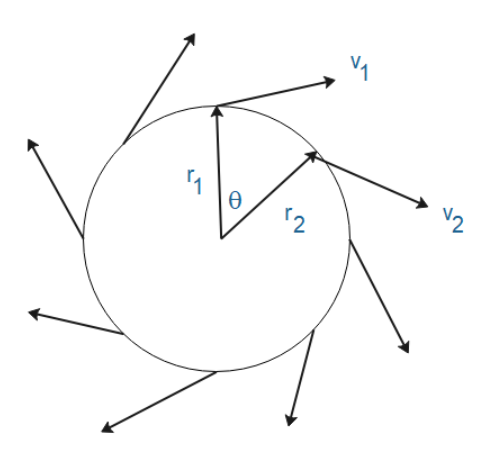
When an object moves in a circle, it has a centripetal acceleration directed toward the center of the circle. We know that centripetal acceleration is given by ${{a}_{c}}=\dfrac{{{v}^{2}}}{r}$. This centripetal acceleration is directed along a radius so it can be called the radial acceleration.
If the speed is not constant (i.e. vary), then there is also a tangential acceleration. The tangential acceleration is, indeed, tangent to the path of the particle performing motion.
Take the example of a turning rotor. Suppose the rotor is turning at a steady rate and there is no tangential acceleration, but there is centripetal acceleration. The point is following a circular path and its velocity (vector) is changing. The direction it is pointing is changing every instant as it goes around the circle, as shown in the figure. Whenever the rotor is turning, every point on the rotor except the axis will have centripetal acceleration.
If the rotation rate of the rotor varies with time, then there is angular acceleration. If we look at a point on the rotor some distance r from the axis of the circle, then it will have a tangential acceleration along its circular path equal to r times the angular acceleration of the body, as shown in the figure. Whenever the rotor as a whole has an angular acceleration. Every point on the rotor except points right on the axis of rotation will have a tangential acceleration
Hence, the angle between the tangential and radial acceleration is always perpendicular to each other.
Therefore correct option is (A).
Note:
Every point on the rotor will experience the same angular acceleration. In a uniform circular motion, linear acceleration is centripetal acceleration. Tangential acceleration is zero always, in case of uniform circular motion.
Complete answer:
When an object moves in a circle, it has a centripetal acceleration directed toward the center of the circle. We know that centripetal acceleration is given by ${{a}_{c}}=\dfrac{{{v}^{2}}}{r}$. This centripetal acceleration is directed along a radius so it can be called the radial acceleration.
If the speed is not constant (i.e. vary), then there is also a tangential acceleration. The tangential acceleration is, indeed, tangent to the path of the particle performing motion.
Take the example of a turning rotor. Suppose the rotor is turning at a steady rate and there is no tangential acceleration, but there is centripetal acceleration. The point is following a circular path and its velocity (vector) is changing. The direction it is pointing is changing every instant as it goes around the circle, as shown in the figure. Whenever the rotor is turning, every point on the rotor except the axis will have centripetal acceleration.
If the rotation rate of the rotor varies with time, then there is angular acceleration. If we look at a point on the rotor some distance r from the axis of the circle, then it will have a tangential acceleration along its circular path equal to r times the angular acceleration of the body, as shown in the figure. Whenever the rotor as a whole has an angular acceleration. Every point on the rotor except points right on the axis of rotation will have a tangential acceleration
Hence, the angle between the tangential and radial acceleration is always perpendicular to each other.
Therefore correct option is (A).
Note:
Every point on the rotor will experience the same angular acceleration. In a uniform circular motion, linear acceleration is centripetal acceleration. Tangential acceleration is zero always, in case of uniform circular motion.
Recently Updated Pages
Master Class 12 Economics: Engaging Questions & Answers for Success

Master Class 12 English: Engaging Questions & Answers for Success
Master Class 12 Social Science: Engaging Questions & Answers for Success
Master Class 12 Maths: Engaging Questions & Answers for Success
Master Class 12 Physics: Engaging Questions & Answers for Success
Master Class 9 General Knowledge: Engaging Questions & Answers for Success
Trending doubts
One Metric ton is equal to kg A 10000 B 1000 C 100 class 11 physics CBSE
Difference Between Prokaryotic Cells and Eukaryotic Cells
Two of the body parts which do not appear in MRI are class 11 biology CBSE
1 ton equals to A 100 kg B 1000 kg C 10 kg D 10000 class 11 physics CBSE
Draw a diagram of nephron and explain its structur class 11 biology CBSE
10 examples of friction in our daily life