




The alkylation of benzene with n-propyl chloride in the presence of anhydrous $AlC{{l}_{3}}$ produces:
(A) n-propyl benzene
(B) isopropyl benzene
(C) o-dipropyl benzene
(D) a mixture of all of these
Answer
 Verified
592.2k+ views
Hint: In this question, we can see that the alkylation of an aromatic ring, benzene is done with an alkyl halide, n-propyl chloride, in the presence of a strong Lewis acid, anhydrous $AlC{{l}_{3}}$. Hence the given reaction is an example of Friedel-Crafts alkylation.
Complete answer:
The Friedel-Crafts reactions are reactions that can be used to add substituents to an aromatic ring. They were developed by chemists James Crafts and Charles Friedel in 1877.
They are mainly of two types, Friedel-Crafts alkylation reaction, and Friedel-Crafts acylation reaction.
Both the alkylation and acylation reactions follow the electrophilic aromatic substitution mechanism.
In the given question, Friedel-Crafts alkylation takes place.
When n-propyl chloride is taken in the presence of aluminum chloride, it forms an electrophilic propyl carbocation.
\[C{{H}_{3}}C{{H}_{2}}C{{H}_{2}}Cl+AlC{{l}_{3}}\to C{{H}_{3}}C{{H}_{2}}CH_{2}^{+}+AlCl_{4}^{-}\]
Since primary carbocations are unstable, a more stable secondary isopropyl carbocation is formed by hydride shift.
\[C{{H}_{3}}C{{H}_{2}}CH_{2}^{+}\to C{{H}_{3}}C{{H}^{+}}C{{H}_{3}}\]
When this carbocation attacks the benzene ring, an isopropyl cyclohexane carbocation intermediate is formed. This results in the loss of its aromaticity since carbon-carbon double bond C=C is broken.
When this intermediate is deprotonated, the carbon-carbon double bond C=C is reformed and the compound restores aromaticity to form isopropyl benzene. The protons and chlorine ion from $AlCl_{4}^{-}$ form hydrochloric acid and hence aluminum chloride $AlC{{l}_{3}}$ is restored.
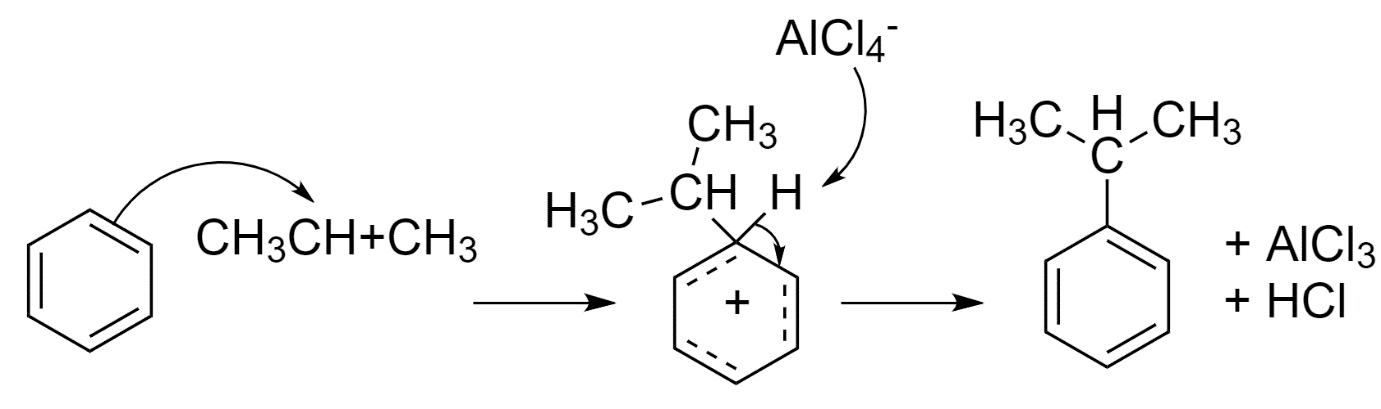
So, option (B) isopropyl benzene is formed when n-propyl chloride is reacted with benzene in presence of anhydrous $AlC{{l}_{3}}$.
Note:
This question can be tricky and confusing as one can forget to factor in the stability of the carbocation formed. When the stability of a carbocation intermediate is increased, the activation energy of the reaction is lowered, and hence the speed of the reaction increases.
The common name of isopropyl benzene is cumene.
Complete answer:
The Friedel-Crafts reactions are reactions that can be used to add substituents to an aromatic ring. They were developed by chemists James Crafts and Charles Friedel in 1877.
They are mainly of two types, Friedel-Crafts alkylation reaction, and Friedel-Crafts acylation reaction.
Both the alkylation and acylation reactions follow the electrophilic aromatic substitution mechanism.
In the given question, Friedel-Crafts alkylation takes place.
When n-propyl chloride is taken in the presence of aluminum chloride, it forms an electrophilic propyl carbocation.
\[C{{H}_{3}}C{{H}_{2}}C{{H}_{2}}Cl+AlC{{l}_{3}}\to C{{H}_{3}}C{{H}_{2}}CH_{2}^{+}+AlCl_{4}^{-}\]
Since primary carbocations are unstable, a more stable secondary isopropyl carbocation is formed by hydride shift.
\[C{{H}_{3}}C{{H}_{2}}CH_{2}^{+}\to C{{H}_{3}}C{{H}^{+}}C{{H}_{3}}\]
When this carbocation attacks the benzene ring, an isopropyl cyclohexane carbocation intermediate is formed. This results in the loss of its aromaticity since carbon-carbon double bond C=C is broken.
When this intermediate is deprotonated, the carbon-carbon double bond C=C is reformed and the compound restores aromaticity to form isopropyl benzene. The protons and chlorine ion from $AlCl_{4}^{-}$ form hydrochloric acid and hence aluminum chloride $AlC{{l}_{3}}$ is restored.
So, option (B) isopropyl benzene is formed when n-propyl chloride is reacted with benzene in presence of anhydrous $AlC{{l}_{3}}$.
Note:
This question can be tricky and confusing as one can forget to factor in the stability of the carbocation formed. When the stability of a carbocation intermediate is increased, the activation energy of the reaction is lowered, and hence the speed of the reaction increases.
The common name of isopropyl benzene is cumene.
Recently Updated Pages
Which will be the least stable resonating structure class 11 chemistry CBSE

How many 5 digit telephone numbers can be construc-class-11-maths-CBSE
How do you find the angle of the resultant vector class 11 physics CBSE
Draw labelled diagram of the following i Gram seed class 11 biology CBSE
What is the need and importance of classification class 11 biology CBSE
The way in which the sparrows expressed their sorrow class 11 english CBSE
Trending doubts
One Metric ton is equal to kg A 10000 B 1000 C 100 class 11 physics CBSE
1 Quintal is equal to a 110 kg b 10 kg c 100kg d 1000 class 11 physics CBSE
Draw a diagram of nephron and explain its structur class 11 biology CBSE
10 examples of friction in our daily life
Proton was discovered by A Thomson B Rutherford C Chadwick class 11 chemistry CBSE
Bond order ofO2 O2+ O2 and O22 is in order A O2 langle class 11 chemistry CBSE