




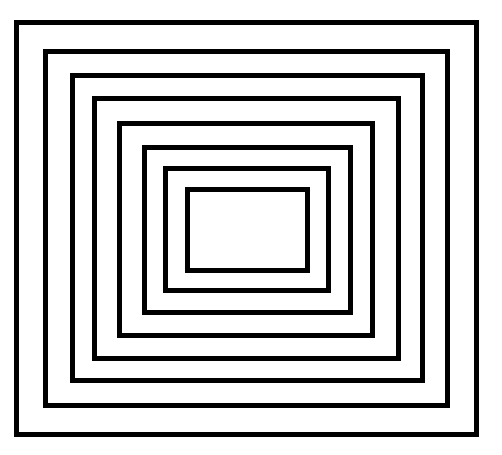
The adjoining figure shows a set of concentric squares. If the diagonal of the innermost square is 2 units, and if the distance between the corresponding corners of any two successive squares is 1 unit, find the difference between the values of the areas of the eight and the seventh squares, counting from the innermost square in square units.
Answer
 Verified
644.1k+ views
Hint: First of all, find the length of the diagonal of seventh square as the length of diagonal of seventh square is equal to sum of lengths of diagonal of the first square and twice the sum of distance between the seventh and first square at one end. Then find the area of the seventh square. Similarly find for the eighth square. And then subtract the area of seventh square from eighth to get the required answer.
Complete step-by-step answer:
Given the distance between the corresponding corners = 1 unit
The diagonal of the innermost square = 2 units
The length of diagonal of seventh square is equal to sum of lengths of diagonal of the first square and the sum of distance between the seventh and first square.
So, diagonal of 7th square \[ = 2 + 2\left( {6 \times 1} \right) = 14\]
And diagonal of 8th square \[ = 2 + 2\left( {7 \times 1} \right) = 16\]
We know that the area of the square with diagonal \[D\] is given by \[\dfrac{{{D^2}}}{2}\].
So, the area of 7th square \[ = \dfrac{{{{\left( {14} \right)}^2}}}{2} = 98\]
And the area of 8th square \[ = \dfrac{{{{\left( {16} \right)}^2}}}{2} = 128\]
Difference of area of 8th square and 7th square \[ = 128 - 98 = 30{\text{ sq}}{\text{.units}}\]
Hence find the difference between the values of the areas of the eight and the seventh squares, counting from the innermost square in square units is 30 sq. units.
Note: The area of the square with diagonal \[D\] is given by \[\dfrac{{{D^2}}}{2}\]. The area of the outermost square is always greater than the area of the innermost square. Always remember that the units of area are given in sq. units.
Complete step-by-step answer:
Given the distance between the corresponding corners = 1 unit
The diagonal of the innermost square = 2 units
The length of diagonal of seventh square is equal to sum of lengths of diagonal of the first square and the sum of distance between the seventh and first square.
So, diagonal of 7th square \[ = 2 + 2\left( {6 \times 1} \right) = 14\]
And diagonal of 8th square \[ = 2 + 2\left( {7 \times 1} \right) = 16\]
We know that the area of the square with diagonal \[D\] is given by \[\dfrac{{{D^2}}}{2}\].
So, the area of 7th square \[ = \dfrac{{{{\left( {14} \right)}^2}}}{2} = 98\]
And the area of 8th square \[ = \dfrac{{{{\left( {16} \right)}^2}}}{2} = 128\]
Difference of area of 8th square and 7th square \[ = 128 - 98 = 30{\text{ sq}}{\text{.units}}\]
Hence find the difference between the values of the areas of the eight and the seventh squares, counting from the innermost square in square units is 30 sq. units.
Note: The area of the square with diagonal \[D\] is given by \[\dfrac{{{D^2}}}{2}\]. The area of the outermost square is always greater than the area of the innermost square. Always remember that the units of area are given in sq. units.
Recently Updated Pages
Master Class 12 Business Studies: Engaging Questions & Answers for Success

Master Class 12 Biology: Engaging Questions & Answers for Success
Master Class 12 Chemistry: Engaging Questions & Answers for Success
Class 12 Question and Answer - Your Ultimate Solutions Guide
Master Class 11 Social Science: Engaging Questions & Answers for Success
Master Class 11 English: Engaging Questions & Answers for Success
Trending doubts
What is the full form of NDA a National Democratic class 10 social science CBSE
Explain the Treaty of Vienna of 1815 class 10 social science CBSE
Who Won 36 Oscar Awards? Record Holder Revealed
Bharatiya Janata Party was founded in the year A 1979 class 10 social science CBSE
What is the median of the first 10 natural numbers class 10 maths CBSE
Why is it 530 pm in india when it is 1200 afternoon class 10 social science CBSE