




The acute angle between the medians drawn from the acute angles of an isosceles right angled triangle is?
Answer
 Verified
549.9k+ views
Hint: To solve the question we need to have the knowledge of inverse trigonometric functions and properties of inverse trigonometric functions. The first step for solving this problem will be to draw an isosceles right angle. The second step will be to find the angle of theta,$\theta $ by using the formula of dot product of the two median.
Complete step by step answer:
The question asks us to find the acute angle between the medians which is drawn from the acute angles of an isosceles angled triangle. Now we know that an isosceles triangle means the two angles are equal. We will consider an isosceles right angle $\vartriangle OAB$ where $O$ is the origin, $A$ is on the x-axis and $B$ is on the y-axis. Let $AC$and $BD$ be the medians drawn from vertices. $C$ is midpoint of $OB$ and $D$ is midpoint of $OA$.
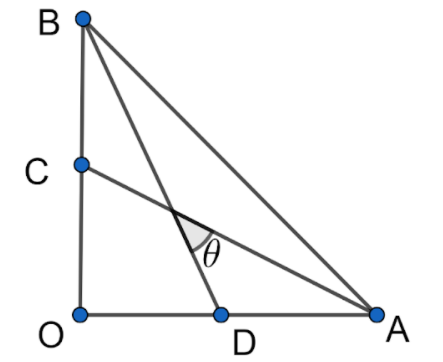
In the diagram given $\overrightarrow{OB}$ and $\overrightarrow{OA}$ are equal in length. Let the length of the equal side be $a$ . So $\overrightarrow{OA}=ai$ and $\overrightarrow{OB}=aj$. Let $AC$and $BD$ be the medians drawn from vertices. $C$ is the point of $OB$ and $D$ is midpoint of $OA$. On writing the sides in vector form with the length then it is $\overrightarrow{OC}=\dfrac{a}{2}j$ and $\overrightarrow{OB}=\dfrac{a}{2}i$.
Now we will have to find the measurement of the median which are $AC$and $BD$. Firstly we will find the value of $AC$.
$\Rightarrow \overrightarrow{AC}=\overrightarrow{OC}-\overrightarrow{OA}$
We do know the value of $\overrightarrow{OC}$and $\overrightarrow{OA}$. On substituting the value we get:
$\Rightarrow \overrightarrow{AC}=-ai+\dfrac{a}{2}j$
Similarly we will find the value for $BD$, which could be written as: $\Rightarrow \overrightarrow{BD}=\overrightarrow{OD}-\overrightarrow{OB}$
$\Rightarrow \overrightarrow{BD}=\dfrac{a}{2}i-aj$
The last step will be to find the angle formed by the two medians. To do this we will use the vector dot product. The formula for the vector product is $a. b=\left| a \right|\left| b \right|\cos \theta $ . On applying the same in the formula we get:
$\cos \theta =\dfrac{\overrightarrow{AC}. \overrightarrow{BD}}{\left| \overrightarrow{AC} \right|\left| \overrightarrow{BD} \right|}$
$\theta ={{\cos }^{-1}}\left( \dfrac{\overrightarrow{AC}. \overrightarrow{BD}}{\left| \overrightarrow{AC} \right|\left| \overrightarrow{BD} \right|} \right)$
Substituting the value, we get:
\[\theta ={{\cos }^{-1}}\left( \dfrac{\left( -ai+\dfrac{a}{2}j \right). \left( \dfrac{a}{2}i-aj \right)}{\left| -ai+\dfrac{a}{2}j \right|\left| \dfrac{a}{2}i-aj \right|} \right)\]
\[\theta ={{\cos }^{-1}}\left( \dfrac{-\dfrac{{{a}^{2}}}{2}-\dfrac{{{a}^{2}}}{2}}{\sqrt{{{\left( -a \right)}^{2}}+{{\left( \dfrac{a}{2} \right)}^{2}}}\sqrt{{{\left( \dfrac{a}{2} \right)}^{2}}+{{\left( -a \right)}^{2}}}} \right)\]
\[\theta ={{\cos }^{-1}}\left(\dfrac{{{a}^{2}}}{\sqrt{{{a}^{2}}+\dfrac{{{a}^{2}}}{4}}\sqrt{{{a}^{2}}+\dfrac{{{a}^{2}}}{4}}} \right)\]
\[\theta ={{\cos }^{-1}}\left( \dfrac{{{a}^{2}}}{\sqrt{\dfrac{5{{a}^{2}}}{4}}\sqrt{\dfrac{5{{a}^{2}}}{4}}} \right)\]
\[\theta ={{\cos }^{-1}}\left( \dfrac{{{a}^{2}}}{\dfrac{5{{a}^{2}}}{4}} \right)\]
\[\theta ={{\cos }^{-1}}\left( \dfrac{4{{a}^{2}}}{5{{a}^{2}}} \right)\]
\[\theta ={{\cos }^{-1}}\left( \dfrac{4}{5} \right)\]
$\therefore $ The acute angle between the medians drawn from the acute angles of an isosceles right angled triangle is \[{{\cos }^{-1}}\left( \dfrac{4}{5} \right)\].
Note: Vector dot product has great significance. The dot product in $i,j,k$ coordinates are $\left( {{a}_{1}}i+{{a}_{2}}j+{{a}_{3}}k \right). \left( {{b}_{1}}i+{{b}_{2}}j+{{b}_{3}}k \right)={{a}_{1}}{{b}_{1}}+{{a}_{2}}{{b}_{2}}+{{a}_{3}}{{b}_{3}}$. The dot product is a scalar product which means it does not have any direction as we can see in the formula below. $\left( {{a}_{1}}i+{{a}_{2}}j+{{a}_{3}}k \right). \left( {{b}_{1}}i+{{b}_{2}}j+{{b}_{3}}k \right)={{a}_{1}}{{b}_{1}}+{{a}_{2}}{{b}_{2}}+{{a}_{3}}{{b}_{3}}=\sqrt{{{a}_{1}}^{2}+{{a}_{2}}^{2}+{{a}_{3}}^{2}}\sqrt{{{b}_{1}}^{2}+{{b}_{2}}^{2}+{{b}_{3}}^{2}}\cos \theta $.
Complete step by step answer:
The question asks us to find the acute angle between the medians which is drawn from the acute angles of an isosceles angled triangle. Now we know that an isosceles triangle means the two angles are equal. We will consider an isosceles right angle $\vartriangle OAB$ where $O$ is the origin, $A$ is on the x-axis and $B$ is on the y-axis. Let $AC$and $BD$ be the medians drawn from vertices. $C$ is midpoint of $OB$ and $D$ is midpoint of $OA$.
In the diagram given $\overrightarrow{OB}$ and $\overrightarrow{OA}$ are equal in length. Let the length of the equal side be $a$ . So $\overrightarrow{OA}=ai$ and $\overrightarrow{OB}=aj$. Let $AC$and $BD$ be the medians drawn from vertices. $C$ is the point of $OB$ and $D$ is midpoint of $OA$. On writing the sides in vector form with the length then it is $\overrightarrow{OC}=\dfrac{a}{2}j$ and $\overrightarrow{OB}=\dfrac{a}{2}i$.
Now we will have to find the measurement of the median which are $AC$and $BD$. Firstly we will find the value of $AC$.
$\Rightarrow \overrightarrow{AC}=\overrightarrow{OC}-\overrightarrow{OA}$
We do know the value of $\overrightarrow{OC}$and $\overrightarrow{OA}$. On substituting the value we get:
$\Rightarrow \overrightarrow{AC}=-ai+\dfrac{a}{2}j$
Similarly we will find the value for $BD$, which could be written as: $\Rightarrow \overrightarrow{BD}=\overrightarrow{OD}-\overrightarrow{OB}$
$\Rightarrow \overrightarrow{BD}=\dfrac{a}{2}i-aj$
The last step will be to find the angle formed by the two medians. To do this we will use the vector dot product. The formula for the vector product is $a. b=\left| a \right|\left| b \right|\cos \theta $ . On applying the same in the formula we get:
$\cos \theta =\dfrac{\overrightarrow{AC}. \overrightarrow{BD}}{\left| \overrightarrow{AC} \right|\left| \overrightarrow{BD} \right|}$
$\theta ={{\cos }^{-1}}\left( \dfrac{\overrightarrow{AC}. \overrightarrow{BD}}{\left| \overrightarrow{AC} \right|\left| \overrightarrow{BD} \right|} \right)$
Substituting the value, we get:
\[\theta ={{\cos }^{-1}}\left( \dfrac{\left( -ai+\dfrac{a}{2}j \right). \left( \dfrac{a}{2}i-aj \right)}{\left| -ai+\dfrac{a}{2}j \right|\left| \dfrac{a}{2}i-aj \right|} \right)\]
\[\theta ={{\cos }^{-1}}\left( \dfrac{-\dfrac{{{a}^{2}}}{2}-\dfrac{{{a}^{2}}}{2}}{\sqrt{{{\left( -a \right)}^{2}}+{{\left( \dfrac{a}{2} \right)}^{2}}}\sqrt{{{\left( \dfrac{a}{2} \right)}^{2}}+{{\left( -a \right)}^{2}}}} \right)\]
\[\theta ={{\cos }^{-1}}\left(\dfrac{{{a}^{2}}}{\sqrt{{{a}^{2}}+\dfrac{{{a}^{2}}}{4}}\sqrt{{{a}^{2}}+\dfrac{{{a}^{2}}}{4}}} \right)\]
\[\theta ={{\cos }^{-1}}\left( \dfrac{{{a}^{2}}}{\sqrt{\dfrac{5{{a}^{2}}}{4}}\sqrt{\dfrac{5{{a}^{2}}}{4}}} \right)\]
\[\theta ={{\cos }^{-1}}\left( \dfrac{{{a}^{2}}}{\dfrac{5{{a}^{2}}}{4}} \right)\]
\[\theta ={{\cos }^{-1}}\left( \dfrac{4{{a}^{2}}}{5{{a}^{2}}} \right)\]
\[\theta ={{\cos }^{-1}}\left( \dfrac{4}{5} \right)\]
$\therefore $ The acute angle between the medians drawn from the acute angles of an isosceles right angled triangle is \[{{\cos }^{-1}}\left( \dfrac{4}{5} \right)\].
Note: Vector dot product has great significance. The dot product in $i,j,k$ coordinates are $\left( {{a}_{1}}i+{{a}_{2}}j+{{a}_{3}}k \right). \left( {{b}_{1}}i+{{b}_{2}}j+{{b}_{3}}k \right)={{a}_{1}}{{b}_{1}}+{{a}_{2}}{{b}_{2}}+{{a}_{3}}{{b}_{3}}$. The dot product is a scalar product which means it does not have any direction as we can see in the formula below. $\left( {{a}_{1}}i+{{a}_{2}}j+{{a}_{3}}k \right). \left( {{b}_{1}}i+{{b}_{2}}j+{{b}_{3}}k \right)={{a}_{1}}{{b}_{1}}+{{a}_{2}}{{b}_{2}}+{{a}_{3}}{{b}_{3}}=\sqrt{{{a}_{1}}^{2}+{{a}_{2}}^{2}+{{a}_{3}}^{2}}\sqrt{{{b}_{1}}^{2}+{{b}_{2}}^{2}+{{b}_{3}}^{2}}\cos \theta $.
Recently Updated Pages
Master Class 11 English: Engaging Questions & Answers for Success

Master Class 11 Social Science: Engaging Questions & Answers for Success
Master Class 11 Maths: Engaging Questions & Answers for Success
Master Class 11 Chemistry: Engaging Questions & Answers for Success
Master Class 11 Biology: Engaging Questions & Answers for Success
Master Class 11 Physics: Engaging Questions & Answers for Success
Trending doubts
Explain the Treaty of Vienna of 1815 class 10 social science CBSE
Why is it 530 pm in india when it is 1200 afternoon class 10 social science CBSE
What is the full form of CNG A Complete Natural Gas class 10 social science CBSE
In cricket, what is a "Yorker" designed to do?
What is the full form of POSCO class 10 social science CBSE
Define Potential, Developed, Stock and Reserved resources