




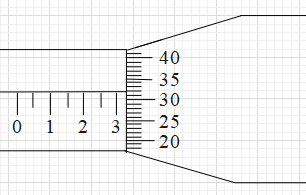
The accompanying diagram represents a screw gauge. The circular scale is divided into 50 divisions and the linear scale is divided into millimeters. If the screw advances by 1mm when the circular scale makes 2 complete revolutions, the least count of the instrument and the reading of the instrument in figure are:
A. 0.01mm, 3.82mm
B. 0.01mm, 4.82mm
C. 0.02mm, 3.82mm
D. 0.05mm, 3.82mm
Answer
 Verified
621k+ views
Hint: Calculate the pitch of the screw gauge with the help of the given information. Then divide the pitch by the number of circular scale divisions to find the least count of the instrument. To calculate the reading of the measurement shown, use the formula for the reading of a screw gauge.
Formula used: $p=\dfrac{\text{length moved}}{\text{revolutions needed}}$
$LC=\dfrac{p}{N}$
$l=LSR+(LC\times CSR)$
Complete step by step answer:
Let us first calculate the pitch of the screw gauge. The pitch of a screw gauge is defined as the ratio of the length moved on the linear scale to the number of revolutions of the circular scale needed for this movement.
i.e. $p=\dfrac{\text{length moved}}{\text{revolutions needed}}$.
It is given that when the circular scale makes 2 complete revolutions, the screw moves for 1mm.
Therefore, $p=\dfrac{1}{2}=0.5mm$.
The least count of a screw gauge is equal to the pitch divided by the number of divisions on the circular scale.
i.e. $LC=\dfrac{p}{N}$, LC is the least count and N is the number of divisions on the circular scale.
Here, N = 50.
$\Rightarrow LC=\dfrac{p}{N}=\dfrac{0.5}{50}=0.01mm$.
Therefore, the least count of the given instrument is 0.01mm.
The reading of a screw gauge is given as $l=LSR+(LC\times CSR)$ …. (i).
Here, LSR is the linear scale reading and CSR is the circular scale reading.
From the given figure of the measurement, we get that LSR = 3mm and CSR = 32.
Substitute the values of LSR and CSR in equation (i).
$l=3+(0.01\times 32)=3+0.32=3.32mm$.
This means that the reading of the instrument is 3.32mm.
So, the correct answer is “Option A”.
Note: Sometimes the instrument may have an instrumental error.
Actually, when the linear scale reading is zero, the circular scale must be zero. However, sometimes the circular scale reading may not show zero. Therefore, there will be an error in the final reading. Hence, the error must be corrected.
Formula used: $p=\dfrac{\text{length moved}}{\text{revolutions needed}}$
$LC=\dfrac{p}{N}$
$l=LSR+(LC\times CSR)$
Complete step by step answer:
Let us first calculate the pitch of the screw gauge. The pitch of a screw gauge is defined as the ratio of the length moved on the linear scale to the number of revolutions of the circular scale needed for this movement.
i.e. $p=\dfrac{\text{length moved}}{\text{revolutions needed}}$.
It is given that when the circular scale makes 2 complete revolutions, the screw moves for 1mm.
Therefore, $p=\dfrac{1}{2}=0.5mm$.
The least count of a screw gauge is equal to the pitch divided by the number of divisions on the circular scale.
i.e. $LC=\dfrac{p}{N}$, LC is the least count and N is the number of divisions on the circular scale.
Here, N = 50.
$\Rightarrow LC=\dfrac{p}{N}=\dfrac{0.5}{50}=0.01mm$.
Therefore, the least count of the given instrument is 0.01mm.
The reading of a screw gauge is given as $l=LSR+(LC\times CSR)$ …. (i).
Here, LSR is the linear scale reading and CSR is the circular scale reading.
From the given figure of the measurement, we get that LSR = 3mm and CSR = 32.
Substitute the values of LSR and CSR in equation (i).
$l=3+(0.01\times 32)=3+0.32=3.32mm$.
This means that the reading of the instrument is 3.32mm.
So, the correct answer is “Option A”.
Note: Sometimes the instrument may have an instrumental error.
Actually, when the linear scale reading is zero, the circular scale must be zero. However, sometimes the circular scale reading may not show zero. Therefore, there will be an error in the final reading. Hence, the error must be corrected.
Recently Updated Pages
Master Class 11 Social Science: Engaging Questions & Answers for Success

Master Class 11 English: Engaging Questions & Answers for Success
Master Class 11 Maths: Engaging Questions & Answers for Success
Master Class 11 Chemistry: Engaging Questions & Answers for Success
Master Class 11 Biology: Engaging Questions & Answers for Success
Class 11 Question and Answer - Your Ultimate Solutions Guide
Trending doubts
One Metric ton is equal to kg A 10000 B 1000 C 100 class 11 physics CBSE
Difference Between Prokaryotic Cells and Eukaryotic Cells
Find the value of the expression given below sin 30circ class 11 maths CBSE
1 ton equals to A 100 kg B 1000 kg C 10 kg D 10000 class 11 physics CBSE
Two of the body parts which do not appear in MRI are class 11 biology CBSE
Draw a diagram of nephron and explain its structur class 11 biology CBSE