




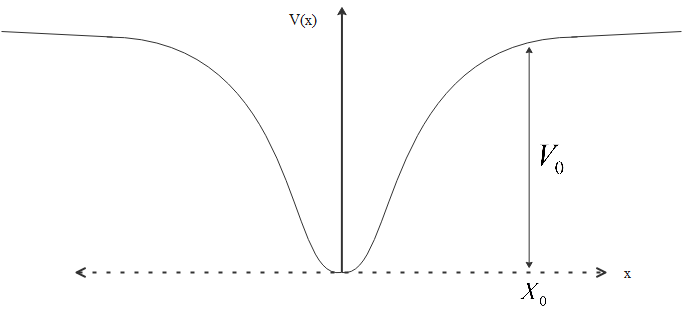
The acceleration of this particle for $\left| x \right|>{{X}_{0}}$ is proportional to
A. ${{V}_{0}}$
B. $\sqrt{\dfrac{{{V}_{0}}}{m{{X}_{0}}}}$
C. $\dfrac{{{V}_{0}}}{m{{X}_{0}}}$
D. zero
Answer
 Verified
590.4k+ views
Hint: When a particle moves in a potential of the form $V(x)=k{{x}^{n}}$. It performs simple harmonic motion. Simple harmonic motion can be defined as a periodic oscillatory motion in which the acceleration of the particle at any position is directly proportional to the displacement from the mean position.
We need to study this graph and answer this question accordingly.
Complete answer:
From this graph it can be noted that potential varies with position of the particle as
$V(x)=\left\{ \begin{align}
& \begin{matrix}
k{{x}^{4}} & \text{if }0<\left| x \right|<{{X}_{0}} \\
\end{matrix} \\
& \begin{matrix}
{{V}_{0}} & \text{Otherwise} \\
\end{matrix} \\
\end{align} \right.$
Force acting on a particle moving under a potential is the negative gradient of the potential. Therefore, we get
$F(x)=\left\{ \begin{align}
& \begin{matrix}
-4k{{x}^{3}} & \text{if }0<\left| x \right|<{{X}_{0}} \\
\end{matrix} \\
& \begin{matrix}
0 & \text{Otherwise} \\
\end{matrix} \\
\end{align} \right.$
Force on a particle is also defined as a product of its mass and acceleration. That is,
$F=ma$
Therefore acceleration of the particle can be written as,
$a=\dfrac{F}{m}$
Acceleration of particle at $\left| x \right|>{{X}_{0}}$
$a=\dfrac{F(>{{X}_{0}})}{m}$
Since, force acting on the particle at $\left| x \right|>{{X}_{0}}$ is zero. Therefore,
$\Rightarrow a=0$
So, the correct answer is “Option D”.
Additional Information:
Simple harmonic motion can be defined as a periodic oscillatory motion in which the acceleration of the particle at any position is directly proportional to the displacement from the mean position.
Oscillatory motion is the to and fro motion of a particle about its mean position. This means force always acts towards the mean position.
When potential is constant, no force acts on the particle. Hence, acceleration is zero.
Note:
During a SHM, the force acting on a particle is always towards the mean position or equilibrium position.
The force on a particle is zero when it reaches equilibrium position and maximum when it is at a distance equal to its amplitude. Amplitude of a SHM is the maximum distance of a particle as measured from its equilibrium position.
We need to study this graph and answer this question accordingly.
Complete answer:
From this graph it can be noted that potential varies with position of the particle as
$V(x)=\left\{ \begin{align}
& \begin{matrix}
k{{x}^{4}} & \text{if }0<\left| x \right|<{{X}_{0}} \\
\end{matrix} \\
& \begin{matrix}
{{V}_{0}} & \text{Otherwise} \\
\end{matrix} \\
\end{align} \right.$
Force acting on a particle moving under a potential is the negative gradient of the potential. Therefore, we get
$F(x)=\left\{ \begin{align}
& \begin{matrix}
-4k{{x}^{3}} & \text{if }0<\left| x \right|<{{X}_{0}} \\
\end{matrix} \\
& \begin{matrix}
0 & \text{Otherwise} \\
\end{matrix} \\
\end{align} \right.$
Force on a particle is also defined as a product of its mass and acceleration. That is,
$F=ma$
Therefore acceleration of the particle can be written as,
$a=\dfrac{F}{m}$
Acceleration of particle at $\left| x \right|>{{X}_{0}}$
$a=\dfrac{F(>{{X}_{0}})}{m}$
Since, force acting on the particle at $\left| x \right|>{{X}_{0}}$ is zero. Therefore,
$\Rightarrow a=0$
So, the correct answer is “Option D”.
Additional Information:
Simple harmonic motion can be defined as a periodic oscillatory motion in which the acceleration of the particle at any position is directly proportional to the displacement from the mean position.
Oscillatory motion is the to and fro motion of a particle about its mean position. This means force always acts towards the mean position.
When potential is constant, no force acts on the particle. Hence, acceleration is zero.
Note:
During a SHM, the force acting on a particle is always towards the mean position or equilibrium position.
The force on a particle is zero when it reaches equilibrium position and maximum when it is at a distance equal to its amplitude. Amplitude of a SHM is the maximum distance of a particle as measured from its equilibrium position.
Recently Updated Pages
Basicity of sulphurous acid and sulphuric acid are

Master Class 11 Business Studies: Engaging Questions & Answers for Success
Master Class 11 Computer Science: Engaging Questions & Answers for Success
Master Class 11 Economics: Engaging Questions & Answers for Success
Master Class 11 Social Science: Engaging Questions & Answers for Success
Master Class 11 English: Engaging Questions & Answers for Success
Trending doubts
One Metric ton is equal to kg A 10000 B 1000 C 100 class 11 physics CBSE
The largest wind power cluster is located in the state class 11 social science CBSE
Explain zero factorial class 11 maths CBSE
State and prove Bernoullis theorem class 11 physics CBSE
What steps did the French revolutionaries take to create class 11 social science CBSE
Which among the following are examples of coming together class 11 social science CBSE