




The \[_{98}^{250}Cf\] is split into two parts of almost equal mass. What is the order of magnitude of potential energy of interaction of the two parts when they are just touching each other? (In ${10^n}$ eV)
Answer
 Verified
533.7k+ views
Hint:Since the atom got split into two parts of almost equal mass, the mass of each of the daughter atoms would be half of the original atom. When the daughter atoms are just touching each other, they share a common point through which both atoms pass. And since while calculating the gravitational potential, the distance is calculated from the center of the bodies, the total effective distance would become $x = 2r$ . We will now simply plug in the values into the formula to get the order of magnitude of the potential energy.
Formula used:
The gravitational potential is given by,
$V = \dfrac{{G{m_1}{m_2}}}{x}$
where $x$ is the distance between the two bodies.
Complete step by step answer:
Let’s visualize the situation first.The diagram below shows the situation
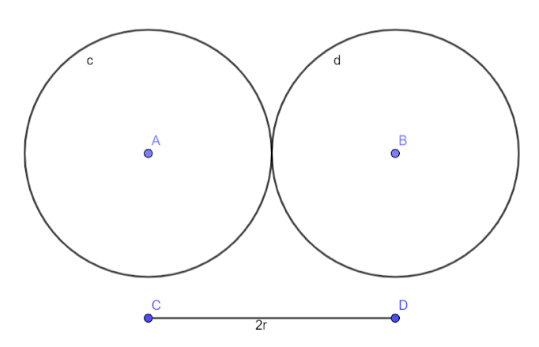
Let the radius of one of the masses be r. The distance between the centers is $x = 2r$.The mass of the given \[_{98}^{250}Cf\] atom is 250. Hence the mass of each of the entities is,
$m = \dfrac{{250}}{2}$
$ \Rightarrow m = 125\,g$
The gravitational potential is given by
$V = \dfrac{{G{m_1}{m_2}}}{x}$
Here it is given that ${m_1} = {m_2}$.
So, the formula reduces to $V = \dfrac{{G{m^2}}}{x}$ .
Substituting the values in the equation we get,
$V = \dfrac{{6.67 \times {{10}^{ - 11}} \times {{(125 \times 1.67 \times {{10}^{ - 27}})}^2}}}{{2 \times {{10}^{ - 15}}}}$
$ \Rightarrow V = \dfrac{{290655 \times {{10}^{ - 65}}}}{{{{10}^{ - 15}}}}$
$ \Rightarrow V = 290655 \times {10^{ - 50}}$
Making an approximation,
$V \sim 3 \times {10^{ - 45}}$
Converting to eV we get,
$V \sim \dfrac{{3 \times {{10}^{ - 45}}}}{{1.6 \times {{10}^{ - 19}}}}$
$ \therefore V \sim 1.875 \times {10^{ - 26}}$
So, the potential is of the order of -26.
Note:The distance is taken from the centers of the two bodies along the line of action of force. When the radius of the bodies is appreciably large, we take into account their radii as well while calculating the force. Else we take point masses and neglect their radii.The value of G is universal and does not depend on any factors like temperature, pressure and hence it is also called the universal gravitational constant.
Formula used:
The gravitational potential is given by,
$V = \dfrac{{G{m_1}{m_2}}}{x}$
where $x$ is the distance between the two bodies.
Complete step by step answer:
Let’s visualize the situation first.The diagram below shows the situation
Let the radius of one of the masses be r. The distance between the centers is $x = 2r$.The mass of the given \[_{98}^{250}Cf\] atom is 250. Hence the mass of each of the entities is,
$m = \dfrac{{250}}{2}$
$ \Rightarrow m = 125\,g$
The gravitational potential is given by
$V = \dfrac{{G{m_1}{m_2}}}{x}$
Here it is given that ${m_1} = {m_2}$.
So, the formula reduces to $V = \dfrac{{G{m^2}}}{x}$ .
Substituting the values in the equation we get,
$V = \dfrac{{6.67 \times {{10}^{ - 11}} \times {{(125 \times 1.67 \times {{10}^{ - 27}})}^2}}}{{2 \times {{10}^{ - 15}}}}$
$ \Rightarrow V = \dfrac{{290655 \times {{10}^{ - 65}}}}{{{{10}^{ - 15}}}}$
$ \Rightarrow V = 290655 \times {10^{ - 50}}$
Making an approximation,
$V \sim 3 \times {10^{ - 45}}$
Converting to eV we get,
$V \sim \dfrac{{3 \times {{10}^{ - 45}}}}{{1.6 \times {{10}^{ - 19}}}}$
$ \therefore V \sim 1.875 \times {10^{ - 26}}$
So, the potential is of the order of -26.
Note:The distance is taken from the centers of the two bodies along the line of action of force. When the radius of the bodies is appreciably large, we take into account their radii as well while calculating the force. Else we take point masses and neglect their radii.The value of G is universal and does not depend on any factors like temperature, pressure and hence it is also called the universal gravitational constant.
Recently Updated Pages
Master Class 12 Economics: Engaging Questions & Answers for Success

Master Class 12 English: Engaging Questions & Answers for Success
Master Class 12 Social Science: Engaging Questions & Answers for Success
Master Class 12 Maths: Engaging Questions & Answers for Success
Master Class 12 Physics: Engaging Questions & Answers for Success
Master Class 11 Social Science: Engaging Questions & Answers for Success
Trending doubts
One Metric ton is equal to kg A 10000 B 1000 C 100 class 11 physics CBSE
Difference Between Prokaryotic Cells and Eukaryotic Cells
Find the value of the expression given below sin 30circ class 11 maths CBSE
Two of the body parts which do not appear in MRI are class 11 biology CBSE
Draw a diagram of nephron and explain its structur class 11 biology CBSE
10 examples of friction in our daily life