




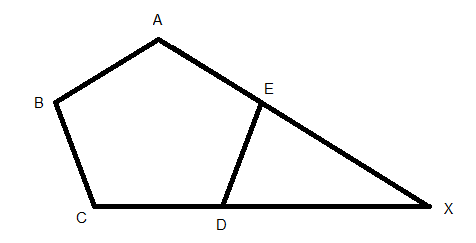
The 2 nonadjacent sides of a regular pentagon (5 congruent and 5 congruent interior angles) are extended to meet at point X as shown in the above figure. Find the measure of \[\angle X\],
A. \[18^\circ \]
B. \[30^\circ \]
C. \[36^\circ \]
D. \[45^\circ \]
E. \[72^\circ \]
Answer
 Verified
600.6k+ views
Hint: Since we have given a regular polygon here pentagon, whose all interior angles are equal. Then using the linear pair, we can find the measures of the angles of the triangle other than x as it is given that the lines are extended, hence we can use linear pairs, as we have already found the interior angles of the pentagon. Then using the property of the sum of all the angles of a triangle which is the sum of all the angles of the triangle is \[{180^o}\], we can find the measure of x.
Complete step-by-step answer:
We know that the sum of the interior angles of regular polygon with n sides is given by the equation \[S = \left( {n - 2} \right) \times 180^\circ \]
Here we have a pentagon and we know that a pentagon has 5 sides.
$ \Rightarrow S = \left( {5 - 2} \right) \times 180^\circ $
On simplification, we get
$ \Rightarrow S = 3 \times 180^\circ $
On multiplication we get
$ \Rightarrow S = 540^\circ $
We know that for a regular polygon, each of the angles will be equal.
Therefore, the measure of each angle will be \[ = \dfrac{S}{n}\]
$ \Rightarrow \dfrac{{540^\circ }}{5} = 108^\circ $
Therefore, the measure of each angle is \[108^\circ \].
From the figure, we can write
$\angle AED = \angle CDE = 108^\circ $ …. (1)
Again, from the figure, $\angle AED$ and $\angle XED$ are linear pairs and will be supplementary.
$ \Rightarrow \angle AED + \angle XED = 180^\circ $
On substituting (1), we get
$ \Rightarrow 108^\circ + \angle XED = 180^\circ $
On rearranging, we get
$ \Rightarrow \angle XED = 180^\circ - 108^\circ $
On simplification we get
$ \Rightarrow \angle XED = 72^\circ $ …. (2)
Similarly, from the figure, $\angle CDE$ and $\angle XDE$ are linear pairs and will be supplementary.
$ \Rightarrow \angle CDE + \angle XDE = 180^\circ $
On substituting (1), we get
$ \Rightarrow 108^\circ + \angle XDE = 180^\circ $
On rearranging, we get
$ \Rightarrow \angle XDE = 180^\circ - 108^\circ $
On simplification, we get
$ \Rightarrow \angle XDE = 72^\circ $ …. (3).
Now consider the triangle XDE. We know that sum of the angles of a triangle is \[{\text{18}}{{\text{0}}^{\text{o}}}\]
\[ \Rightarrow \angle XED + \angle XDE + \angle DXE = 180^\circ \]
On substituting, equation (2) and (3), we get
\[ \Rightarrow 72\;^\circ + 72^\circ + \angle X = 180^\circ \]
On simplification, we get
\[ \Rightarrow 144^\circ + \angle X = 180^\circ \]
On rearranging, we get
\[ \Rightarrow \angle X = 180^\circ - 144^\circ \]
On simplification we get
\[ \Rightarrow \angle X = 36^\circ \]
Therefore, the required solution is \[36^\circ \].
So, the correct answer is option C.
Note: Alternatively, we can consider the given figure is quadrilateral ABCX.
We know that the sum of the angles of a quadrilateral is \[360^\circ \].
$ \Rightarrow \angle A + \angle B + \angle C + \angle X = 360^\circ $ … (a)
We know that each angle of a regular pentagon is equal to $108^\circ $.
$ \Rightarrow \angle A = \angle B = \angle C = 108^\circ $.
On substituting this is (a), we get
$ \Rightarrow 108^\circ + 108^\circ + 108^\circ + \angle X = 360^\circ $
On simplification, we get
$ \Rightarrow 324^\circ + \angle X = 360^\circ $
On rearranging, we get
$ \Rightarrow \angle X = 360^\circ - 324^\circ $
On simplification we get
$ \Rightarrow \angle X = 36^\circ $
Therefore, the required solution is \[36^\circ \].
Complete step-by-step answer:
We know that the sum of the interior angles of regular polygon with n sides is given by the equation \[S = \left( {n - 2} \right) \times 180^\circ \]
Here we have a pentagon and we know that a pentagon has 5 sides.
$ \Rightarrow S = \left( {5 - 2} \right) \times 180^\circ $
On simplification, we get
$ \Rightarrow S = 3 \times 180^\circ $
On multiplication we get
$ \Rightarrow S = 540^\circ $
We know that for a regular polygon, each of the angles will be equal.
Therefore, the measure of each angle will be \[ = \dfrac{S}{n}\]
$ \Rightarrow \dfrac{{540^\circ }}{5} = 108^\circ $
Therefore, the measure of each angle is \[108^\circ \].
From the figure, we can write
$\angle AED = \angle CDE = 108^\circ $ …. (1)
Again, from the figure, $\angle AED$ and $\angle XED$ are linear pairs and will be supplementary.
$ \Rightarrow \angle AED + \angle XED = 180^\circ $
On substituting (1), we get
$ \Rightarrow 108^\circ + \angle XED = 180^\circ $
On rearranging, we get
$ \Rightarrow \angle XED = 180^\circ - 108^\circ $
On simplification we get
$ \Rightarrow \angle XED = 72^\circ $ …. (2)
Similarly, from the figure, $\angle CDE$ and $\angle XDE$ are linear pairs and will be supplementary.
$ \Rightarrow \angle CDE + \angle XDE = 180^\circ $
On substituting (1), we get
$ \Rightarrow 108^\circ + \angle XDE = 180^\circ $
On rearranging, we get
$ \Rightarrow \angle XDE = 180^\circ - 108^\circ $
On simplification, we get
$ \Rightarrow \angle XDE = 72^\circ $ …. (3).
Now consider the triangle XDE. We know that sum of the angles of a triangle is \[{\text{18}}{{\text{0}}^{\text{o}}}\]
\[ \Rightarrow \angle XED + \angle XDE + \angle DXE = 180^\circ \]
On substituting, equation (2) and (3), we get
\[ \Rightarrow 72\;^\circ + 72^\circ + \angle X = 180^\circ \]
On simplification, we get
\[ \Rightarrow 144^\circ + \angle X = 180^\circ \]
On rearranging, we get
\[ \Rightarrow \angle X = 180^\circ - 144^\circ \]
On simplification we get
\[ \Rightarrow \angle X = 36^\circ \]
Therefore, the required solution is \[36^\circ \].
So, the correct answer is option C.
Note: Alternatively, we can consider the given figure is quadrilateral ABCX.
We know that the sum of the angles of a quadrilateral is \[360^\circ \].
$ \Rightarrow \angle A + \angle B + \angle C + \angle X = 360^\circ $ … (a)
We know that each angle of a regular pentagon is equal to $108^\circ $.
$ \Rightarrow \angle A = \angle B = \angle C = 108^\circ $.
On substituting this is (a), we get
$ \Rightarrow 108^\circ + 108^\circ + 108^\circ + \angle X = 360^\circ $
On simplification, we get
$ \Rightarrow 324^\circ + \angle X = 360^\circ $
On rearranging, we get
$ \Rightarrow \angle X = 360^\circ - 324^\circ $
On simplification we get
$ \Rightarrow \angle X = 36^\circ $
Therefore, the required solution is \[36^\circ \].
Recently Updated Pages
Master Class 12 Business Studies: Engaging Questions & Answers for Success

Master Class 12 Biology: Engaging Questions & Answers for Success
Master Class 12 Chemistry: Engaging Questions & Answers for Success
Class 12 Question and Answer - Your Ultimate Solutions Guide
Master Class 11 Social Science: Engaging Questions & Answers for Success
Master Class 11 English: Engaging Questions & Answers for Success
Trending doubts
Explain the Treaty of Vienna of 1815 class 10 social science CBSE
Which Indian city is known as the "City of Victory"?
Which instrument is used to measure the Blood Pressure?
Who Won 36 Oscar Awards? Record Holder Revealed
What is the median of the first 10 natural numbers class 10 maths CBSE
Why is it 530 pm in india when it is 1200 afternoon class 10 social science CBSE