




Tertiary butyl methyl ether on treatment with $ HI $ forms:
(A) Isobutane and methyl iodide
(B) Isobutanol and methanol
(C) Tertiary butyl iodide and methyl iodide
(D) tertiary butyl iodide and methanol
Answer
 Verified
573.9k+ views
Hint: The action of hydrogen iodide on any ether is to cleave the ether into two fragments. One of the two fragments contains an oxygen atom and the other does not. The fragment will contain oxygen or not depending upon the mechanism through which the reaction happens.
Complete answer:
Hydrogen iodide reacts with ether to give a nucleophilic substitution reaction in which one alkyl group of the ether gets attached to the iodide molecule and becomes an alkyl halide and the other alkyl group that is connected to oxygen form a bond with hydrogen (coming from the dissociation of hydrogen iodide) to form the corresponding alcohol.
The mechanism of the reaction depends on the type of alkyl groups present in the ether molecule. If the alkyl are primary or secondary in nature, then a bimolecular substitution $ S{N^2} $ reaction takes place and the iodide ion (that acts as the incoming nucleophile) reacts from a less hindered position.
If the ether contains a tertiary alkyl group then the mechanism that is followed is unimolecular $ S{N^1} $ substitution. The driving force of the reaction is formation of a tertiary carbocation which gets attacked by the iodide nucleophile.
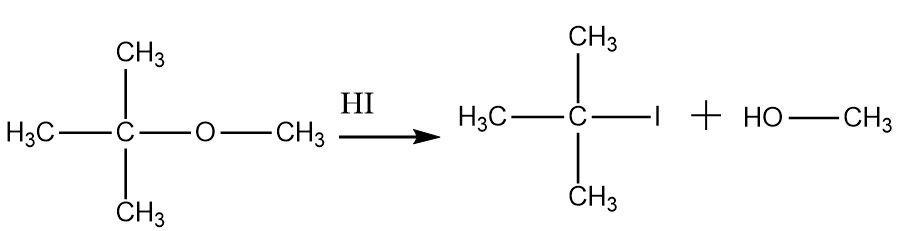
Thus Tertiary butyl methyl ether on treatment with $ HI $ forms tertiary butyl iodide and methanol, option (d) is correct.
Note:
A tertiary carbocation formation is preferred in all organic reactions due to its high stability. The tertiary carbocation is stabilized by the phenomenon of hyperconjugation. The greater number of $ \alpha - hydrogens $ present in a tertiary carbocation increases the number of hyperconjugative structures and hence the stability gets enhanced.
Complete answer:
Hydrogen iodide reacts with ether to give a nucleophilic substitution reaction in which one alkyl group of the ether gets attached to the iodide molecule and becomes an alkyl halide and the other alkyl group that is connected to oxygen form a bond with hydrogen (coming from the dissociation of hydrogen iodide) to form the corresponding alcohol.
The mechanism of the reaction depends on the type of alkyl groups present in the ether molecule. If the alkyl are primary or secondary in nature, then a bimolecular substitution $ S{N^2} $ reaction takes place and the iodide ion (that acts as the incoming nucleophile) reacts from a less hindered position.
If the ether contains a tertiary alkyl group then the mechanism that is followed is unimolecular $ S{N^1} $ substitution. The driving force of the reaction is formation of a tertiary carbocation which gets attacked by the iodide nucleophile.
Thus Tertiary butyl methyl ether on treatment with $ HI $ forms tertiary butyl iodide and methanol, option (d) is correct.
Note:
A tertiary carbocation formation is preferred in all organic reactions due to its high stability. The tertiary carbocation is stabilized by the phenomenon of hyperconjugation. The greater number of $ \alpha - hydrogens $ present in a tertiary carbocation increases the number of hyperconjugative structures and hence the stability gets enhanced.
Recently Updated Pages
If x a + bt + ct2 where x is in meters and t is in class 11 physics CBSE

A car covers the first half distance between two places class 11 physics CBSE
The resultant of two vectors overrightarrow P and overrightarrow class 11 physics CBSE
Find the value of cos 135 class 11 maths CBSE
A mass M is held in place by an applied force F and class 11 physics CBSE
A solution of glucose in water is labelled as 10 dfracwv class 11 chemistry CBSE
Trending doubts
One Metric ton is equal to kg A 10000 B 1000 C 100 class 11 physics CBSE
Find the value of the expression given below sin 30circ class 11 maths CBSE
Draw a diagram of nephron and explain its structur class 11 biology CBSE
10 examples of friction in our daily life
Proton was discovered by A Thomson B Rutherford C Chadwick class 11 chemistry CBSE
Bond order ofO2 O2+ O2 and O22 is in order A O2 langle class 11 chemistry CBSE