




Teflon is an example of polymer which is/are -
A.Polyamide
B.Addition polymer
C.Polyester
D.Formaldehyde resin.
Answer
 Verified
600k+ views
Hint:It is known, a polymer is a substance or material which consists of a very large number of molecules, or macromolecules, and is composed of many repeating subunits. Basically, they are materials made of long, repeating chains of molecules.
Complete step by step answer:
Polymers , based on their polymerisation, can be classified mainly into two categories -
Addition polymerisation, which is basically when a polymer is, is formed by simple linking of monomers without the co-generation of other products.
Condensation polymerisation, which is formed by the step-growth polymerization in which monomers or oligomers react with each other to form larger structural units while releasing smaller molecules as a by - product such as water or methanol, mainly water.
So as we know, Teflon is formed from the monomer tetrafluoroethene by its repeated addition. It is also a homopolymer i.e. consisting of a single monomer.
And hence option B is the correct answer.
Additional information
The structure of the monomer of Teflon is -
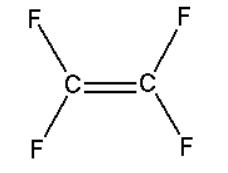
The carbons are $s{p_2}$ hybridized, and they share a double bond while the two fluorine atoms present are bonded to each carbon, and their geometry around the carbon atoms is of trigonal planar.
Note:
Polytetrafluoroethylene or Teflon is best known for its use in making the coating of non-stick frying pans and other cookware, as it is known to be hydrophobic and possesses fairly a very high heat resistance.
Complete step by step answer:
Polymers , based on their polymerisation, can be classified mainly into two categories -
Addition polymerisation, which is basically when a polymer is, is formed by simple linking of monomers without the co-generation of other products.
Condensation polymerisation, which is formed by the step-growth polymerization in which monomers or oligomers react with each other to form larger structural units while releasing smaller molecules as a by - product such as water or methanol, mainly water.
So as we know, Teflon is formed from the monomer tetrafluoroethene by its repeated addition. It is also a homopolymer i.e. consisting of a single monomer.
And hence option B is the correct answer.
Additional information
The structure of the monomer of Teflon is -
The carbons are $s{p_2}$ hybridized, and they share a double bond while the two fluorine atoms present are bonded to each carbon, and their geometry around the carbon atoms is of trigonal planar.
Note:
Polytetrafluoroethylene or Teflon is best known for its use in making the coating of non-stick frying pans and other cookware, as it is known to be hydrophobic and possesses fairly a very high heat resistance.
Recently Updated Pages
Master Class 12 Business Studies: Engaging Questions & Answers for Success

Master Class 12 Chemistry: Engaging Questions & Answers for Success
Master Class 12 Biology: Engaging Questions & Answers for Success
Class 12 Question and Answer - Your Ultimate Solutions Guide
Master Class 11 English: Engaging Questions & Answers for Success
Master Class 11 Social Science: Engaging Questions & Answers for Success
Trending doubts
Which are the Top 10 Largest Countries of the World?
Draw a labelled sketch of the human eye class 12 physics CBSE
The end of compass needle which points towards north class 12 physics CBSE
Differentiate between homogeneous and heterogeneous class 12 chemistry CBSE
Why is the cell called the structural and functional class 12 biology CBSE
When was the first election held in India a 194748 class 12 sst CBSE