




What is the taxonomic classification for starfish?
Answer
 Verified
509.7k+ views
Hint: Because of their star-shaped appearance, starfish are also known as sea stars. They are linked to sand dollars, sea urchins, and sea cucumbers and belong to the group Echinodermata. Starfish, often known as Sea Stars, are one of the most stunning creatures to be seen in the water. They have a strange anatomy, with no brain or blood, but they can digest food outside of their bodies.
Complete answer:
Starfish are classified as Echinodermata phylum and Asteroidea.
Starfish come in a variety of species, genera, and families, but they are all members of the Echinodermata phylum (together with sea urchins and sea cucumbers) and Asteroidea class (exclusively composed of starfishes).
Starfish, often known as sea stars, are echinoderms with a star-shaped body that belong to the Asteroidea class. These names are frequently used for ophiuroids, which are accurately referred to as brittle stars or basket stars in common usage. Because they belong to the Asteroidea class, starfish are sometimes known as asteroids. Starfish can be found on the seafloor in all of the world's oceans, from the tropics to the icy depths of the polar regions.
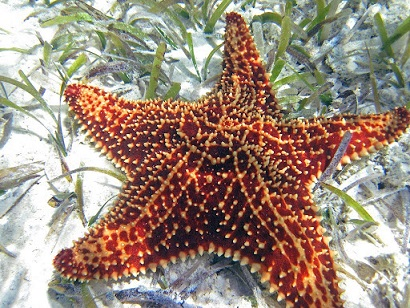
Starfish are invertebrates that live in the sea. They normally have a centre disc and five arms, though some species have more. The aboral or upper surface is covered with overlapping plates and can be smooth, granular, or spiny. Many species are brilliantly coloured, ranging from red to orange, while others are blue, grey, or brown in colour. A hydraulic system powers the tube feet of starfish, which have a mouth in the centre of the oral or bottom surface.
Note:
Echinoderms, such as starfish, have a sensitive internal electrolyte balance that is in balance with sea water, making them impossible to exist in a freshwater environment. All of the world's waters are home to starfish species. Tropical coral reefs, rocky coastlines, tidal pools, mud, and sand are among the habitats, as are kelp forests and seagrass meadows.
Complete answer:
Starfish are classified as Echinodermata phylum and Asteroidea.
Starfish come in a variety of species, genera, and families, but they are all members of the Echinodermata phylum (together with sea urchins and sea cucumbers) and Asteroidea class (exclusively composed of starfishes).
Starfish, often known as sea stars, are echinoderms with a star-shaped body that belong to the Asteroidea class. These names are frequently used for ophiuroids, which are accurately referred to as brittle stars or basket stars in common usage. Because they belong to the Asteroidea class, starfish are sometimes known as asteroids. Starfish can be found on the seafloor in all of the world's oceans, from the tropics to the icy depths of the polar regions.
Starfish are invertebrates that live in the sea. They normally have a centre disc and five arms, though some species have more. The aboral or upper surface is covered with overlapping plates and can be smooth, granular, or spiny. Many species are brilliantly coloured, ranging from red to orange, while others are blue, grey, or brown in colour. A hydraulic system powers the tube feet of starfish, which have a mouth in the centre of the oral or bottom surface.
Note:
Echinoderms, such as starfish, have a sensitive internal electrolyte balance that is in balance with sea water, making them impossible to exist in a freshwater environment. All of the world's waters are home to starfish species. Tropical coral reefs, rocky coastlines, tidal pools, mud, and sand are among the habitats, as are kelp forests and seagrass meadows.
Recently Updated Pages
Master Class 9 General Knowledge: Engaging Questions & Answers for Success

Master Class 9 Maths: Engaging Questions & Answers for Success
Master Class 9 Science: Engaging Questions & Answers for Success
Master Class 9 English: Engaging Questions & Answers for Success
Master Class 9 Social Science: Engaging Questions & Answers for Success
Class 9 Question and Answer - Your Ultimate Solutions Guide
Trending doubts
One Metric ton is equal to kg A 10000 B 1000 C 100 class 11 physics CBSE
Difference Between Prokaryotic Cells and Eukaryotic Cells
Two of the body parts which do not appear in MRI are class 11 biology CBSE
1 ton equals to A 100 kg B 1000 kg C 10 kg D 10000 class 11 physics CBSE
10 examples of friction in our daily life
Name the Largest and the Smallest Cell in the Human Body ?