




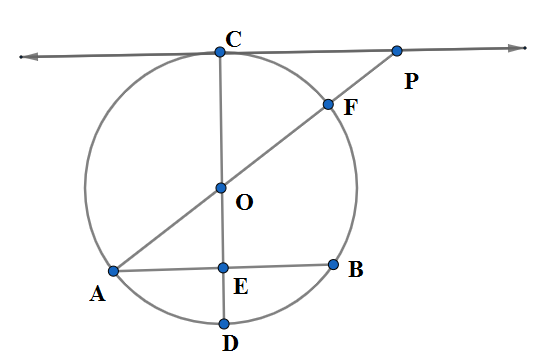
Tangent $\overleftrightarrow {PC}$. intersects circle with centre $O$ at $C$, chord $\overline {AB} ||\overleftrightarrow {CP}$ ,diameter $\overline {COD} $ intersects AB at $E$ and diameter $\overline {AOF} $ is extended to $P.$
If $m\angle OAE = {30^ \circ }$ find $m\widehat {AC}$ and $m\angle P$. \[\]
Answer
 Verified
564.6k+ views
Hint: We use the equality of measures of alternate angles subtended by the transverse AP to have $m\angle OAE = m\angle OPC = m\angle P$. We use the theorem that radius and tangent are perpendicular to have$\angle OCP = {90^ \circ }$. We find the arc measure $m\widehat {AC} = m\angle AOC = {180^ \circ } - m\angle COP$.\[\]
Complete step-by-step solution:
We are given in the question that tangent $\overleftrightarrow {PC}$ intersects circle with centre $O$ at $C$, chord $\overline {AB} ||\overleftrightarrow {PC}$ ,diameter $\overline {COD} $ intersects AB at $E$ and diameter $\overline {AOF} $ is extended to $P.$We know that tangent and radius of circle are always perpendicular to each other. So here the tangent $\overleftrightarrow {PC}$ is perpendicular to radius OC. Hence we have
\[m\angle OCP = {90^ \circ }\]
We know that when a transversal intersects two parallel lines the measure of alternate angles are equal. Here we are given the parallel lines $\overline {AB} ||\overleftrightarrow {CP}$. We observe the transverse AP which subtends alternate angles $\angle OPC,\angle OAE$. We are given in the question that $m\angle OAE = {30^ \circ }$.So by equality of alternate angles we have;
\[m\angle OPC = m\angle OAE = {30^ \circ }\]
We know that the sum of measures of internal angles is ${180^ \circ }$. The internal angles of triangle OPC are$\angle OPC,\angle OCP,\angle COP$.So we have
\[m\angle OPC + m\angle OCP + m\angle OCP = {180^ \circ }\]
We put previously obtained $m\angle OPC = {30^ \circ },m\angle OCP = {90^ \circ }$ in above equation to have
\[\begin{gathered}
m\angle OPC + m\angle OCP + m\angle COP = {180^ \circ } \\
\Rightarrow {30^ \circ } + {90^ \circ } + m\angle COP = {180^ \circ } \\
\Rightarrow m\angle COP = {180^ \circ } - {120^ \circ } = {60^ \circ } \\
\end{gathered} \]
We know that the sum of measured linear pairs of angles subtended on a straight line is ${180^ \circ }$. We see in the figure that the angles $\angle COA,\angle COP$ are linear pair of angles and hence
\[\begin{gathered}
m\angle COA + m\angle COP = {180^ \circ } \\
\Rightarrow m\angle COA + {60^ \circ } = {180^ \circ } \\
\Rightarrow m\angle COA = {180^ \circ } - {60^ \circ } = {120^ \circ } \\
\end{gathered} \]
So we have
\[m\widehat {AC} = m\angle COA = {120^ \circ }\]
So the required results are $m\widehat {AC} = {120^ \circ },m\angle P = {30^ \circ }$.\[\]
Note: We note that the angle measure of an arc is the angle the endpoints of the arc subtended at the centre (also called central angle). That is why $m\widehat {AC} = m\angle COA$.W can further prove that the triangles OAE and OPC are similar either by equality of alternate angles by the transverse CD to have $m\angle OEA = \angle OCP = {90^ \circ }$ or equality of vertically opposite angles $\angle COP = \angle AOE$ with angle-angle criterion.
Complete step-by-step solution:
We are given in the question that tangent $\overleftrightarrow {PC}$ intersects circle with centre $O$ at $C$, chord $\overline {AB} ||\overleftrightarrow {PC}$ ,diameter $\overline {COD} $ intersects AB at $E$ and diameter $\overline {AOF} $ is extended to $P.$We know that tangent and radius of circle are always perpendicular to each other. So here the tangent $\overleftrightarrow {PC}$ is perpendicular to radius OC. Hence we have
\[m\angle OCP = {90^ \circ }\]
We know that when a transversal intersects two parallel lines the measure of alternate angles are equal. Here we are given the parallel lines $\overline {AB} ||\overleftrightarrow {CP}$. We observe the transverse AP which subtends alternate angles $\angle OPC,\angle OAE$. We are given in the question that $m\angle OAE = {30^ \circ }$.So by equality of alternate angles we have;
\[m\angle OPC = m\angle OAE = {30^ \circ }\]
We know that the sum of measures of internal angles is ${180^ \circ }$. The internal angles of triangle OPC are$\angle OPC,\angle OCP,\angle COP$.So we have
\[m\angle OPC + m\angle OCP + m\angle OCP = {180^ \circ }\]
We put previously obtained $m\angle OPC = {30^ \circ },m\angle OCP = {90^ \circ }$ in above equation to have
\[\begin{gathered}
m\angle OPC + m\angle OCP + m\angle COP = {180^ \circ } \\
\Rightarrow {30^ \circ } + {90^ \circ } + m\angle COP = {180^ \circ } \\
\Rightarrow m\angle COP = {180^ \circ } - {120^ \circ } = {60^ \circ } \\
\end{gathered} \]
We know that the sum of measured linear pairs of angles subtended on a straight line is ${180^ \circ }$. We see in the figure that the angles $\angle COA,\angle COP$ are linear pair of angles and hence
\[\begin{gathered}
m\angle COA + m\angle COP = {180^ \circ } \\
\Rightarrow m\angle COA + {60^ \circ } = {180^ \circ } \\
\Rightarrow m\angle COA = {180^ \circ } - {60^ \circ } = {120^ \circ } \\
\end{gathered} \]
So we have
\[m\widehat {AC} = m\angle COA = {120^ \circ }\]
So the required results are $m\widehat {AC} = {120^ \circ },m\angle P = {30^ \circ }$.\[\]
Note: We note that the angle measure of an arc is the angle the endpoints of the arc subtended at the centre (also called central angle). That is why $m\widehat {AC} = m\angle COA$.W can further prove that the triangles OAE and OPC are similar either by equality of alternate angles by the transverse CD to have $m\angle OEA = \angle OCP = {90^ \circ }$ or equality of vertically opposite angles $\angle COP = \angle AOE$ with angle-angle criterion.
Recently Updated Pages
Master Class 10 Computer Science: Engaging Questions & Answers for Success

Master Class 10 General Knowledge: Engaging Questions & Answers for Success
Master Class 10 English: Engaging Questions & Answers for Success
Master Class 10 Social Science: Engaging Questions & Answers for Success
Master Class 10 Maths: Engaging Questions & Answers for Success
Master Class 10 Science: Engaging Questions & Answers for Success
Trending doubts
What is the median of the first 10 natural numbers class 10 maths CBSE
Which women's tennis player has 24 Grand Slam singles titles?
Who is the Brand Ambassador of Incredible India?
Why is there a time difference of about 5 hours between class 10 social science CBSE
Write a letter to the principal requesting him to grant class 10 english CBSE
State and prove converse of BPT Basic Proportionality class 10 maths CBSE