




Synovial fluid is secreted by
(a) Blood
(b) Cartilage
(c) Bone
(d) Synovial membrane
Answer
 Verified
643.5k+ views
Hint: Present in the ligament around the easily movable joints of the hip and elbow. Synovial fluid is secreted as a lubricant to reduce friction and also aids in the free movement.
Complete Step by Step Answer:
Synovial fluid is secreted by the synovial membrane. The synovial membrane secretes synovial fluid into the cavity of joints such as the hip and elbow to reduce friction and improves shock absorption. It also contains immune cells such as phagocytes to kill microbes and to remove debris.
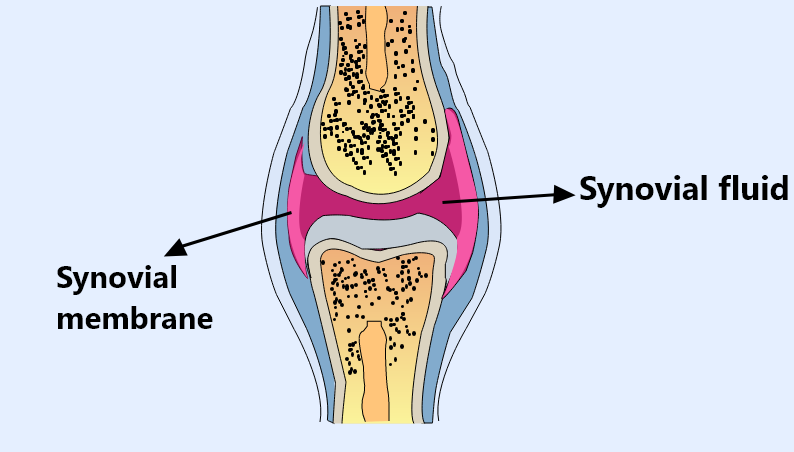
So, the correct answer is the ‘Synovial membrane’.
Additional information:
- Synovial fluid acts as a medium that supplies oxygen and nutrients and removes carbon dioxide.
Blood: A body fluid in vertebrates that delivers nutrients and transports oxygen and carbon dioxide in the body.
- Blood is made up of four major components, which are plasma (55%) , red blood cells (41%) , white blood cells, and platelets(4%) .
Cartilage: Cartilage is a connective tissue found in the joints, the rib cage, the ear, the nose, and in the throat.
- There are three major types of cartilage in the human body, which are hyaline, elastic, and fibrocartilage.
Bone: Bones provide structural support and a frame for the body. It also helps in mobility and aids in the storage of minerals.
- Bones protect major internal organs. There are a total of 206 bones present in an adult human.
Note:
- White blood cells, a major component of blood, play a vital role in immunity.
- The lengthiest and strongest bone of the human body is the femur which is also known as the thigh bone.
- Through the process of hematopoiesis, more than 16 million red blood cells are produced in the human body per second.
Complete Step by Step Answer:
Synovial fluid is secreted by the synovial membrane. The synovial membrane secretes synovial fluid into the cavity of joints such as the hip and elbow to reduce friction and improves shock absorption. It also contains immune cells such as phagocytes to kill microbes and to remove debris.
So, the correct answer is the ‘Synovial membrane’.
Additional information:
- Synovial fluid acts as a medium that supplies oxygen and nutrients and removes carbon dioxide.
Blood: A body fluid in vertebrates that delivers nutrients and transports oxygen and carbon dioxide in the body.
- Blood is made up of four major components, which are plasma (55%) , red blood cells (41%) , white blood cells, and platelets(4%) .
Cartilage: Cartilage is a connective tissue found in the joints, the rib cage, the ear, the nose, and in the throat.
- There are three major types of cartilage in the human body, which are hyaline, elastic, and fibrocartilage.
Bone: Bones provide structural support and a frame for the body. It also helps in mobility and aids in the storage of minerals.
- Bones protect major internal organs. There are a total of 206 bones present in an adult human.
Note:
- White blood cells, a major component of blood, play a vital role in immunity.
- The lengthiest and strongest bone of the human body is the femur which is also known as the thigh bone.
- Through the process of hematopoiesis, more than 16 million red blood cells are produced in the human body per second.
Recently Updated Pages
Master Class 11 Social Science: Engaging Questions & Answers for Success

Master Class 11 English: Engaging Questions & Answers for Success
Master Class 11 Accountancy: Engaging Questions & Answers for Success
Master Class 11 Physics: Engaging Questions & Answers for Success
Master Class 11 Computer Science: Engaging Questions & Answers for Success
Master Class 11 Business Studies: Engaging Questions & Answers for Success
Trending doubts
One Metric ton is equal to kg A 10000 B 1000 C 100 class 11 physics CBSE
Find the value of the expression given below sin 30circ class 11 maths CBSE
Draw a diagram of nephron and explain its structur class 11 biology CBSE
10 examples of friction in our daily life
Proton was discovered by A Thomson B Rutherford C Chadwick class 11 chemistry CBSE
How many kilometers are there in 100 meters class 11 maths CBSE