




Synapsis occurs between-
a. mRNA and ribosome
b. Spindle fibres and centromere
c. Two homologous chromosomes
d. A male and female gamete.
Answer
 Verified
629.1k+ views
Hint: The synapsis is a process that occurs between chromosomes just before the process of crossing over. This process helps in the pairing of chromosomes before the segregation process.
Complete answer:
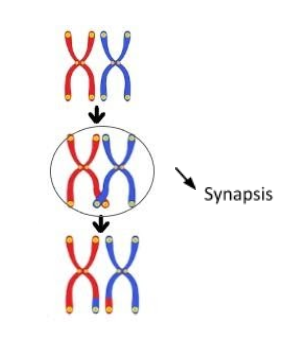
The synapsis is the process by which pairing of homologous chromosomes occurs by crossing over. This crossing over generally takes place at its zygotene stage of meiosis. During the process of meiosis, the pairing of the homologous chromosomes occurs. After this the pairing is separated in order to reduce the genetic content of the gamete. The exchange of chromosomal segments occurs after the synapsis and this causes a genetic recombination among them. The genetic recombination further causes variation in the gene pool of a population. Hence the option (c) two homologous chromosomes is the correct option.
In the beginning of the translation process, the ribosome and a tRNA remain attached to the mRNA. The tRNA at that time is generally located at the ribosome's first docking site. The tRNA carries the amino acid that corresponds to that codon. Hence, in between the mRNA and ribosome, synapsis does not occur or has no function. So, the option (a) mRNA and ribosome is incorrect.
The centromere is the specialized DNA sequence. They are the part of a chromosome that links a pair of sister chromatids. During the process of mitosis, the spindle fibers attach to the centromere via the kinetochore. Here, no synapsis is formed. So the option (b) spindle fibres and centromere is the incorrect option.
Gametes are defined as an organism's reproductive cells or sex cells. Female gametes are called ova or egg cells and male gametes are called sperm. Gametes are normally haploid cells. Each of these cells carries only one copy of each chromosome. There is no such link called synapsis that is formed between the male and female gamete. So, the option (d) male and female gamete is incorrect.
Hence, The correct answer is option (C).
Additional information:
The difference between synapsis and crossing over is that, the synapsis is pairing of homologous chromosomes before the process of crossing over. On the other hand, the crossing over is the process of exchange of genetic material during synapsis.
Note: The process of synopsis starts when the protein that connects the various chromosomes to the nuclear membranes begins migrating. The protein component keeps on migrating in order to find its counterpart to bind. These counterparts and protein complexes help to hold the homologous chromosomes together. The complex formed is known as synaptonemal complex.
Complete answer:
The synapsis is the process by which pairing of homologous chromosomes occurs by crossing over. This crossing over generally takes place at its zygotene stage of meiosis. During the process of meiosis, the pairing of the homologous chromosomes occurs. After this the pairing is separated in order to reduce the genetic content of the gamete. The exchange of chromosomal segments occurs after the synapsis and this causes a genetic recombination among them. The genetic recombination further causes variation in the gene pool of a population. Hence the option (c) two homologous chromosomes is the correct option.
In the beginning of the translation process, the ribosome and a tRNA remain attached to the mRNA. The tRNA at that time is generally located at the ribosome's first docking site. The tRNA carries the amino acid that corresponds to that codon. Hence, in between the mRNA and ribosome, synapsis does not occur or has no function. So, the option (a) mRNA and ribosome is incorrect.
The centromere is the specialized DNA sequence. They are the part of a chromosome that links a pair of sister chromatids. During the process of mitosis, the spindle fibers attach to the centromere via the kinetochore. Here, no synapsis is formed. So the option (b) spindle fibres and centromere is the incorrect option.
Gametes are defined as an organism's reproductive cells or sex cells. Female gametes are called ova or egg cells and male gametes are called sperm. Gametes are normally haploid cells. Each of these cells carries only one copy of each chromosome. There is no such link called synapsis that is formed between the male and female gamete. So, the option (d) male and female gamete is incorrect.
Hence, The correct answer is option (C).
Additional information:
The difference between synapsis and crossing over is that, the synapsis is pairing of homologous chromosomes before the process of crossing over. On the other hand, the crossing over is the process of exchange of genetic material during synapsis.
Note: The process of synopsis starts when the protein that connects the various chromosomes to the nuclear membranes begins migrating. The protein component keeps on migrating in order to find its counterpart to bind. These counterparts and protein complexes help to hold the homologous chromosomes together. The complex formed is known as synaptonemal complex.
Recently Updated Pages
Master Class 12 Economics: Engaging Questions & Answers for Success

Master Class 12 English: Engaging Questions & Answers for Success
Master Class 12 Social Science: Engaging Questions & Answers for Success
Master Class 12 Maths: Engaging Questions & Answers for Success
Master Class 12 Physics: Engaging Questions & Answers for Success
Master Class 11 Social Science: Engaging Questions & Answers for Success
Trending doubts
One Metric ton is equal to kg A 10000 B 1000 C 100 class 11 physics CBSE
Difference Between Prokaryotic Cells and Eukaryotic Cells
Find the value of the expression given below sin 30circ class 11 maths CBSE
1 ton equals to A 100 kg B 1000 kg C 10 kg D 10000 class 11 physics CBSE
Two of the body parts which do not appear in MRI are class 11 biology CBSE
Draw a diagram of nephron and explain its structur class 11 biology CBSE