




What is the symmetric difference of sets A and B, where A = {1, 4, 9, 10, 15} and B = {2, 4, 7, 10} ?
Answer
 Verified
561.6k+ views
Hint: We know that the symmetric difference of two sets, is the set that contains only those elements which are present either in any one of these sets, but not in both of them. We can also find the symmetric difference by subtracting the intersection from the union.
Complete step by step answer:
We know that the symmetric difference of two sets A and B, is the set of elements that contains only those elements which are present either in set A, or in set B, but not in both of them.
In terms of set theory, we can say that the symmetric difference of two sets is the difference of union and intersection of those two sets.
We must also remember that the symmetric difference of set A with respect to set B is represented as $A\oplus B$.
Thus, mathematically, we can also write that
$A\oplus B=A\bigcup B-A\bigcap B$
We can use Venn diagrams to represent the symmetric difference as follows,
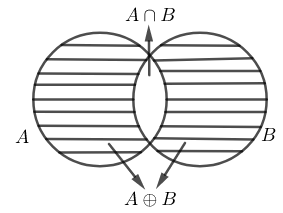
Here in this question, we have A = {1, 4, 9, 10, 15} and B = {2, 4, 7, 10}.
We know that the union of two sets is a set containing all elements that are in A or in B.
So, $A\bigcup B$ = {1, 2, 4, 7, 9, 10, 15}.
We also know that the intersection of sets is a set containing all those elements which are present in both A and B.
So, $A\bigcap B$ = {4, 10}.
We know that $A\oplus B=A\bigcup B-A\bigcap B$.
So, $A\oplus B$ = {1, 2, 7, 9, 15}.
Thus, the symmetric difference of sets A and B is {1, 2, 7, 9, 15}.
Note: We must remember that symmetric difference is also known as disjunctive union. We must keep in mind that different texts use different symbols for symmetric difference. Some of these forms are $A\oplus B,A\Delta B\text{ and }A\Theta B$.
Complete step by step answer:
We know that the symmetric difference of two sets A and B, is the set of elements that contains only those elements which are present either in set A, or in set B, but not in both of them.
In terms of set theory, we can say that the symmetric difference of two sets is the difference of union and intersection of those two sets.
We must also remember that the symmetric difference of set A with respect to set B is represented as $A\oplus B$.
Thus, mathematically, we can also write that
$A\oplus B=A\bigcup B-A\bigcap B$
We can use Venn diagrams to represent the symmetric difference as follows,
Here in this question, we have A = {1, 4, 9, 10, 15} and B = {2, 4, 7, 10}.
We know that the union of two sets is a set containing all elements that are in A or in B.
So, $A\bigcup B$ = {1, 2, 4, 7, 9, 10, 15}.
We also know that the intersection of sets is a set containing all those elements which are present in both A and B.
So, $A\bigcap B$ = {4, 10}.
We know that $A\oplus B=A\bigcup B-A\bigcap B$.
So, $A\oplus B$ = {1, 2, 7, 9, 15}.
Thus, the symmetric difference of sets A and B is {1, 2, 7, 9, 15}.
Note: We must remember that symmetric difference is also known as disjunctive union. We must keep in mind that different texts use different symbols for symmetric difference. Some of these forms are $A\oplus B,A\Delta B\text{ and }A\Theta B$.
Recently Updated Pages
Master Class 12 Economics: Engaging Questions & Answers for Success

Master Class 12 English: Engaging Questions & Answers for Success
Master Class 12 Social Science: Engaging Questions & Answers for Success
Master Class 12 Maths: Engaging Questions & Answers for Success
Master Class 12 Physics: Engaging Questions & Answers for Success
Master Class 11 Social Science: Engaging Questions & Answers for Success
Trending doubts
One Metric ton is equal to kg A 10000 B 1000 C 100 class 11 physics CBSE
Difference Between Prokaryotic Cells and Eukaryotic Cells
Two of the body parts which do not appear in MRI are class 11 biology CBSE
1 ton equals to A 100 kg B 1000 kg C 10 kg D 10000 class 11 physics CBSE
Draw a diagram of nephron and explain its structur class 11 biology CBSE
10 examples of friction in our daily life