




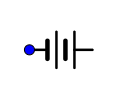
What is the symbol for a battery?
A.)
B.)

C.)

D.)

Answer
 Verified
619.8k+ views
Hint: A battery consists of one or more electrochemical cells. In a battery one terminal is positively charged and one terminal negatively charged. When a circuit is closed the electrons will flow from negative terminal to positive terminal which will create current inside the circuit.
Complete step by step answer:
The symbol for battery is
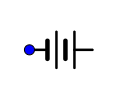
 Represents an open switch and
 represents a closed switch.
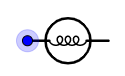 This represents a bulb.
Hence, the correct answer is option A.
Additional Information
Circuit Diagram: It is a diagram which shows how the different components of a circuit are connected together. The different circuit components are cell,battery(combination of cells).switch(open) and switch(closed), bulb, resistance, rheostat, ammeter, voltmeter, galvanometer. Different circuit symbols of a circuit are given below table
(I)Ammeter: It is an electronic device used to measure the amount of current flow in terms of $Ampere$ a mili-Ampere. An ammeter always connected in series with the circuit.
(II)Voltmeter: It is an electronic device used to measure the potential difference between two points in terms of $Volt$. Voltmeter always connected parallel with the circuit.
(III)Galvanometer: It measures a very small potential difference between two points.
Note:
In a circuit the direction of current is from positive end to negative end (opposite to direction of charge flow). The longer end of the battery is positive and the shorter end is negative. The positive end of the ammeter is always connected to the positive end of the battery and negative end of the ammeter connected to the negative end of the battery. Ammeter is connected in series whereas voltmeter and galvanometer were always connected in parallel with the circuit.
Complete step by step answer:
The symbol for battery is
Hence, the correct answer is option A.
Additional Information
Circuit Diagram: It is a diagram which shows how the different components of a circuit are connected together. The different circuit components are cell,battery(combination of cells).switch(open) and switch(closed), bulb, resistance, rheostat, ammeter, voltmeter, galvanometer. Different circuit symbols of a circuit are given below table
| Cell | 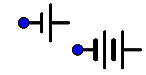
|
| battery | 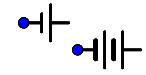
|
| Switch(open) | 
|
| Switch(closed) | 
|
| resistance | 
|
| bulb | 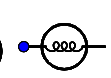
|
| voltmeter | 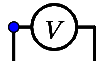
|
| ammeter | 
|
(I)Ammeter: It is an electronic device used to measure the amount of current flow in terms of $Ampere$ a mili-Ampere. An ammeter always connected in series with the circuit.
(II)Voltmeter: It is an electronic device used to measure the potential difference between two points in terms of $Volt$. Voltmeter always connected parallel with the circuit.
(III)Galvanometer: It measures a very small potential difference between two points.
Note:
In a circuit the direction of current is from positive end to negative end (opposite to direction of charge flow). The longer end of the battery is positive and the shorter end is negative. The positive end of the ammeter is always connected to the positive end of the battery and negative end of the ammeter connected to the negative end of the battery. Ammeter is connected in series whereas voltmeter and galvanometer were always connected in parallel with the circuit.
Recently Updated Pages
Master Class 12 Business Studies: Engaging Questions & Answers for Success

Master Class 12 Biology: Engaging Questions & Answers for Success
Master Class 12 Chemistry: Engaging Questions & Answers for Success
Class 12 Question and Answer - Your Ultimate Solutions Guide
Master Class 11 Social Science: Engaging Questions & Answers for Success
Master Class 11 English: Engaging Questions & Answers for Success
Trending doubts
Explain the Treaty of Vienna of 1815 class 10 social science CBSE
Which Indian city is known as the "City of Victory"?
Which instrument is used to measure the Blood Pressure?
Who Won 36 Oscar Awards? Record Holder Revealed
What is the median of the first 10 natural numbers class 10 maths CBSE
Why is it 530 pm in india when it is 1200 afternoon class 10 social science CBSE