




Sycon belongs to a group of organisms, Which are best described as
(a)Unicellular or acellular
(b)Multicellular without any tissue organization
(c)Multicellular with gastrovascular system
(d)Multicellular having tissue organization, but no body cavity
Answer
 Verified
609.9k+ views
Hint: Sycon belongs to the phylum Porifera. Members of this phylum are commonly known as sponges. They are also known as pore bearing animals as their body walls possess numerous tiny pores. Sponges are the first phylum in the animal kingdom.
Complete answer:
Sponges are primitive multicellular animals. They have the cellular level of organization. The cells in their body do not form the tissues. All cells act more or less independently and show little coordination. They are mostly marine and asymmetrical. They are known for their well-developed water canal system. Their body is supported by a skeleton made of calcareous or siliceous spicules and spongin fiber. Different cells are found in sponges; namely pinacocytes, choanocytes, and amoebocytes. Pinacocytes form the protective layer of the body. Choanocytes maintain water current inside the body. Amoebocytes store reserve food. Sponges are believed to be evolved from flagellated protozoans. They are hermaphrodites with males and females in the same individual. They reproduce sexually and asexually. Asexual reproduction involves fragmentation, budding, and regeneration. Sexual reproduction involves internal fertilization and indirect development.
Additional Information: -Examples of sponges are; Luecosolenia, Sycon, Euplectella (Venus flower basket) Euspongia (Bath sponges), etc.
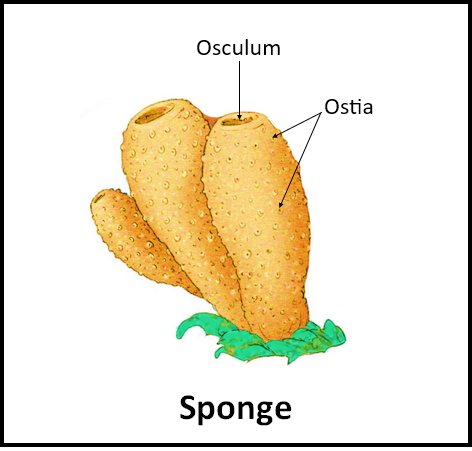
-Sponges have a well-developed water canal system. This system comprises of Ostia, (through which water enters inside), osculum (pore through which water moves outside), and spongocoel (cavity inside the body)
-Spongocoel is lined by choanocytes or collar cells. These cells maintain the water current inside the body.
So, the correct answer is 'Multicellular without any tissue organization'
Note: All sponges are sessile aquatic animals. They attach to an underwater surface and remain fixed in place.
- Although there are freshwater species, the great majority are marine species.
-Sponges do not have nervous, digestive, or circulatory systems. Instead, most rely on maintaining constant water flow through their bodies to obtain food and oxygen and to remove wastes.
Complete answer:
Sponges are primitive multicellular animals. They have the cellular level of organization. The cells in their body do not form the tissues. All cells act more or less independently and show little coordination. They are mostly marine and asymmetrical. They are known for their well-developed water canal system. Their body is supported by a skeleton made of calcareous or siliceous spicules and spongin fiber. Different cells are found in sponges; namely pinacocytes, choanocytes, and amoebocytes. Pinacocytes form the protective layer of the body. Choanocytes maintain water current inside the body. Amoebocytes store reserve food. Sponges are believed to be evolved from flagellated protozoans. They are hermaphrodites with males and females in the same individual. They reproduce sexually and asexually. Asexual reproduction involves fragmentation, budding, and regeneration. Sexual reproduction involves internal fertilization and indirect development.
Additional Information: -Examples of sponges are; Luecosolenia, Sycon, Euplectella (Venus flower basket) Euspongia (Bath sponges), etc.
-Sponges have a well-developed water canal system. This system comprises of Ostia, (through which water enters inside), osculum (pore through which water moves outside), and spongocoel (cavity inside the body)
-Spongocoel is lined by choanocytes or collar cells. These cells maintain the water current inside the body.
So, the correct answer is 'Multicellular without any tissue organization'
Note: All sponges are sessile aquatic animals. They attach to an underwater surface and remain fixed in place.
- Although there are freshwater species, the great majority are marine species.
-Sponges do not have nervous, digestive, or circulatory systems. Instead, most rely on maintaining constant water flow through their bodies to obtain food and oxygen and to remove wastes.
Recently Updated Pages
Master Class 12 Economics: Engaging Questions & Answers for Success

Master Class 12 English: Engaging Questions & Answers for Success
Master Class 12 Social Science: Engaging Questions & Answers for Success
Master Class 12 Maths: Engaging Questions & Answers for Success
Master Class 12 Physics: Engaging Questions & Answers for Success
Master Class 11 Social Science: Engaging Questions & Answers for Success
Trending doubts
One Metric ton is equal to kg A 10000 B 1000 C 100 class 11 physics CBSE
Difference Between Prokaryotic Cells and Eukaryotic Cells
Two of the body parts which do not appear in MRI are class 11 biology CBSE
1 ton equals to A 100 kg B 1000 kg C 10 kg D 10000 class 11 physics CBSE
Draw a diagram of nephron and explain its structur class 11 biology CBSE
10 examples of friction in our daily life