




Suppose \[{z_1},{z_2},{z_3}\] are three vertices of an equilateral triangle in the argand plane. Let \[\alpha = \dfrac{1}{2}(\sqrt 3 - i)\] and \[\beta \] be a non-zero complex number. The points \[\alpha {z_1} + \beta ,\alpha {z_2} + \beta ,\alpha {z_3} + \beta \] constitute which of the following?
(a). The vertices of an equilateral triangle
(b). The vertices of an isosceles triangle
(c). Collinear
(d). Vertices of a scalene triangle
Answer
 Verified
635.4k+ views
Hint: Find the relation between \[{z_1},{z_2},{z_3}\] for an equilateral triangle. Then use this relation to find the relation between \[\alpha {z_1} + \beta ,\alpha {z_2} + \beta ,\alpha {z_3} + \beta \] and conclude the answer.
Complete step by step answer:
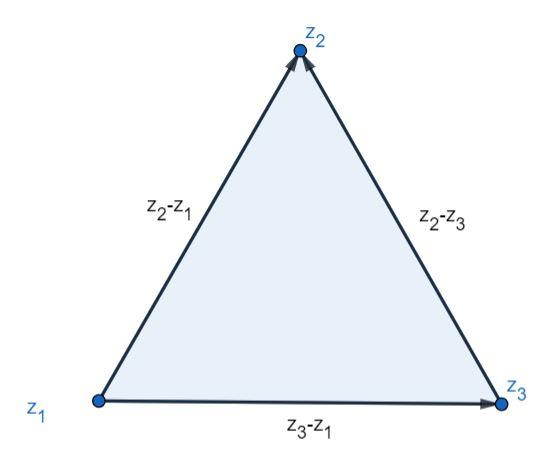
If \[{z_1},{z_2},{z_3}\] are the vertices of the equilateral triangle, then the sides in the argand plane will be given by the difference between these points taken two at a time, as shown in the figure.
We know that the sides make an angle 60° with each other in an equilateral triangle.
Hence, for the sides \[{z_2} - {z_1}\] and \[{z_3} - {z_1}\], we have:
\[{z_2} - {z_1} = {e^{i\dfrac{\pi }{3}}}({z_3} - {z_1})........(1)\]
Similarly, for the sides \[{z_1} - {z_3}\] and \[{z_2} - {z_3}\], we have:
\[{z_1} - {z_3} = {e^{i\dfrac{\pi }{3}}}({z_2} - {z_3})........(2)\]
Now, dividing equation (1) by equation (2), the \[{e^{i\dfrac{\pi }{3}}}\] term cancels out, then, we have:
\[\dfrac{{{z_2} - {z_1}}}{{{z_1} - {z_3}}} = \dfrac{{{z_3} - {z_1}}}{{{z_2} - {z_3}}}.........(3)\]
Hence, equation (3) is the condition for the three vertices to form an equilateral triangle in the argand plane.
We now have to find the relation between the points \[\alpha {z_1} + \beta ,\alpha {z_2} + \beta ,\alpha {z_3} + \beta \].
It can be observed from equation (3) that if all the three points \[{z_1},{z_2},{z_3}\] are shifted by the same complex number, they still satisfy the condition.
Also, it can be observed that, if the points \[{z_1},{z_2},{z_3}\] are multiplied with a same complex number, they still form an equilateral triangle.
Hence, calculating the left hand side of equation (3) for the points \[\alpha {z_1} + \beta ,\alpha {z_2} + \beta ,\alpha {z_3} + \beta \], we get:
\[LHS = \dfrac{{(\alpha {z_2} + \beta ) - (\alpha {z_1} + \beta )}}{{(\alpha {z_1} + \beta ) - (\alpha {z_3} + \beta )}}\]
\[LHS = \dfrac{{\alpha {z_2} + \beta - \alpha {z_1} - \beta }}{{\alpha {z_1} + \beta - \alpha {z_3} - \beta }}\]
Cancelling \[\beta \], we get:
\[LHS = \dfrac{{\alpha {z_2} - \alpha {z_1}}}{{\alpha {z_1} - \alpha {z_3}}}\]
Taking \[\alpha \] as a common term and cancelling it, we get:
\[LHS = \dfrac{{{z_2} - {z_1}}}{{{z_1} - {z_3}}}\]
Calculating the right hand side of equation (3) for the points \[\alpha {z_1} + \beta ,\alpha {z_2} + \beta ,\alpha {z_3} + \beta \], we get:
\[RHS = \dfrac{{(\alpha {z_3} + \beta ) - (\alpha {z_1} + \beta )}}{{(\alpha {z_2} + \beta ) - (\alpha {z_3} + \beta )}}\]
\[RHS = \dfrac{{\alpha {z_3} + \beta - \alpha {z_1} - \beta }}{{\alpha {z_2} + \beta - \alpha {z_3} - \beta }}\]
Cancelling \[\beta \], we get:
\[RHS = \dfrac{{\alpha {z_3} - \alpha {z_1}}}{{\alpha {z_2} - \alpha {z_3}}}\]
Taking \[\alpha \] as a common term and cancelling it, we get:
\[LHS = \dfrac{{{z_3} - {z_1}}}{{{z_2} - {z_3}}}\]
From equation (3), we have:
LHS=RHS
Hence,
\[\dfrac{{(\alpha {z_2} + \beta ) - (\alpha {z_1} + \beta )}}{{(\alpha {z_1} + \beta ) - (\alpha {z_3} + \beta )}} = \dfrac{{(\alpha {z_3} + \beta ) - (\alpha {z_1} + \beta )}}{{(\alpha {z_2} + \beta ) - (\alpha {z_3} + \beta )}}\]
Hence, the points \[\alpha {z_1} + \beta ,\alpha {z_2} + \beta ,\alpha {z_3} + \beta \] form an equilateral triangle.
Hence, option (a) is the correct answer.
Note: For an equilateral triangle, all the three sides are equal, so you can also use the condition \[\left| {{z_2} - {z_1}} \right| = \left| {{z_2} - {z_3}} \right| = \left| {{z_1} - {z_3}} \right|\] to prove that the points \[\alpha {z_1} + \beta ,\alpha {z_2} + \beta ,\alpha {z_3} + \beta \] form an equilateral triangle.
Complete step by step answer:
If \[{z_1},{z_2},{z_3}\] are the vertices of the equilateral triangle, then the sides in the argand plane will be given by the difference between these points taken two at a time, as shown in the figure.
We know that the sides make an angle 60° with each other in an equilateral triangle.
Hence, for the sides \[{z_2} - {z_1}\] and \[{z_3} - {z_1}\], we have:
\[{z_2} - {z_1} = {e^{i\dfrac{\pi }{3}}}({z_3} - {z_1})........(1)\]
Similarly, for the sides \[{z_1} - {z_3}\] and \[{z_2} - {z_3}\], we have:
\[{z_1} - {z_3} = {e^{i\dfrac{\pi }{3}}}({z_2} - {z_3})........(2)\]
Now, dividing equation (1) by equation (2), the \[{e^{i\dfrac{\pi }{3}}}\] term cancels out, then, we have:
\[\dfrac{{{z_2} - {z_1}}}{{{z_1} - {z_3}}} = \dfrac{{{z_3} - {z_1}}}{{{z_2} - {z_3}}}.........(3)\]
Hence, equation (3) is the condition for the three vertices to form an equilateral triangle in the argand plane.
We now have to find the relation between the points \[\alpha {z_1} + \beta ,\alpha {z_2} + \beta ,\alpha {z_3} + \beta \].
It can be observed from equation (3) that if all the three points \[{z_1},{z_2},{z_3}\] are shifted by the same complex number, they still satisfy the condition.
Also, it can be observed that, if the points \[{z_1},{z_2},{z_3}\] are multiplied with a same complex number, they still form an equilateral triangle.
Hence, calculating the left hand side of equation (3) for the points \[\alpha {z_1} + \beta ,\alpha {z_2} + \beta ,\alpha {z_3} + \beta \], we get:
\[LHS = \dfrac{{(\alpha {z_2} + \beta ) - (\alpha {z_1} + \beta )}}{{(\alpha {z_1} + \beta ) - (\alpha {z_3} + \beta )}}\]
\[LHS = \dfrac{{\alpha {z_2} + \beta - \alpha {z_1} - \beta }}{{\alpha {z_1} + \beta - \alpha {z_3} - \beta }}\]
Cancelling \[\beta \], we get:
\[LHS = \dfrac{{\alpha {z_2} - \alpha {z_1}}}{{\alpha {z_1} - \alpha {z_3}}}\]
Taking \[\alpha \] as a common term and cancelling it, we get:
\[LHS = \dfrac{{{z_2} - {z_1}}}{{{z_1} - {z_3}}}\]
Calculating the right hand side of equation (3) for the points \[\alpha {z_1} + \beta ,\alpha {z_2} + \beta ,\alpha {z_3} + \beta \], we get:
\[RHS = \dfrac{{(\alpha {z_3} + \beta ) - (\alpha {z_1} + \beta )}}{{(\alpha {z_2} + \beta ) - (\alpha {z_3} + \beta )}}\]
\[RHS = \dfrac{{\alpha {z_3} + \beta - \alpha {z_1} - \beta }}{{\alpha {z_2} + \beta - \alpha {z_3} - \beta }}\]
Cancelling \[\beta \], we get:
\[RHS = \dfrac{{\alpha {z_3} - \alpha {z_1}}}{{\alpha {z_2} - \alpha {z_3}}}\]
Taking \[\alpha \] as a common term and cancelling it, we get:
\[LHS = \dfrac{{{z_3} - {z_1}}}{{{z_2} - {z_3}}}\]
From equation (3), we have:
LHS=RHS
Hence,
\[\dfrac{{(\alpha {z_2} + \beta ) - (\alpha {z_1} + \beta )}}{{(\alpha {z_1} + \beta ) - (\alpha {z_3} + \beta )}} = \dfrac{{(\alpha {z_3} + \beta ) - (\alpha {z_1} + \beta )}}{{(\alpha {z_2} + \beta ) - (\alpha {z_3} + \beta )}}\]
Hence, the points \[\alpha {z_1} + \beta ,\alpha {z_2} + \beta ,\alpha {z_3} + \beta \] form an equilateral triangle.
Hence, option (a) is the correct answer.
Note: For an equilateral triangle, all the three sides are equal, so you can also use the condition \[\left| {{z_2} - {z_1}} \right| = \left| {{z_2} - {z_3}} \right| = \left| {{z_1} - {z_3}} \right|\] to prove that the points \[\alpha {z_1} + \beta ,\alpha {z_2} + \beta ,\alpha {z_3} + \beta \] form an equilateral triangle.
Recently Updated Pages
Master Class 10 Social Science: Engaging Questions & Answers for Success

Master Class 10 Science: Engaging Questions & Answers for Success
Master Class 10 Maths: Engaging Questions & Answers for Success
Master Class 10 General Knowledge: Engaging Questions & Answers for Success
Master Class 10 Computer Science: Engaging Questions & Answers for Success
Class 10 Question and Answer - Your Ultimate Solutions Guide
Trending doubts
What is the full form of PNG A Petrol Natural Gas B class 10 chemistry CBSE
Explain the Treaty of Vienna of 1815 class 10 social science CBSE
In cricket, how many legal balls are there in a standard over?
Why is there a time difference of about 5 hours between class 10 social science CBSE
Who Won 36 Oscar Awards? Record Holder Revealed
What is the median of the first 10 natural numbers class 10 maths CBSE