




Suppose a hypothetical H-like atom produces a blue, yellow, red and violet line in the emission spectrum. Match the above lines with their corresponding possible electronic transition:
Colour of spectral lines Possible corresponding transitions a. Blue p. $6 \to 3$ b. Yellow q. $2 \to 1$ c. Red r. $5 \to 2$ d. Violet s. $4 \to 3$
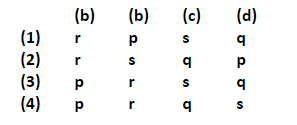
The correct option is-
| Colour of spectral lines | Possible corresponding transitions | ||
| a. | Blue | p. | $6 \to 3$ |
| b. | Yellow | q. | $2 \to 1$ |
| c. | Red | r. | $5 \to 2$ |
| d. | Violet | s. | $4 \to 3$ |
Answer
 Verified
574.5k+ views
Hint: The line spectrum results from the emission of radiations from atoms of the elements and thus called the atomic spectrum whereas molecules give a band spectrum known as molecular spectrum. We know that energy carried by a light is directly proportional to its frequency, from this we can compare which lines produce which colours.
Complete Step by step answer:
Here, we just have to compare the energy transition of the spectrum to identify the colours produced by it. Before that let us understand what the emission spectrum is.
When an excited electron returns back from higher energy level to ground state. It emits energy in the form of radiations. The spectrum produced by these emitted radiation is known as emission spectrum.
The frequency of the spectral line is given as
$\nu = 3.29 \times {10^{15}}\left[ {\dfrac{1}{{n_1^2}} - \dfrac{1}{{n_2^2}}} \right]$
Where ${n_1}$ and ${n_2}$ are the electronic levels involved in transition
Also we know that he energy is directly proportional to frequency hence we can say that
$Energy,E\; \propto frequency,\;\nu $
So we can relate the both equations as
$Energy\; \propto \left[ {\dfrac{1}{{n_1^2}} - \dfrac{1}{{n_2^2}}} \right]$ Since the number are constant and we can ignore them
Now let us come back to the colours, we know that the colours in VIBGYOR are violet, indigo, blue, green, yellow, orange and red. There are many important details VIBGYOR can provide us such that the frequency of VIBGYOR increases from red to violet. So we can say red has the least frequency. Also the wavelength of VIBGYOR increases from violet to red.
As we said earlier energy is directly proportional to frequency. We can keep this in mind before moving to our next step.
(p)$6 \to 3$: Let's find out the energy emitted when this electronic transmission happens
Here, ${n_1} = 3$and ${n_2} = 6$
${E_{6 \to 3}} = {E_0}\left[ {\dfrac{1}{{{3^2}}} - \dfrac{1}{{{6^2}}}} \right]$
Here we took a constant ${E_0}$ to remove the proportionality, it is just for comparison
${E_{6 \to 3}} = {E_0}\left[ {\dfrac{1}{9} - \dfrac{1}{{36}}} \right] = {E_0}\left[ {\dfrac{3}{{36}}} \right]$
${E_{6 \to 3}} = 0.0833{E_0}$
(q) $2 \to 1$
Here, ${n_1} = 1$and ${n_2} = 2$
${E_{2 \to 1}} = {E_0}\left[ {\dfrac{1}{{{1^2}}} - \dfrac{1}{{{2^2}}}} \right]$
${E_{2 \to 1}} = {E_0}\left[ {1 - \dfrac{1}{4}} \right] = {E_0}\left[ {\dfrac{3}{4}} \right]$
${E_{2 \to 1}} = 0.75{E_0}$
(r) $5 \to 2$
Here, ${n_1} = 2$and ${n_2} = 5$
${E_{5 \to 2}} = {E_0}\left[ {\dfrac{1}{{{2^2}}} - \dfrac{1}{{{5^2}}}} \right]$
${E_{5 \to 2}} = {E_0}\left[ {\dfrac{1}{4} - \dfrac{1}{{25}}} \right] = {E_0}\left[ {\dfrac{{21}}{{100}}} \right]$
${E_{5 \to 2}} = 0.21{E_0}$
(s) $4 \to 3$
Here, ${n_1} = 3$and ${n_2} = 4$
${E_{4 \to 3}} = {E_0}\left[ {\dfrac{1}{{{3^2}}} - \dfrac{1}{{{4^2}}}} \right]$
${E_{4 \to 3}} = {E_0}\left[ {\dfrac{1}{9} - \dfrac{1}{{16}}} \right] = {E_0}\left[ {\dfrac{7}{{144}}} \right]$
${E_{4 \to 3}} = 0.0486{E_0}$
So the energy variations can be compared as
${E_{2 \to 1}} > {E_{5 \to 2}} > {E_{6 \to 3}} > {E_{4 \to 3}}$
${\text{q}} > {\text{r}} > {\text{s}} > {\text{p}}$
This is the order of energy
We have four colours blue, yellow, violet and red
Their order of energy will be as discussed above red has least energy and violet has highest energy and keeping VIBGYOR in mind we can compare the given colours
${\text{violet}} > {\text{blue}} > {\text{yellow}} > {\text{red}}$
Hence we say
q is violet (d)
r is blue (a)
p is yellow (b)
s is red (c)
Hence option (1) is correct.
Note: Here we took energy to compare them, we could have taken any measurement to compare them like frequency or wavelength. All of them will result in the same answer. For better understanding only we choose energy as the parameter.
Complete Step by step answer:
Here, we just have to compare the energy transition of the spectrum to identify the colours produced by it. Before that let us understand what the emission spectrum is.
When an excited electron returns back from higher energy level to ground state. It emits energy in the form of radiations. The spectrum produced by these emitted radiation is known as emission spectrum.
The frequency of the spectral line is given as
$\nu = 3.29 \times {10^{15}}\left[ {\dfrac{1}{{n_1^2}} - \dfrac{1}{{n_2^2}}} \right]$
Where ${n_1}$ and ${n_2}$ are the electronic levels involved in transition
Also we know that he energy is directly proportional to frequency hence we can say that
$Energy,E\; \propto frequency,\;\nu $
So we can relate the both equations as
$Energy\; \propto \left[ {\dfrac{1}{{n_1^2}} - \dfrac{1}{{n_2^2}}} \right]$ Since the number are constant and we can ignore them
Now let us come back to the colours, we know that the colours in VIBGYOR are violet, indigo, blue, green, yellow, orange and red. There are many important details VIBGYOR can provide us such that the frequency of VIBGYOR increases from red to violet. So we can say red has the least frequency. Also the wavelength of VIBGYOR increases from violet to red.
As we said earlier energy is directly proportional to frequency. We can keep this in mind before moving to our next step.
(p)$6 \to 3$: Let's find out the energy emitted when this electronic transmission happens
Here, ${n_1} = 3$and ${n_2} = 6$
${E_{6 \to 3}} = {E_0}\left[ {\dfrac{1}{{{3^2}}} - \dfrac{1}{{{6^2}}}} \right]$
Here we took a constant ${E_0}$ to remove the proportionality, it is just for comparison
${E_{6 \to 3}} = {E_0}\left[ {\dfrac{1}{9} - \dfrac{1}{{36}}} \right] = {E_0}\left[ {\dfrac{3}{{36}}} \right]$
${E_{6 \to 3}} = 0.0833{E_0}$
(q) $2 \to 1$
Here, ${n_1} = 1$and ${n_2} = 2$
${E_{2 \to 1}} = {E_0}\left[ {\dfrac{1}{{{1^2}}} - \dfrac{1}{{{2^2}}}} \right]$
${E_{2 \to 1}} = {E_0}\left[ {1 - \dfrac{1}{4}} \right] = {E_0}\left[ {\dfrac{3}{4}} \right]$
${E_{2 \to 1}} = 0.75{E_0}$
(r) $5 \to 2$
Here, ${n_1} = 2$and ${n_2} = 5$
${E_{5 \to 2}} = {E_0}\left[ {\dfrac{1}{{{2^2}}} - \dfrac{1}{{{5^2}}}} \right]$
${E_{5 \to 2}} = {E_0}\left[ {\dfrac{1}{4} - \dfrac{1}{{25}}} \right] = {E_0}\left[ {\dfrac{{21}}{{100}}} \right]$
${E_{5 \to 2}} = 0.21{E_0}$
(s) $4 \to 3$
Here, ${n_1} = 3$and ${n_2} = 4$
${E_{4 \to 3}} = {E_0}\left[ {\dfrac{1}{{{3^2}}} - \dfrac{1}{{{4^2}}}} \right]$
${E_{4 \to 3}} = {E_0}\left[ {\dfrac{1}{9} - \dfrac{1}{{16}}} \right] = {E_0}\left[ {\dfrac{7}{{144}}} \right]$
${E_{4 \to 3}} = 0.0486{E_0}$
So the energy variations can be compared as
${E_{2 \to 1}} > {E_{5 \to 2}} > {E_{6 \to 3}} > {E_{4 \to 3}}$
${\text{q}} > {\text{r}} > {\text{s}} > {\text{p}}$
This is the order of energy
We have four colours blue, yellow, violet and red
Their order of energy will be as discussed above red has least energy and violet has highest energy and keeping VIBGYOR in mind we can compare the given colours
${\text{violet}} > {\text{blue}} > {\text{yellow}} > {\text{red}}$
Hence we say
q is violet (d)
r is blue (a)
p is yellow (b)
s is red (c)
Hence option (1) is correct.
Note: Here we took energy to compare them, we could have taken any measurement to compare them like frequency or wavelength. All of them will result in the same answer. For better understanding only we choose energy as the parameter.
Recently Updated Pages
Basicity of sulphurous acid and sulphuric acid are

Master Class 11 Business Studies: Engaging Questions & Answers for Success
Master Class 11 Computer Science: Engaging Questions & Answers for Success
Master Class 11 Economics: Engaging Questions & Answers for Success
Master Class 11 Social Science: Engaging Questions & Answers for Success
Master Class 11 English: Engaging Questions & Answers for Success
Trending doubts
One Metric ton is equal to kg A 10000 B 1000 C 100 class 11 physics CBSE
The largest wind power cluster is located in the state class 11 social science CBSE
Explain zero factorial class 11 maths CBSE
State and prove Bernoullis theorem class 11 physics CBSE
What steps did the French revolutionaries take to create class 11 social science CBSE
Which among the following are examples of coming together class 11 social science CBSE