




Sum of the areas of two squares is $468{{m}^{2}}$. If the difference of their perimeters is 24m, formulate the quadratic equation to find the sides of the two squares.
Answer
 Verified
655.2k+ views
Hint: Assume that the length of sides of both the squares is ‘x’ and ‘y’. Use the fact that if the length of the side of the square is ‘a’, then its perimeter is 4a and the area is ${{a}^{2}}$. Write an equation relating the length of sides of both two squares. Simplify them to get the quadratic equation relating the length of sides of both the squares.
Complete step-by-step answer:
We have data regarding the sum of areas of two squares and the difference of their perimeters. We have to formulate a quadratic equation to find the sides of both the squares.
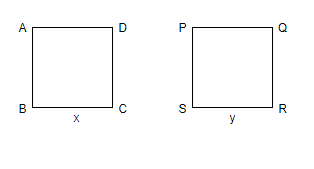
Let’s assume that there are two squares ABCD and PQRS, with sides of length x and y, as shown in the figure.
We know that if the length of the side of the square is ‘a’, then its perimeter is 4a and the area is ${{a}^{2}}$.
Thus, the area of square ABCD is ${{x}^{2}}$ and its perimeter is 4x.
Similarly, the area of square PQRS is ${{y}^{2}}$ and its perimeter is 4y.
We know that the sum of areas of both the squares is $468{{m}^{2}}$. Thus, we have ${{x}^{2}}+{{y}^{2}}=468.....\left( 1 \right)$.
We know that the difference of perimeters of both the squares is 24m. Thus, we have $4x-4y=24$. Rearranging the terms of the previous equation, we have $x-y=\dfrac{24}{4}=6.....\left( 2 \right)$
We can rewrite the above equation as $x=y+6$.
Squaring the above equation on both sides, we have ${{x}^{2}}={{\left( y+6 \right)}^{2}}={{y}^{2}}+12y+36.....\left( 3 \right)$.
Substituting equation (3) in equation (1), we have ${{y}^{2}}+12y+36+{{y}^{2}}=468$.
Simplifying the above equation, we have $2{{y}^{2}}+12y+=468-36=432\Rightarrow {{y}^{2}}+6y=216$ .
Hence, the quadratic equation which can be used to find the side of squares is ${{y}^{2}}+6y-216=0$.
Note: We can factorize this equation to find the value of y and then substitute it in the equation relating ‘x’ and ‘y’ to calculate the value of ‘x’. We can then verify the calculated values of ‘x’ and ‘y’ by substituting the values in the equation and then checking if they satisfy the equation or not.
Complete step-by-step answer:
We have data regarding the sum of areas of two squares and the difference of their perimeters. We have to formulate a quadratic equation to find the sides of both the squares.
Let’s assume that there are two squares ABCD and PQRS, with sides of length x and y, as shown in the figure.
We know that if the length of the side of the square is ‘a’, then its perimeter is 4a and the area is ${{a}^{2}}$.
Thus, the area of square ABCD is ${{x}^{2}}$ and its perimeter is 4x.
Similarly, the area of square PQRS is ${{y}^{2}}$ and its perimeter is 4y.
We know that the sum of areas of both the squares is $468{{m}^{2}}$. Thus, we have ${{x}^{2}}+{{y}^{2}}=468.....\left( 1 \right)$.
We know that the difference of perimeters of both the squares is 24m. Thus, we have $4x-4y=24$. Rearranging the terms of the previous equation, we have $x-y=\dfrac{24}{4}=6.....\left( 2 \right)$
We can rewrite the above equation as $x=y+6$.
Squaring the above equation on both sides, we have ${{x}^{2}}={{\left( y+6 \right)}^{2}}={{y}^{2}}+12y+36.....\left( 3 \right)$.
Substituting equation (3) in equation (1), we have ${{y}^{2}}+12y+36+{{y}^{2}}=468$.
Simplifying the above equation, we have $2{{y}^{2}}+12y+=468-36=432\Rightarrow {{y}^{2}}+6y=216$ .
Hence, the quadratic equation which can be used to find the side of squares is ${{y}^{2}}+6y-216=0$.
Note: We can factorize this equation to find the value of y and then substitute it in the equation relating ‘x’ and ‘y’ to calculate the value of ‘x’. We can then verify the calculated values of ‘x’ and ‘y’ by substituting the values in the equation and then checking if they satisfy the equation or not.
Recently Updated Pages
Master Class 11 English: Engaging Questions & Answers for Success

Master Class 11 Social Science: Engaging Questions & Answers for Success
Master Class 11 Maths: Engaging Questions & Answers for Success
Master Class 11 Biology: Engaging Questions & Answers for Success
Master Class 11 Physics: Engaging Questions & Answers for Success
Master Class 11 Chemistry: Engaging Questions & Answers for Success
Trending doubts
Explain the Treaty of Vienna of 1815 class 10 social science CBSE
What is the full form of POSCO class 10 social science CBSE
Define Potential, Developed, Stock and Reserved resources
The diagonals of a rhombus are 10cm and 24cm Find the class 10 maths CBSE
Fill the blanks with proper collective nouns 1 A of class 10 english CBSE
What planets have no moons Which one has only one moon class 10 physics CBSE