




sugar cane has a high efficiency of carbon dioxide fixation because it performs
(a)Calvin cycle
(b)EMP pathway
(c)hatch and slack pathway
(d)TCA cycle
Answer
 Verified
592.8k+ views
Hint: The metabolic pathway in plants where carbon fixation is done in bundle sheath cells by the enzyme RuBisCO. This is seen in ${ C }_{ 4 }$ plants such as sugar cane.
Complete answer:
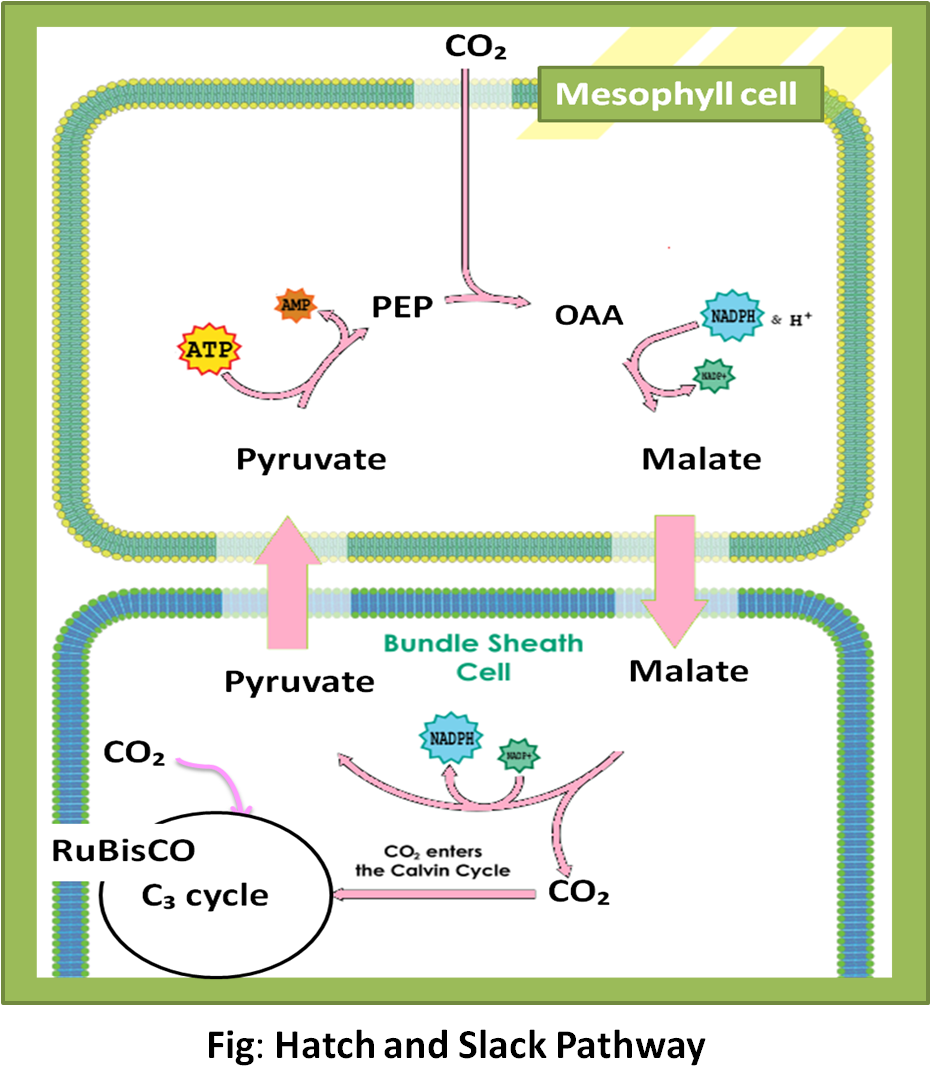
Sugar cane can grow in dry tropical regions. Plants in these regions are adapted to perform the ${ C }_{ 4 }$ pathway. They are called ${ C }_{ 4 }$ plants. These plants have a high affinity for carbon fixation because they perform the ${ C }_{ 4 }$ pathway which is also known as Hatch and Slack pathway.
Other examples of plants that perform ${ C }_{ 4 }$ Pathway are maize, sorghum, corn. Etc.
Additional Information: -${ C }_{ 4 }$plants have special leaf anatomy and they can tolerate higher temperatures and can show responses to high light intensities.
- Photorespiration, a process generally found in ${ C }_{ 3 }$ plants is absent in ${ C }_{ 4 }$ plants.
- Production of biomass is more in ${ C }_{ 4 }$ plants
- ${ C }_{ 4 }$ plants have the 4 carbon compound oxaloacetic acid which is the first carbon dioxide fixation product.
- ${ C }_{ 4 }$ plants have a special type of Anatomical feature called Kranz Anatomy where vascular cells are surrounded by large cells called bundle sheath cells.
- Bundle sheath cells have a large number of chloroplasts, thick walls, no intracellular spaces and contain an enzyme called RuBiSco.
- Enzyme PEP carboxylase helps in carbon fixation in the mesophyll cells. ${ C }_{ 4 }$ plants lack this enzyme, so carbon fixation is performed by the enzyme RuBisCO present in the bundle sheath cells.
- The 4-carbon oxaloacetic acid is converted into malic acid or aspartic acid which is transported into bundle sheath cells where these acids are broken down into carbon dioxide and 3 carbon compounds.
So, the correct answer is the 'Hatch and Slack pathway'.
Note: The Calvin pathway occurs in mesophyll cells in ${ C }_{ 3 }$ plants and in ${ C }_{ 4 }$ plants it occurs in bundle sheath cells.
RuBisCO - Ribulose bisphosphate carboxylase-oxygenase.
Crassulacean Acid Metabolism(CAM) is an alternative pathway for ${ C }_{ 3 }$ and ${ C }_{ 4 }$ pathways for carbon dioxide fixation. It is found in plants that grow in hot and dry environments. Ex: plants belong to the Crassulaceae family ex: cacti.
Complete answer:
Sugar cane can grow in dry tropical regions. Plants in these regions are adapted to perform the ${ C }_{ 4 }$ pathway. They are called ${ C }_{ 4 }$ plants. These plants have a high affinity for carbon fixation because they perform the ${ C }_{ 4 }$ pathway which is also known as Hatch and Slack pathway.
Other examples of plants that perform ${ C }_{ 4 }$ Pathway are maize, sorghum, corn. Etc.
Additional Information: -${ C }_{ 4 }$plants have special leaf anatomy and they can tolerate higher temperatures and can show responses to high light intensities.
- Photorespiration, a process generally found in ${ C }_{ 3 }$ plants is absent in ${ C }_{ 4 }$ plants.
- Production of biomass is more in ${ C }_{ 4 }$ plants
- ${ C }_{ 4 }$ plants have the 4 carbon compound oxaloacetic acid which is the first carbon dioxide fixation product.
- ${ C }_{ 4 }$ plants have a special type of Anatomical feature called Kranz Anatomy where vascular cells are surrounded by large cells called bundle sheath cells.
- Bundle sheath cells have a large number of chloroplasts, thick walls, no intracellular spaces and contain an enzyme called RuBiSco.
- Enzyme PEP carboxylase helps in carbon fixation in the mesophyll cells. ${ C }_{ 4 }$ plants lack this enzyme, so carbon fixation is performed by the enzyme RuBisCO present in the bundle sheath cells.
- The 4-carbon oxaloacetic acid is converted into malic acid or aspartic acid which is transported into bundle sheath cells where these acids are broken down into carbon dioxide and 3 carbon compounds.
So, the correct answer is the 'Hatch and Slack pathway'.
Note: The Calvin pathway occurs in mesophyll cells in ${ C }_{ 3 }$ plants and in ${ C }_{ 4 }$ plants it occurs in bundle sheath cells.
RuBisCO - Ribulose bisphosphate carboxylase-oxygenase.
Crassulacean Acid Metabolism(CAM) is an alternative pathway for ${ C }_{ 3 }$ and ${ C }_{ 4 }$ pathways for carbon dioxide fixation. It is found in plants that grow in hot and dry environments. Ex: plants belong to the Crassulaceae family ex: cacti.
Recently Updated Pages
Basicity of sulphurous acid and sulphuric acid are

Master Class 11 Business Studies: Engaging Questions & Answers for Success
Master Class 11 Computer Science: Engaging Questions & Answers for Success
Master Class 11 Economics: Engaging Questions & Answers for Success
Master Class 11 Social Science: Engaging Questions & Answers for Success
Master Class 11 English: Engaging Questions & Answers for Success
Trending doubts
One Metric ton is equal to kg A 10000 B 1000 C 100 class 11 physics CBSE
The largest wind power cluster is located in the state class 11 social science CBSE
Explain zero factorial class 11 maths CBSE
State and prove Bernoullis theorem class 11 physics CBSE
What steps did the French revolutionaries take to create class 11 social science CBSE
Which among the following are examples of coming together class 11 social science CBSE