




Students were asked to observe the permanent slides showing different stages of budding in yeast under high power of a microscope.
(A) Which adjustment screw (coarse/fine) were you asked to move to focus the slides?
(B) Draw three diagrams in the correct sequence showing budding in Yeast.
Answer
 Verified
576.6k+ views
Hint: Budding is a mode of asexual reproduction in yeast in which a new organism grows from the bud due to cell division at a particular site. This small projection or outgrowth from the yeast cell is known as bud. The budding in yeast can be visualised under microscope under high magnification.
Complete answer:
A) The budding in yeast can be visualised under a compound microscope. The mixture of yeast must be placed on the microscope and necessary coverslip should be placed. The high magnification is needed to visualise the bud. So, the coarse adjustment is required which helps in moving the objective lens up and down so that the desired part can be focused properly. In case of fine adjustment, the stage is moved up and down so that the visualisation can be controlled.
B) Yeast is a single celled eukaryotic organism. The yeast reproduces asexually through mitosis. Budding in yeast is a means of asexual or vegetative reproduction. In this a small bud or outgrowth develops from the parent body. The nucleus of the parent cell divides into a daughter nucleus. This nucleus shifts into the daughter bud. Ultimately a small chain of bud develops, it breaks and the buds form new yeast cells.
The budding in yeast can be shown by the help of the diagram:
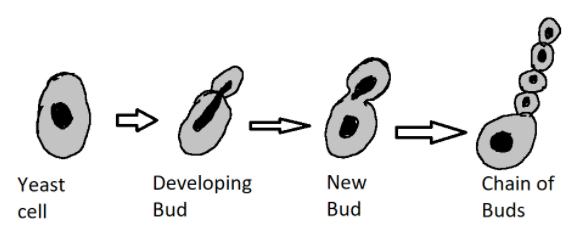
Note: The buds detach after getting mature and thrive as individual organisms. The newly formed organism is the exact copy or clone of the parent organism. The other organisms which reproduce by budding are hydra.
Complete answer:
A) The budding in yeast can be visualised under a compound microscope. The mixture of yeast must be placed on the microscope and necessary coverslip should be placed. The high magnification is needed to visualise the bud. So, the coarse adjustment is required which helps in moving the objective lens up and down so that the desired part can be focused properly. In case of fine adjustment, the stage is moved up and down so that the visualisation can be controlled.
B) Yeast is a single celled eukaryotic organism. The yeast reproduces asexually through mitosis. Budding in yeast is a means of asexual or vegetative reproduction. In this a small bud or outgrowth develops from the parent body. The nucleus of the parent cell divides into a daughter nucleus. This nucleus shifts into the daughter bud. Ultimately a small chain of bud develops, it breaks and the buds form new yeast cells.
The budding in yeast can be shown by the help of the diagram:
Note: The buds detach after getting mature and thrive as individual organisms. The newly formed organism is the exact copy or clone of the parent organism. The other organisms which reproduce by budding are hydra.
Recently Updated Pages
Master Class 11 English: Engaging Questions & Answers for Success

Master Class 11 Social Science: Engaging Questions & Answers for Success
Master Class 11 Maths: Engaging Questions & Answers for Success
Master Class 11 Biology: Engaging Questions & Answers for Success
Master Class 11 Physics: Engaging Questions & Answers for Success
Master Class 11 Chemistry: Engaging Questions & Answers for Success
Trending doubts
One Metric ton is equal to kg A 10000 B 1000 C 100 class 11 physics CBSE
What is cell theory Who formulated it class 11 biology CBSE
Phyllotaxy is the arrangement of ALeaflets BLeaves class 11 biology CBSE
Difference Between Prokaryotic Cells and Eukaryotic Cells
The symbiotic association of fungi and algae is called class 11 biology CBSE
Cell theory was formulated by A Schleiden and Schwann class 11 biology CBSE