




What is the structural formula of cyclobutane?
Answer
 Verified
594.6k+ views
Hint: From the name of the compound, we can infer that
- It has a cyclic structure
- It has four carbon atoms
- It does not have any multiple bonds
Complete answer:
We know that cyclobutane is a type of cycloalkane. A cycloalkane is a monocyclic saturated hydrocarbon. It does not contain any atoms or elements except hydrogen and carbon.
Since we know that it has a saturated monocyclic structure and has four carbon atoms, its Lewis structure will be as follows

So, from the structure, we can see that it has 8 hydrogen atoms and hence structural formula of cyclobutane will be ${{(C{{H}_{2}})}_{4}}$ or ${{C}_{4}}{{H}_{8}}$.
Additional Information:
Some properties of cyclobutane are
- It is prepared by dimerization of alkenes in UV-light. It can also be prepared by dehalogenation of 1,4-dihalobutene in the presence of reducing metals.
- It is a colorless gas but can be liquified for commercial purposes.
- It has a molar mass of 56.107 g/mol.
- Its boiling point is 285.6K and its melting point is 182K.
- Complex derivatives of cyclobutane are of much importance in the fields of biotechnology and biology.
- It does not have much biological or commercial significance.
- Carbon-carbon bonds in cyclobutane have lower bond energy and have significantly strained bond angles. This is why it is unstable at a temperature above $500{}^\circ C$.
Note:
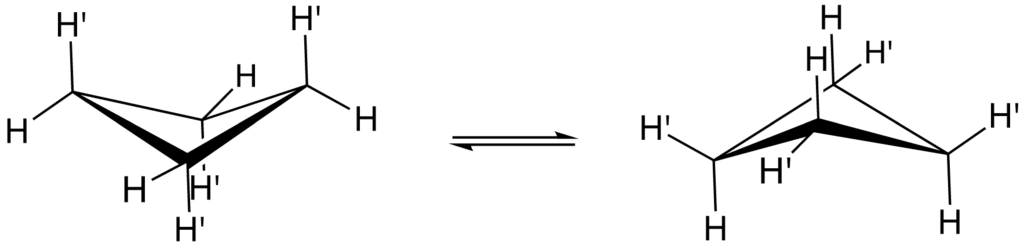
It should be noted that the four carbon atoms in the cyclobutane compound are not coplanar. A puckered or a folded conformation is adopted by the cyclobutane ring. The angle between the plane formed by the three carbon atoms and the fourth carbon atom is $25{}^\circ $.
- It has a cyclic structure
- It has four carbon atoms
- It does not have any multiple bonds
Complete answer:
We know that cyclobutane is a type of cycloalkane. A cycloalkane is a monocyclic saturated hydrocarbon. It does not contain any atoms or elements except hydrogen and carbon.
Since we know that it has a saturated monocyclic structure and has four carbon atoms, its Lewis structure will be as follows
So, from the structure, we can see that it has 8 hydrogen atoms and hence structural formula of cyclobutane will be ${{(C{{H}_{2}})}_{4}}$ or ${{C}_{4}}{{H}_{8}}$.
Additional Information:
Some properties of cyclobutane are
- It is prepared by dimerization of alkenes in UV-light. It can also be prepared by dehalogenation of 1,4-dihalobutene in the presence of reducing metals.
- It is a colorless gas but can be liquified for commercial purposes.
- It has a molar mass of 56.107 g/mol.
- Its boiling point is 285.6K and its melting point is 182K.
- Complex derivatives of cyclobutane are of much importance in the fields of biotechnology and biology.
- It does not have much biological or commercial significance.
- Carbon-carbon bonds in cyclobutane have lower bond energy and have significantly strained bond angles. This is why it is unstable at a temperature above $500{}^\circ C$.
Note:
It should be noted that the four carbon atoms in the cyclobutane compound are not coplanar. A puckered or a folded conformation is adopted by the cyclobutane ring. The angle between the plane formed by the three carbon atoms and the fourth carbon atom is $25{}^\circ $.
Recently Updated Pages
If x a + bt + ct2 where x is in meters and t is in class 11 physics CBSE

A car covers the first half distance between two places class 11 physics CBSE
The resultant of two vectors overrightarrow P and overrightarrow class 11 physics CBSE
Find the value of cos 135 class 11 maths CBSE
A mass M is held in place by an applied force F and class 11 physics CBSE
A solution of glucose in water is labelled as 10 dfracwv class 11 chemistry CBSE
Trending doubts
One Metric ton is equal to kg A 10000 B 1000 C 100 class 11 physics CBSE
Find the value of the expression given below sin 30circ class 11 maths CBSE
Draw a diagram of nephron and explain its structur class 11 biology CBSE
10 examples of friction in our daily life
Proton was discovered by A Thomson B Rutherford C Chadwick class 11 chemistry CBSE
Bond order ofO2 O2+ O2 and O22 is in order A O2 langle class 11 chemistry CBSE