




How do the stereoisomers of $ 2-bromo-3-hexene $ arise?
Answer
 Verified
585.3k+ views
Hint: We know that stereoisomers are the type of isomers which different in the three-dimensional orientations of their atoms in space but have the same molecular formula and the sequence of the bonded atoms. First draw chain structure of the given compound. Then find out all the chiral carbons present in the given compound. Check the number of right and left handed isomers that can be generated for the given structure.
Complete answer:
Stereoisomers are the type of isomers which differ in the three-dimensional orientations of their atoms in space but have the same molecular formula and the sequence of the bonded atoms. It can be of two types- enantiomers and diastereomers. The compound given in the question is $ 2-bromo-3-hexene $
A chiral carbon atom is that carbon atom that is attached to four different types of atoms or groups of atoms. Hence from the structure we can say that only $ C2 $ is the chiral carbon present in the compound. Since there is only one chiral carbon present in the compound hence only two stereoisomers are possible for this structure.
The two stereoisomers can be represented using wedge dash structure. In one wedge dash structure $ Br $ will be present on wedge and $ H $ on dash while in another structure $ Br $ will be present on dash and $ H $ on wedge. The two stereoisomers are:
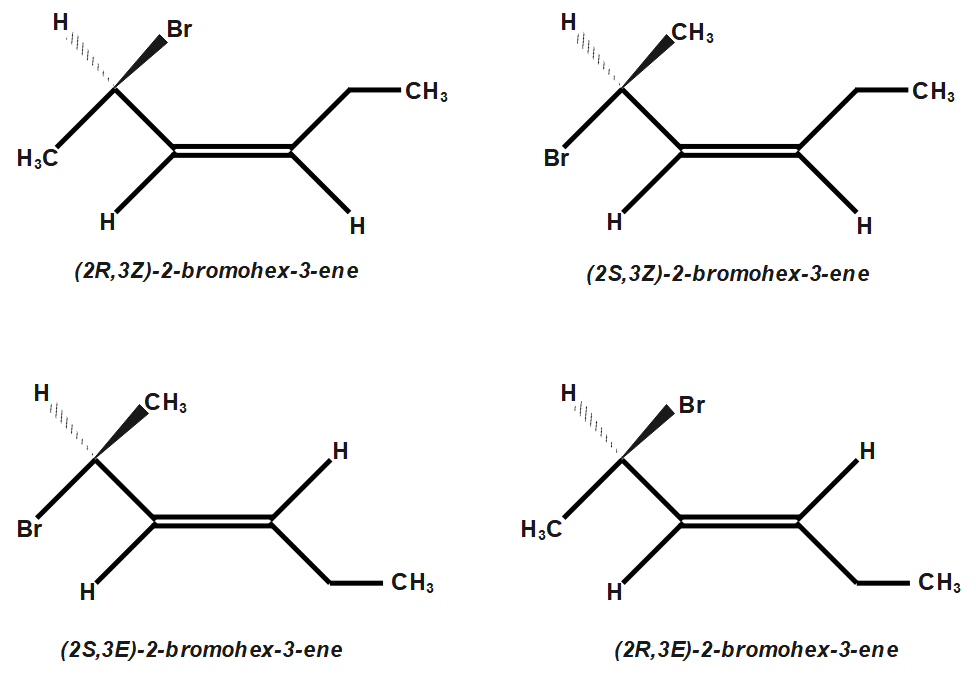
Comparing the two structures we can see that they are mirror images of each other. Since they are non-superimposable mirror images they are known as enantiomers and hence are a type of stereoisomers.
Note:
The total number of stereoisomers of a given compound can also be calculated using $ {{2}^{n}} $ where is the number of chiral centers present in the given compound. The given compound has one chiral center. Using the formula we get that the given compound has $ {{2}^{1}}=2 $ stereoisomers.
Complete answer:
Stereoisomers are the type of isomers which differ in the three-dimensional orientations of their atoms in space but have the same molecular formula and the sequence of the bonded atoms. It can be of two types- enantiomers and diastereomers. The compound given in the question is $ 2-bromo-3-hexene $
A chiral carbon atom is that carbon atom that is attached to four different types of atoms or groups of atoms. Hence from the structure we can say that only $ C2 $ is the chiral carbon present in the compound. Since there is only one chiral carbon present in the compound hence only two stereoisomers are possible for this structure.
The two stereoisomers can be represented using wedge dash structure. In one wedge dash structure $ Br $ will be present on wedge and $ H $ on dash while in another structure $ Br $ will be present on dash and $ H $ on wedge. The two stereoisomers are:
Comparing the two structures we can see that they are mirror images of each other. Since they are non-superimposable mirror images they are known as enantiomers and hence are a type of stereoisomers.
Note:
The total number of stereoisomers of a given compound can also be calculated using $ {{2}^{n}} $ where is the number of chiral centers present in the given compound. The given compound has one chiral center. Using the formula we get that the given compound has $ {{2}^{1}}=2 $ stereoisomers.
Recently Updated Pages
Basicity of sulphurous acid and sulphuric acid are

Master Class 11 English: Engaging Questions & Answers for Success
Master Class 11 Physics: Engaging Questions & Answers for Success
Master Class 11 Computer Science: Engaging Questions & Answers for Success
Master Class 11 Chemistry: Engaging Questions & Answers for Success
Master Class 11 Social Science: Engaging Questions & Answers for Success
Trending doubts
Difference Between Prokaryotic Cells and Eukaryotic Cells
Two of the body parts which do not appear in MRI are class 11 biology CBSE
One Metric ton is equal to kg A 10000 B 1000 C 100 class 11 physics CBSE
Draw a diagram of nephron and explain its structur class 11 biology CBSE
10 examples of friction in our daily life
What will happen if the mucus is not secreted by the class 11 biology CBSE