



How many stereoisomers are possible for 3, 4-dimethylheptane? Which are pairs of enantiomers and which are meso compounds?
Answer
 Verified
597k+ views
Hint: Stereoisomerism is a kind of isomerism where structure differs in spatial arrangement of atoms rather than atom to atom connectivity. Attempt this question by finding the chiral centers followed by making different arrangement substituents around those chiral centers and then classify them as enantiomers and meso compounds.
Complete answer:
Let us first begin with the basic definitions of chiral centers, enantiomers and meso compounds.
-Chiral center: It is a centre where a tetrahedral atom has 4 different substituent (atom, group or ion) attached to it. Chiral centers of carbon atoms are also known as asymmetric carbon atoms.
-Enantiomers: These are chiral molecules which are non – superimposable mirror images of each other (i.e., they cannot overlap each other just like our hands).
-Meso compounds: These are the optically inactive molecules even after having multiple chiral centers. To check meso compounds, we must look for an internal plane so that both parts on each side of the plane cancel each other out, giving us an achiral compound.
Now we will draw the structure of 3, 4-dimethylheptane and find the chiral centers:-
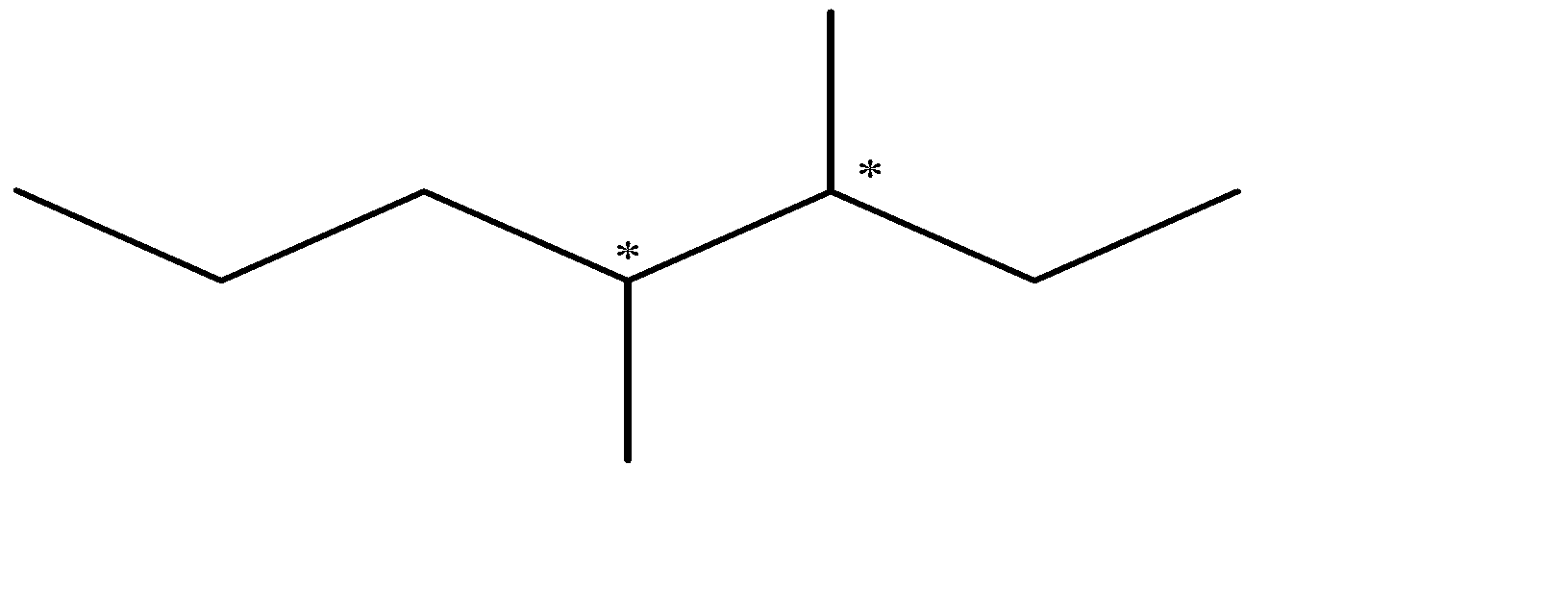
As we can see that there are two chiral centers, therefore we will keep changing the spatial arrangement around them till we get our all possible isomers (all unique).
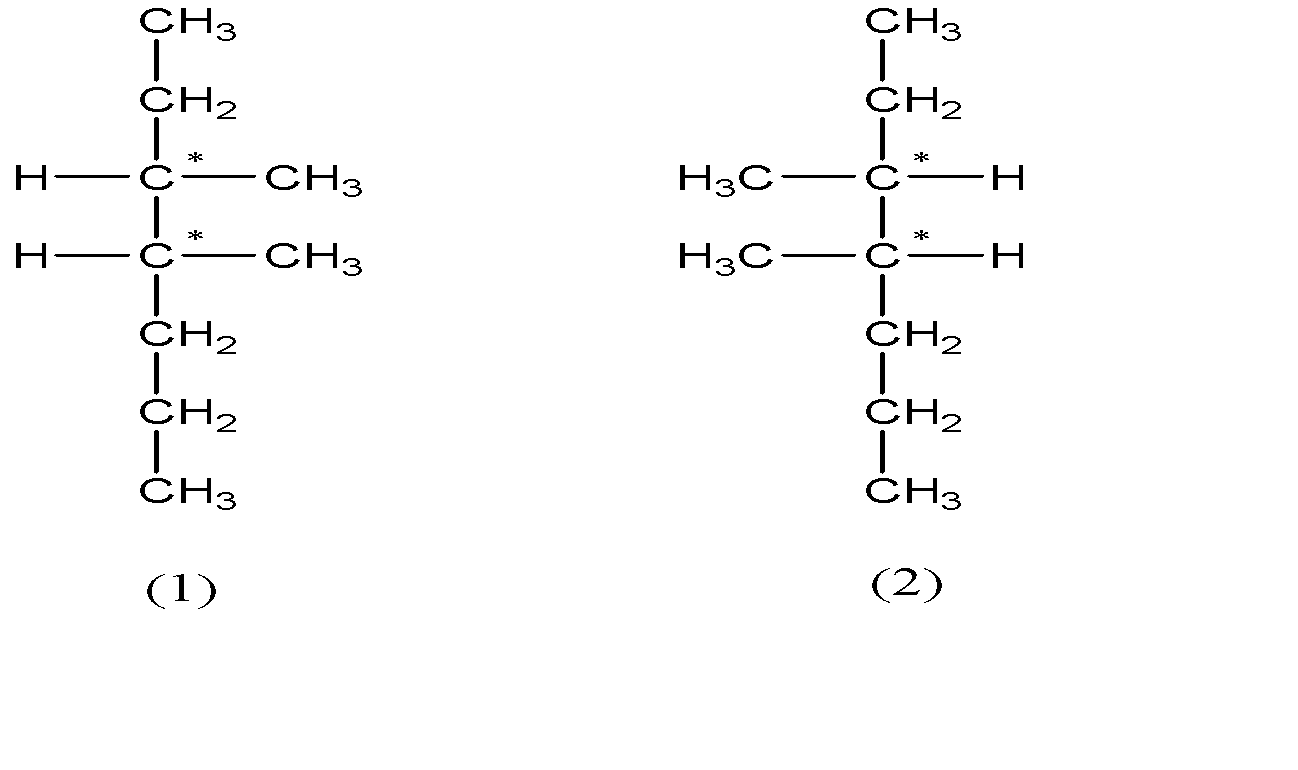
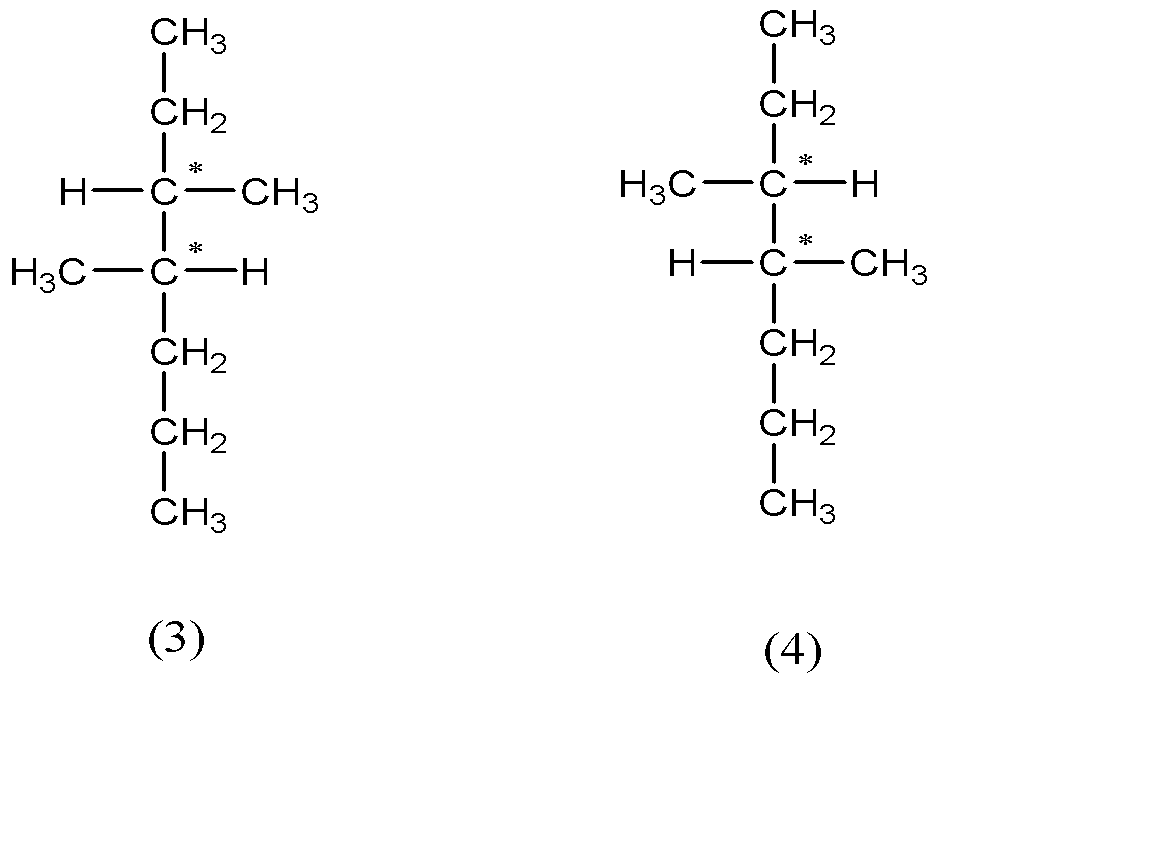
So, there are 4 stereoisomers possible for 3, 4-dimethylheptane.
-From the above structures we can see that (1) and (2) are non - superimposable mirror images of each other and the same goes for (3) and (4). Therefore (1) and (2) ; (3) and (4) are the 2 enantiomeric pairs. Also there is no internal plane in these compounds.
Hence the number of pairs of enantiomers = 2 and there are no meso compounds.
Note:
If there is ‘n’ no. of chiral centre present in a huge unsymmetrical compound, then you can use the formula:-
Total no. of stereoisomer of a molecule or compound = ${{2}^{n}}$
As in case of 3, 4-dimethylheptane, there are 2 chiral centers. Therefore number of stereoisomers = ${{2}^{2}}=4$
-On the basis of chiral centers, we cannot call a molecule to be actively active. This can be explained by the example of meso compounds as they have multiple chiral centers but overall optical activity is null.
Complete answer:
Let us first begin with the basic definitions of chiral centers, enantiomers and meso compounds.
-Chiral center: It is a centre where a tetrahedral atom has 4 different substituent (atom, group or ion) attached to it. Chiral centers of carbon atoms are also known as asymmetric carbon atoms.
-Enantiomers: These are chiral molecules which are non – superimposable mirror images of each other (i.e., they cannot overlap each other just like our hands).
-Meso compounds: These are the optically inactive molecules even after having multiple chiral centers. To check meso compounds, we must look for an internal plane so that both parts on each side of the plane cancel each other out, giving us an achiral compound.
Now we will draw the structure of 3, 4-dimethylheptane and find the chiral centers:-
As we can see that there are two chiral centers, therefore we will keep changing the spatial arrangement around them till we get our all possible isomers (all unique).
So, there are 4 stereoisomers possible for 3, 4-dimethylheptane.
-From the above structures we can see that (1) and (2) are non - superimposable mirror images of each other and the same goes for (3) and (4). Therefore (1) and (2) ; (3) and (4) are the 2 enantiomeric pairs. Also there is no internal plane in these compounds.
Hence the number of pairs of enantiomers = 2 and there are no meso compounds.
Note:
If there is ‘n’ no. of chiral centre present in a huge unsymmetrical compound, then you can use the formula:-
Total no. of stereoisomer of a molecule or compound = ${{2}^{n}}$
As in case of 3, 4-dimethylheptane, there are 2 chiral centers. Therefore number of stereoisomers = ${{2}^{2}}=4$
-On the basis of chiral centers, we cannot call a molecule to be actively active. This can be explained by the example of meso compounds as they have multiple chiral centers but overall optical activity is null.
Recently Updated Pages
Which of the following graphs shows the variation of class 12 physics CBSE

Draw a labelled diagram of the human male reproductive class 12 biology CBSE
Describe the experiment to compare the emf of two cells class 12 physics CBSE
What is standard hydrogen electrode
What is conventional current and electric current class 12 physics CBSE
2Bromopentane is treated with an alcoholic KOH solution class 12 chemistry CBSE
Trending doubts
Draw a labelled sketch of the human eye class 12 physics CBSE
Which are the Top 10 Largest Countries of the World?
A member of Simon commission later became Prime Minister class 12 social science CBSE
Draw ray diagrams each showing i myopic eye and ii class 12 physics CBSE
Give one example of a reptile that is viviparous class 12 biology CBSE
Which is the correct genotypic ratio of mendel dihybrid class 12 biology CBSE