




Static balance is maintained by
A. Maculae
B. Cristae
C. Organ of Corti
D. Reissner’s membrane
Answer
 Verified
625.5k+ views
Hint: The ear is an acusto-static organ. This means that the ear helps in hearing (acusto), and balancing (static) of the body. The ear is subdivided into three main parts- external, middle, and internal ear.
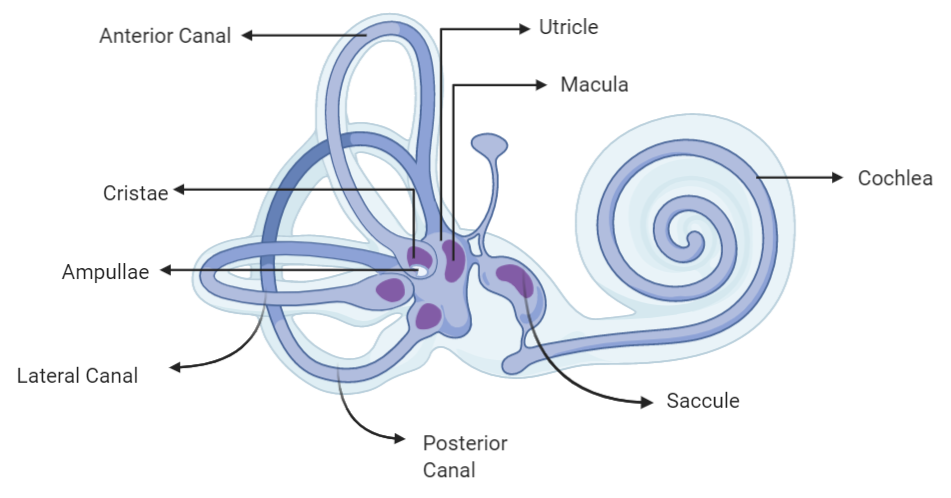
Complete answer:Anatomy of the internal ear- The internal ear consists of the vestibular apparatus that help in the balancing of the body. There are three semicircular canals originating from the utriculus. They consist of a sensory spot in the cristae called the ampulla. The cristae help in the dynamic balancing of the body when a person is in motion. The static balancing in the body is done by the maculae. The macula of the utriculus does balance in forward and backward direction and the maculae of the sacculus help in the sideways balancing of the body.
Thus, the Maculae helps in the static balancing of the body.
Hence, option (A) is correct.
Note: Our ear has three main parts- external, middle and internal ear.
1. External ear – It comprises the cavity which is known as the auditory canal. The outer cartilage of the ear is known as the pinna. At the end of the auditory canal, the tympanum or the eardrum is attached.
2. Middle ear – The cavity of the middle ear is known as the Tympanic bulla. It has 3 ear ossicles of the three bones. These are the malleus, incus, and stapes. The stapes or stirrup is the smallest bone in the human body. The middle ear has three openings, the oval window, or Fenestra ovalis, the round window or the Fenestra rotunda, and the Eustachian tube.
3. Internal ear – The cavity of the inner ear is called the Bony labyrinth and the Membranous labyrinth. The inner ear comprises the vestibular apparatus having the utriculus, sacculus, and cochlea, which helps in balancing the body.
Complete answer:Anatomy of the internal ear- The internal ear consists of the vestibular apparatus that help in the balancing of the body. There are three semicircular canals originating from the utriculus. They consist of a sensory spot in the cristae called the ampulla. The cristae help in the dynamic balancing of the body when a person is in motion. The static balancing in the body is done by the maculae. The macula of the utriculus does balance in forward and backward direction and the maculae of the sacculus help in the sideways balancing of the body.
Thus, the Maculae helps in the static balancing of the body.
Hence, option (A) is correct.
Note: Our ear has three main parts- external, middle and internal ear.
1. External ear – It comprises the cavity which is known as the auditory canal. The outer cartilage of the ear is known as the pinna. At the end of the auditory canal, the tympanum or the eardrum is attached.
2. Middle ear – The cavity of the middle ear is known as the Tympanic bulla. It has 3 ear ossicles of the three bones. These are the malleus, incus, and stapes. The stapes or stirrup is the smallest bone in the human body. The middle ear has three openings, the oval window, or Fenestra ovalis, the round window or the Fenestra rotunda, and the Eustachian tube.
3. Internal ear – The cavity of the inner ear is called the Bony labyrinth and the Membranous labyrinth. The inner ear comprises the vestibular apparatus having the utriculus, sacculus, and cochlea, which helps in balancing the body.
Recently Updated Pages
Basicity of sulphurous acid and sulphuric acid are

Master Class 11 English: Engaging Questions & Answers for Success
Master Class 11 Physics: Engaging Questions & Answers for Success
Master Class 11 Computer Science: Engaging Questions & Answers for Success
Master Class 11 Chemistry: Engaging Questions & Answers for Success
Master Class 11 Social Science: Engaging Questions & Answers for Success
Trending doubts
Difference Between Prokaryotic Cells and Eukaryotic Cells
Two of the body parts which do not appear in MRI are class 11 biology CBSE
One Metric ton is equal to kg A 10000 B 1000 C 100 class 11 physics CBSE
10 examples of friction in our daily life
Draw a diagram of nephron and explain its structur class 11 biology CBSE
What will happen if the mucus is not secreted by the class 11 biology CBSE