




State with reason whether the following statement is ‘True’ or ‘False’. Every rectangle is a parallelogram.
\[\left( {\text{A}} \right){\text{ True}}\]
\[\left( B \right){\text{ False}}\]
Answer
 Verified
509.7k+ views
Hint:: A quadrilateral is a parallelogram if both pairs of opposite sides are parallel. In a rectangle, each pair of co-interior angles are supplementary because two right angles add to a straight angle. So the opposite sides of a rectangle are parallel. This means that a rectangle is a parallelogram.
Complete step by step solution:
Parallelograms: A parallelogram is a quadrilateral whose opposite sides are parallel.
Properties of a parallelogram:
The opposite angles of a parallelogram are equal.
The opposite sides of a parallelogram are equal.
The diagonals of a parallelogram bisect each other.

Rectangles: A rectangle is a quadrilateral in which all angles are right angles.
Properties of a rectangle:
The opposite sides of a rectangle are equal.
The diagonals of a rectangle are equal and bisect each other.
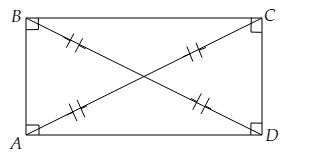
Now we know that for any quadrilateral to be a parallelogram, a pair of opposite angles should be congruent. Now have a look at the above diagram. From which we have
\[\angle A = \angle B = \angle C = \angle D = 90^\circ \]
Or we can also say that
\[\angle A = \angle C = 90^\circ \] and \[\angle B = \angle D = 90^\circ \]
That is the opposite angles of a rectangle are equal and also the opposite sides of a rectangle are also equal. Now the rectangle ABCD has all the properties that a parallelogram has. Therefore, we can say that “Every rectangle is a parallelogram”.
Hence the correct option is \[\left( {\text{A}} \right){\text{ True}}\]
Note:
Remember that if one angle of a parallelogram is a right angle then it is a rectangle. Also keep in mind that not all quadrilaterals are parallelograms. Always start by making a drawing for better understanding when proving quadrilateral as a parallelogram.
Complete step by step solution:
Parallelograms: A parallelogram is a quadrilateral whose opposite sides are parallel.
Properties of a parallelogram:
The opposite angles of a parallelogram are equal.
The opposite sides of a parallelogram are equal.
The diagonals of a parallelogram bisect each other.
Rectangles: A rectangle is a quadrilateral in which all angles are right angles.
Properties of a rectangle:
The opposite sides of a rectangle are equal.
The diagonals of a rectangle are equal and bisect each other.
Now we know that for any quadrilateral to be a parallelogram, a pair of opposite angles should be congruent. Now have a look at the above diagram. From which we have
\[\angle A = \angle B = \angle C = \angle D = 90^\circ \]
Or we can also say that
\[\angle A = \angle C = 90^\circ \] and \[\angle B = \angle D = 90^\circ \]
That is the opposite angles of a rectangle are equal and also the opposite sides of a rectangle are also equal. Now the rectangle ABCD has all the properties that a parallelogram has. Therefore, we can say that “Every rectangle is a parallelogram”.
Hence the correct option is \[\left( {\text{A}} \right){\text{ True}}\]
Note:
Remember that if one angle of a parallelogram is a right angle then it is a rectangle. Also keep in mind that not all quadrilaterals are parallelograms. Always start by making a drawing for better understanding when proving quadrilateral as a parallelogram.
Recently Updated Pages
Master Class 10 Social Science: Engaging Questions & Answers for Success

Master Class 10 Science: Engaging Questions & Answers for Success
Master Class 10 Maths: Engaging Questions & Answers for Success
Master Class 10 General Knowledge: Engaging Questions & Answers for Success
Master Class 10 Computer Science: Engaging Questions & Answers for Success
Class 10 Question and Answer - Your Ultimate Solutions Guide
Trending doubts
What is the full form of PNG A Petrol Natural Gas B class 10 chemistry CBSE
Explain the Treaty of Vienna of 1815 class 10 social science CBSE
Why is there a time difference of about 5 hours between class 10 social science CBSE
Who Won 36 Oscar Awards? Record Holder Revealed
What is the median of the first 10 natural numbers class 10 maths CBSE
The power of the lens is 2D What is its focal length class 10 physics CBSE