




State whether the following statements are true or false. Give reasons for your answers.
For any real number x, ${x^2} \geqslant 0$.
$
(a){\text{ True}} \\
{\text{(b) False}} \\
$
Answer
 Verified
640.8k+ views
Hint – If x is the domain of any function ${x^2}$ then try and substitute any negative value into ${x^2}$ to see whether it comes to be positive or not because eventually if we substitute any positive value in it its square will be positive only.
Complete step-by-step answer:
Given equation ${x^2} \geqslant 0$ for any real number x.
We have to show whether this statement is true or false.
Case (1) let us consider any positive real number say (x = 2).
So square the number we get,
$ \Rightarrow {x^2} = {2^2} = 4$……………….. (1)
And we all know 4 is greater than 0.
Case (2) let us consider x = 0
So 0 square is 0
$ \Rightarrow {x^2} = 0$……………………… (2)
Case (3) let us consider any negative real number say (x = -2)
So square the number we get,
$ \Rightarrow {x^2} = {\left( { - 2} \right)^2} = {\left( { - 1} \right)^2}{\left( 2 \right)^2} = \left( 1 \right)4 = 4$…………………………. (3)
And we all know 4 is greater than 0.
So in general from equation (1), (2) and (3) we can say that for any real number x, the square of x is always greater than or equal to zero.
$ \Rightarrow {x^2} \geqslant 0$ is true for any real number x.
Hence option (A) is correct.
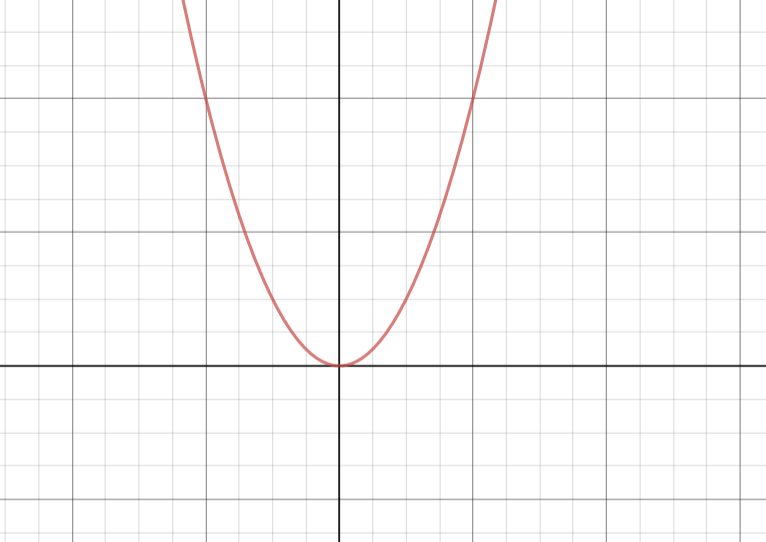
Note – There can be another method to prove this, graph of $y = {x^2}$ is a parabola opening upwards towards y axis, where y is the range and x is the domain of it, clearly from that graph no matter the value of x we substitute the y is always positive. This too proves the above mentioned. The graph is represented as
Complete step-by-step answer:
Given equation ${x^2} \geqslant 0$ for any real number x.
We have to show whether this statement is true or false.
Case (1) let us consider any positive real number say (x = 2).
So square the number we get,
$ \Rightarrow {x^2} = {2^2} = 4$……………….. (1)
And we all know 4 is greater than 0.
Case (2) let us consider x = 0
So 0 square is 0
$ \Rightarrow {x^2} = 0$……………………… (2)
Case (3) let us consider any negative real number say (x = -2)
So square the number we get,
$ \Rightarrow {x^2} = {\left( { - 2} \right)^2} = {\left( { - 1} \right)^2}{\left( 2 \right)^2} = \left( 1 \right)4 = 4$…………………………. (3)
And we all know 4 is greater than 0.
So in general from equation (1), (2) and (3) we can say that for any real number x, the square of x is always greater than or equal to zero.
$ \Rightarrow {x^2} \geqslant 0$ is true for any real number x.
Hence option (A) is correct.
Note – There can be another method to prove this, graph of $y = {x^2}$ is a parabola opening upwards towards y axis, where y is the range and x is the domain of it, clearly from that graph no matter the value of x we substitute the y is always positive. This too proves the above mentioned. The graph is represented as
Recently Updated Pages
Master Class 11 English: Engaging Questions & Answers for Success

Master Class 11 Maths: Engaging Questions & Answers for Success
Class 11 Question and Answer - Your Ultimate Solutions Guide
Master Class 11 Biology: Engaging Questions & Answers for Success
Master Class 11 Physics: Engaging Questions & Answers for Success
Master Class 11 Accountancy: Engaging Questions & Answers for Success
Trending doubts
Differentiate between an exothermic and an endothermic class 11 chemistry CBSE
One Metric ton is equal to kg A 10000 B 1000 C 100 class 11 physics CBSE
In what year Guru Nanak Dev ji was born A15 April 1469 class 11 social science CBSE
Difference Between Prokaryotic Cells and Eukaryotic Cells
Draw a diagram of a plant cell and label at least eight class 11 biology CBSE
1 Quintal is equal to a 110 kg b 10 kg c 100kg d 1000 class 11 physics CBSE