




State the principle of moments as applied to a lever.
Answer
 Verified
655.5k+ views
Hint: The principle of moment states that, when a system or an object is in equilibrium the sum of the clockwise moments will be equal to the sum of the anticlockwise moments on the system or the object. A lever is an instrument, consisting of a long beam balanced over a fulcrum, the two ends consist of load and effort forces.
Step by step solution:
Let’s start by understanding what a moment is. A moment is actually the moment of force acting on a body. It gives us a measure of the body’s tendency to cause it to rotate about a specific point or an axis.
Usually, the concept of moment is accompanied by the concept of moment arm. The moment arm refers to the distance from the axis of rotation. The formula of moment is given by the force applied times the perpendicular distance from the point or axis of rotation. The S.I unit for moment is Newton-meter, that is: $Nm=kg{{m}^{2}}{{s}^{-2}}$.
Now let’s state the principle of moments. The principle of moment states that, when a system or an object is in equilibrium the sum of the clockwise moments will be equal to the sum of the anticlockwise moments on the system or the object.
Some of the everyday examples where moments or the turning effect is observed are opening and closing doors and windows, nutcracker etc. Further, some examples of moments involve the application of lever, such as seesaw.
Now, let’s understand what is a lever and how is the principle of moments applied to a lever. A lever is a simple machine, which consists of a long beam balanced on a fulcrum. One of the arms, in which force is usually applied is called the effort arm and the force applied is known as effort. This force is used to overcome force applied by the load on the other end.
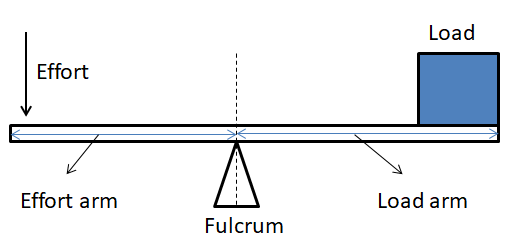
Note: Generally, the lever system is used to lift loads using the principle of moments. When heavy loads have to be lifted, they are put on the load end and then, the fulcrum is pushed close to the load. Hence, the load arm distance is reduced and effort arm distance is increased. Hence using the principle of moments, the load can be lifted using lower amount of effort force, since the products of load and load arm will be equal to the effort and effort arm.
Step by step solution:
Let’s start by understanding what a moment is. A moment is actually the moment of force acting on a body. It gives us a measure of the body’s tendency to cause it to rotate about a specific point or an axis.
Usually, the concept of moment is accompanied by the concept of moment arm. The moment arm refers to the distance from the axis of rotation. The formula of moment is given by the force applied times the perpendicular distance from the point or axis of rotation. The S.I unit for moment is Newton-meter, that is: $Nm=kg{{m}^{2}}{{s}^{-2}}$.
Now let’s state the principle of moments. The principle of moment states that, when a system or an object is in equilibrium the sum of the clockwise moments will be equal to the sum of the anticlockwise moments on the system or the object.
Some of the everyday examples where moments or the turning effect is observed are opening and closing doors and windows, nutcracker etc. Further, some examples of moments involve the application of lever, such as seesaw.
Now, let’s understand what is a lever and how is the principle of moments applied to a lever. A lever is a simple machine, which consists of a long beam balanced on a fulcrum. One of the arms, in which force is usually applied is called the effort arm and the force applied is known as effort. This force is used to overcome force applied by the load on the other end.
Note: Generally, the lever system is used to lift loads using the principle of moments. When heavy loads have to be lifted, they are put on the load end and then, the fulcrum is pushed close to the load. Hence, the load arm distance is reduced and effort arm distance is increased. Hence using the principle of moments, the load can be lifted using lower amount of effort force, since the products of load and load arm will be equal to the effort and effort arm.
Recently Updated Pages
Master Class 11 Social Science: Engaging Questions & Answers for Success

Master Class 11 English: Engaging Questions & Answers for Success
Master Class 11 Accountancy: Engaging Questions & Answers for Success
Master Class 11 Physics: Engaging Questions & Answers for Success
Master Class 11 Computer Science: Engaging Questions & Answers for Success
Master Class 11 Business Studies: Engaging Questions & Answers for Success
Trending doubts
One Metric ton is equal to kg A 10000 B 1000 C 100 class 11 physics CBSE
Find the value of the expression given below sin 30circ class 11 maths CBSE
Draw a diagram of nephron and explain its structur class 11 biology CBSE
10 examples of friction in our daily life
Proton was discovered by A Thomson B Rutherford C Chadwick class 11 chemistry CBSE
The teeth used for biting and cutting food are called class 11 biology CBSE