




State the law of conservation of mass. Give one example to illustrate this law.
Answer
 Verified
634.8k+ views
Hint: In a balanced chemical equation, the number of atoms taking part in the reaction to form a molecule is the same on both sides of the reaction. Ultimately it provides the conclusion that the total mass involved in any reaction remains the same.
Step by step answer: The given question is very straightforward as it asks you to state the law of conservation of mass, with the appropriate example. The example can be given on the basis of the daily life application of the law. Here, one needs to read the question properly as the word mass change- in the law of conservation of mass we can write law of conservation of matter-by matter the example changes, but all other words in the law remain the same.
The law of conservation of mass is derived from the chemical changes that are seen in our daily life, the law is derived and it is based on n-number of observations made by the scientists. Whenever there is change in the state of the molecule after reaction or breaking or formation of the bond the mass of the product form is equal to the mass of the reactants. The properties of the reactants are not similar to that of the product formed by the amount. It is like a production machine: what you put in you will get out of the product after the appropriate physical or chemical changes that are done as per the set procedure.
Law of conservation of mass says that “mass in an isolated system is neither created nor destroyed by chemical reactions or physical transformations. According to the law of conservation of mass, the mass of the products in a chemical reaction must equal the mass of the reactants.”
Whenever the chemical change takes place there is change in the reactant chemically to form products that have different properties by the amount of reactant will always remain the same as that of the product.
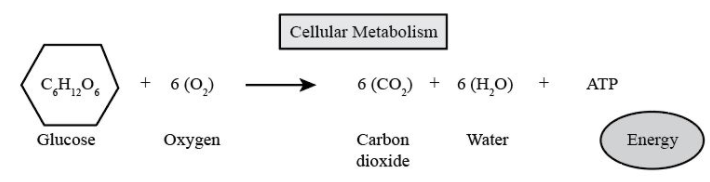
Example reactants like glucose in presence of oxygen will give us products like carbon dioxide and water with energy due to breakage of bond during cellular respiration. Reaction is as shown, the number of molecules are the same on reactants and product sides.
Note: As we know the law of conservation of mass is similar to that of the law of conservation of matter, therefore we should not get confused between them. It's a natural law which states that anyhow represents that mass neither can be created nor destroyed.
Step by step answer: The given question is very straightforward as it asks you to state the law of conservation of mass, with the appropriate example. The example can be given on the basis of the daily life application of the law. Here, one needs to read the question properly as the word mass change- in the law of conservation of mass we can write law of conservation of matter-by matter the example changes, but all other words in the law remain the same.
The law of conservation of mass is derived from the chemical changes that are seen in our daily life, the law is derived and it is based on n-number of observations made by the scientists. Whenever there is change in the state of the molecule after reaction or breaking or formation of the bond the mass of the product form is equal to the mass of the reactants. The properties of the reactants are not similar to that of the product formed by the amount. It is like a production machine: what you put in you will get out of the product after the appropriate physical or chemical changes that are done as per the set procedure.
Law of conservation of mass says that “mass in an isolated system is neither created nor destroyed by chemical reactions or physical transformations. According to the law of conservation of mass, the mass of the products in a chemical reaction must equal the mass of the reactants.”
Whenever the chemical change takes place there is change in the reactant chemically to form products that have different properties by the amount of reactant will always remain the same as that of the product.
Example reactants like glucose in presence of oxygen will give us products like carbon dioxide and water with energy due to breakage of bond during cellular respiration. Reaction is as shown, the number of molecules are the same on reactants and product sides.
Note: As we know the law of conservation of mass is similar to that of the law of conservation of matter, therefore we should not get confused between them. It's a natural law which states that anyhow represents that mass neither can be created nor destroyed.
Recently Updated Pages
Write any three differences between metals and nonmetals class 10 social science CBSE

Amit standing on a horizontal plane finds a bird flying class 10 maths CBSE
Two circles of radii 5 cm and 3 cm intersect at two class 10 maths CBSE
Solve the following i John and Jivanti together have class 10 maths CBSE
What is the relation between orthocenter circumcentre class 10 maths CBSE
Two plane mirrors are inclined at 70circ A ray incident class 10 physics CBSE
Trending doubts
Explain the Treaty of Vienna of 1815 class 10 social science CBSE
1 GB equals how many MB?
10 examples of evaporation in daily life with explanations
What is the full form of POSCO class 10 social science CBSE
Which is the hottest planet in the Solar system A Earth class 10 social science CBSE
Name any four life processes in living things class 10 biology CBSE