




State the De Morgan's Law.
Answer
 Verified
608.7k+ views
Hint: This theorem is particularly a powerful tool in digital design and electronics.
It explains that the complement of the product of all the terms is equal to the sum of complement of each term. Similarly, the complement of the sum of all the terms is equal to the product of the complement of each term.
Complete step by step answer:
1. De Morgan's theorem are basically two sets of rules or laws developed from Boolean expressions for AND, OR and NOT gates using two input variables, A and B. These two rules or theorems allow the input variables to be negated and converted from one form of a Boolean function into an opposite form.
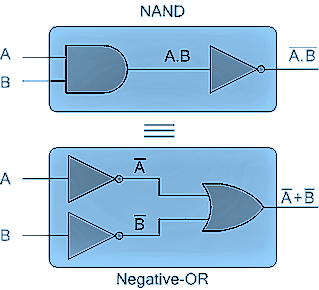
2. De Morgan’s first theorem proves that –when two (or more) input variables are first AND'ed and then negated giving a NAND gate, they are equivalent to the OR of the complement of the individual variables.
Thus, the equivalent NAND function will be negative OR function,
providing that $\overline {A \cdot B} = \overline A + \overline B $ .
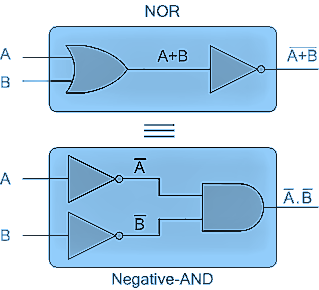
3. De Morgan’s second theorem proves that – when two (or more) input variables are first OR'ed and then negated giving a NOR gate, they are equivalent to the AND of the complements of the individual variables.
Thus, the equivalent of the NOR function is a negative AND function,
proving that $\overline {A + B} = \overline A \cdot \overline B $ .
So, from above discussion it could be concluded that a NAND gate is equivalent to a OR gate with inverted inputs. And similarly, a NOR gate is equivalent to a AND gate with inverted inputs.
Note:Do not confuse with De Morgan’s theorem, also present in Sets (Mathematics).
While solving problems on Boolean algebra it is often easier to approach the problem by breaking the longest (uppermost) bar before breaking any bars under it. You must never attempt to break two bars in one step.
It explains that the complement of the product of all the terms is equal to the sum of complement of each term. Similarly, the complement of the sum of all the terms is equal to the product of the complement of each term.
Complete step by step answer:
1. De Morgan's theorem are basically two sets of rules or laws developed from Boolean expressions for AND, OR and NOT gates using two input variables, A and B. These two rules or theorems allow the input variables to be negated and converted from one form of a Boolean function into an opposite form.
2. De Morgan’s first theorem proves that –when two (or more) input variables are first AND'ed and then negated giving a NAND gate, they are equivalent to the OR of the complement of the individual variables.
Thus, the equivalent NAND function will be negative OR function,
providing that $\overline {A \cdot B} = \overline A + \overline B $ .
3. De Morgan’s second theorem proves that – when two (or more) input variables are first OR'ed and then negated giving a NOR gate, they are equivalent to the AND of the complements of the individual variables.
Thus, the equivalent of the NOR function is a negative AND function,
proving that $\overline {A + B} = \overline A \cdot \overline B $ .
So, from above discussion it could be concluded that a NAND gate is equivalent to a OR gate with inverted inputs. And similarly, a NOR gate is equivalent to a AND gate with inverted inputs.
Note:Do not confuse with De Morgan’s theorem, also present in Sets (Mathematics).
While solving problems on Boolean algebra it is often easier to approach the problem by breaking the longest (uppermost) bar before breaking any bars under it. You must never attempt to break two bars in one step.
Recently Updated Pages
Master Class 12 Business Studies: Engaging Questions & Answers for Success

Master Class 12 Chemistry: Engaging Questions & Answers for Success
Master Class 12 Biology: Engaging Questions & Answers for Success
Class 12 Question and Answer - Your Ultimate Solutions Guide
Master Class 9 General Knowledge: Engaging Questions & Answers for Success
Master Class 9 Maths: Engaging Questions & Answers for Success
Trending doubts
Name the crygenes that control cotton bollworm and class 12 biology CBSE
In a transcription unit the promoter is said to be class 12 biology CBSE
Sulphuric acid is known as the king of acids State class 12 chemistry CBSE
A dentist uses a small mirror that gives a magnification class 12 physics CBSE
What is the structural formula of Aspirin A B C D class 12 chemistry CBSE
Draw a well labelled diagram of LS of the human ki class 12 biology CBSE