




State the condition when a lens is called an equi- concave or equi- convex lens?
Answer
 Verified
568.2k+ views
Hint: In this question, we will study about the equi-convex or equi-concave lens; this will give us the required answer to our question. Further, we will study the basics of a mirror. We will also see the basics of lens and then types of lens, for our better understanding.
Complete answer:
As we know a lens is made up of two curved surfaces. These curved surfaces can be either concave or convex surfaces. Now, when both the surfaces are of the same kind and have the same focal length, then they both together form an equi-convex or equi-concave lens. Also, for such lenses, the first and second given principal focus will be at the same distance from the given optical centre.
Therefore we can say that a lens is called an equi-convex or equi-concave when the radii of curvature of the two surfaces of the lens are equal.
Additional information:
As we know a mirror is defined as a device that contains a surface, which is mainly used to reflect light. As mirrors do not usually absorb much light, most of the light is redirected. The mirror and the object's overall quality is generally preserved in the new image.
In the given figure, the shaded portion is not used to reflect light.
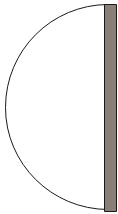
Convex mirror.

Concave mirror.
Now, as we know that a lens is defined as a transmissive optical device that is used to focus or disperse beams of light by the means of refraction. For example- a lens can focus light to form an image, unlike a prism, which refracts light without focusing.
Here, there are two types of lenses, first one is a simple lens and second one is a compound lens. Here, as we know that a simple lens includes only a single piece of transparent material, whereas a compound lens consist of several simple lenses arranged along with a common axis
As we know that lenses are of two types.
This classification of lenses depends on how the light rays bend when they pass through the lens:
Convex Lens also called Converging lens:
As we know, that convex lens is thick in the middle and they are thinner at the edges. Here, we also know that a convex lens is also called the converging lens; this is because the light rays bend inwards and converge at a point which is known as focal length.
Concave Lens also called Diverging lens:
Here, we define a concave lens which is flat in the middle and thicker at the edges. Also, a concave lens is known as a diverging lens as it bends the parallel light rays outward and diverges the light rays at the focal point.
Note:
We should remember that a mirror will have only one focal point, which is in front of the mirror. We should note that compound lenses are constructed from a combination of different simple lenses. The lens which is used to build a compound lens may have different refractive indices and other properties.
Complete answer:
As we know a lens is made up of two curved surfaces. These curved surfaces can be either concave or convex surfaces. Now, when both the surfaces are of the same kind and have the same focal length, then they both together form an equi-convex or equi-concave lens. Also, for such lenses, the first and second given principal focus will be at the same distance from the given optical centre.
Therefore we can say that a lens is called an equi-convex or equi-concave when the radii of curvature of the two surfaces of the lens are equal.
Additional information:
As we know a mirror is defined as a device that contains a surface, which is mainly used to reflect light. As mirrors do not usually absorb much light, most of the light is redirected. The mirror and the object's overall quality is generally preserved in the new image.
In the given figure, the shaded portion is not used to reflect light.
Convex mirror.
Concave mirror.
Now, as we know that a lens is defined as a transmissive optical device that is used to focus or disperse beams of light by the means of refraction. For example- a lens can focus light to form an image, unlike a prism, which refracts light without focusing.
Here, there are two types of lenses, first one is a simple lens and second one is a compound lens. Here, as we know that a simple lens includes only a single piece of transparent material, whereas a compound lens consist of several simple lenses arranged along with a common axis
As we know that lenses are of two types.
This classification of lenses depends on how the light rays bend when they pass through the lens:
Convex Lens also called Converging lens:
As we know, that convex lens is thick in the middle and they are thinner at the edges. Here, we also know that a convex lens is also called the converging lens; this is because the light rays bend inwards and converge at a point which is known as focal length.
Concave Lens also called Diverging lens:
Here, we define a concave lens which is flat in the middle and thicker at the edges. Also, a concave lens is known as a diverging lens as it bends the parallel light rays outward and diverges the light rays at the focal point.
Note:
We should remember that a mirror will have only one focal point, which is in front of the mirror. We should note that compound lenses are constructed from a combination of different simple lenses. The lens which is used to build a compound lens may have different refractive indices and other properties.
Recently Updated Pages
Master Class 12 Economics: Engaging Questions & Answers for Success

Master Class 12 English: Engaging Questions & Answers for Success
Master Class 12 Social Science: Engaging Questions & Answers for Success
Master Class 12 Maths: Engaging Questions & Answers for Success
Master Class 12 Physics: Engaging Questions & Answers for Success
Master Class 9 General Knowledge: Engaging Questions & Answers for Success
Trending doubts
One Metric ton is equal to kg A 10000 B 1000 C 100 class 11 physics CBSE
Difference Between Prokaryotic Cells and Eukaryotic Cells
Two of the body parts which do not appear in MRI are class 11 biology CBSE
1 ton equals to A 100 kg B 1000 kg C 10 kg D 10000 class 11 physics CBSE
10 examples of friction in our daily life
DNA is not present in A Nucleus B Mitochondria C Chloroplast class 11 biology CBSE