




State Hess’s law of constant heat summation and explain it with an example.
Answer
 Verified
596.3k+ views
Hint: Before attempting this question, prior knowledge of Enthalpy is a must. Enthalpy is a thermodynamic quantity,equal to the sum of internal energy of the system and the product of pressure and volume $(H = U + pV)$.
Complete step by step solution:
Hess’s law of constant heat summation-
According to this law, the change in enthalpy for a reaction is always the same and does not depend on whether the reaction occurs in one step or multiple steps.
OR
The Hess’s law states that the total enthalpy change during a complete chemical reaction is the same regardless of the path taken by the chemical reaction.
OR
This law states that, the change in enthalpy in a chemical reaction, at a constant pressure is not dependent on the process, and only dependent on the initial and final states of the chemical reaction.
It can be more easily understood by the following diagram.
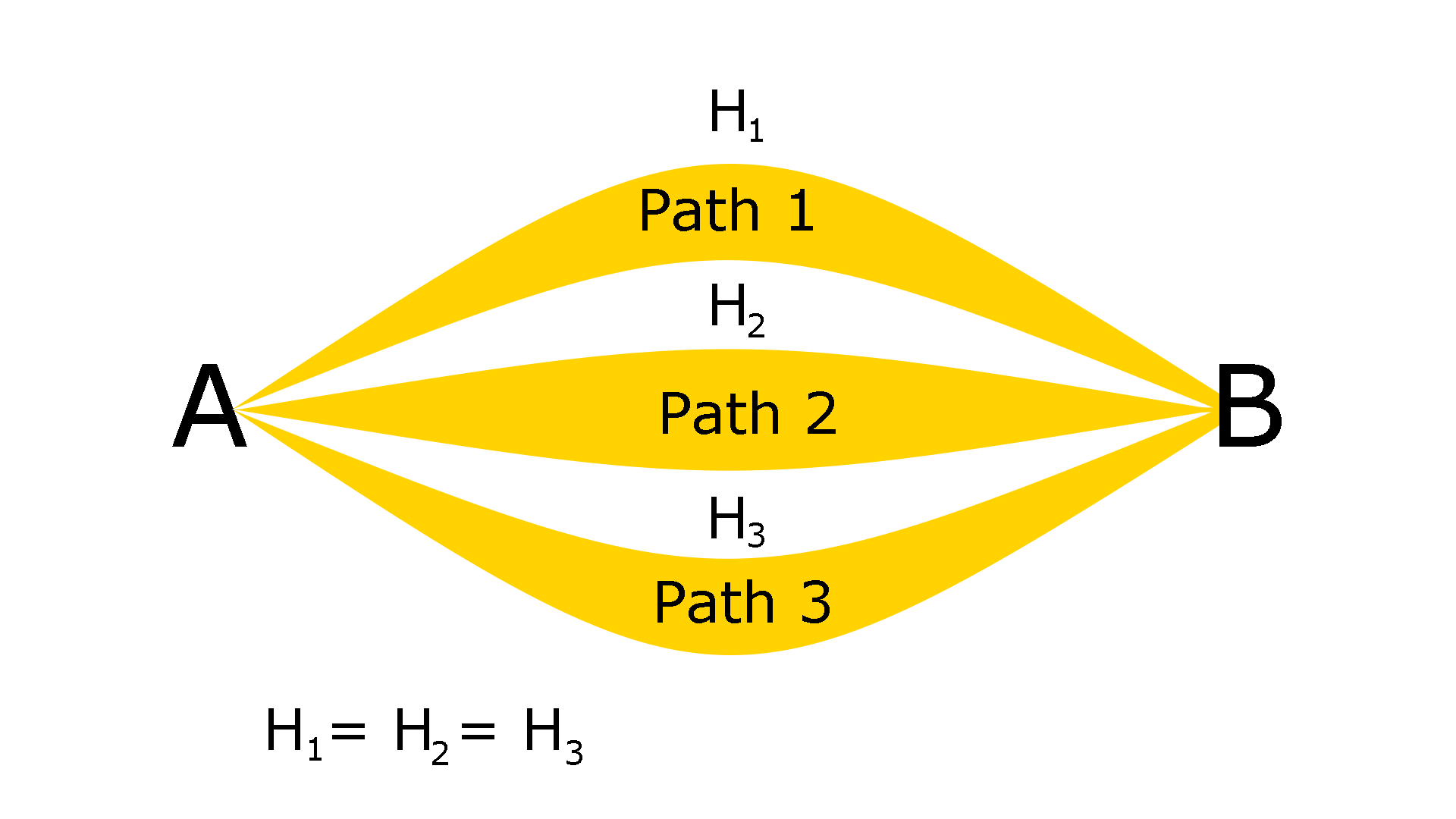
Hess’s law can be seen as an application of the principle of conservation of energy.
As enthalpy only depends upon the initial and final state of the chemical reaction, it is also considered as a state function.
Example:-
Consider the following two routes for preparation of methylene chloride\[(C{H_2}C{l_2})\] from the reaction between methane$(C{H_4})$ and chlorine$(C{l_2})$
Route I:
$C{H_4}(g) + 2C{l_2}(g) \to C{H_2}C{l_2}(g) + 2HCl(g),\Delta H_1^0 = - 202.3kJ$
Route II:
$C{H_4}(g) + C{l_2}(g) \to C{H_3}Cl(g) + HCl(g),\Delta H_2^0 = - 98.3kJ \\
C{H_3}Cl(g) + C{l_2}(g) \to C{H_2}C{l_2}(g) + HCl(g),\Delta H_3^2 = - 104.0kJ \\ $
Adding change in enthalpy of both steps
$C{H_4}(g) + 2C{l_2}(g) \to C{H_2}C{l_2}(g) + 2HCl(g),\Delta H_3^0 = - 202.3kJ$
Thus, it can be clearly seen that no matter what path we follow, the total enthalpy change in the reaction is always the same.
$\Delta H_1^0 = \Delta H_2^0 + \Delta H_3^2 = - 202.3kJ$
Note: Hess’s law is named after Germain Hess, a Russian chemist who was born in Switzerland. Germain’s Hess’s law of constant heat summation was published in 1840, which is before 1850, when Rudolf Clausius proposed the first law of thermodynamics.
Complete step by step solution:
Hess’s law of constant heat summation-
According to this law, the change in enthalpy for a reaction is always the same and does not depend on whether the reaction occurs in one step or multiple steps.
OR
The Hess’s law states that the total enthalpy change during a complete chemical reaction is the same regardless of the path taken by the chemical reaction.
OR
This law states that, the change in enthalpy in a chemical reaction, at a constant pressure is not dependent on the process, and only dependent on the initial and final states of the chemical reaction.
It can be more easily understood by the following diagram.
Hess’s law can be seen as an application of the principle of conservation of energy.
As enthalpy only depends upon the initial and final state of the chemical reaction, it is also considered as a state function.
Example:-
Consider the following two routes for preparation of methylene chloride\[(C{H_2}C{l_2})\] from the reaction between methane$(C{H_4})$ and chlorine$(C{l_2})$
Route I:
$C{H_4}(g) + 2C{l_2}(g) \to C{H_2}C{l_2}(g) + 2HCl(g),\Delta H_1^0 = - 202.3kJ$
Route II:
$C{H_4}(g) + C{l_2}(g) \to C{H_3}Cl(g) + HCl(g),\Delta H_2^0 = - 98.3kJ \\
C{H_3}Cl(g) + C{l_2}(g) \to C{H_2}C{l_2}(g) + HCl(g),\Delta H_3^2 = - 104.0kJ \\ $
Adding change in enthalpy of both steps
$C{H_4}(g) + 2C{l_2}(g) \to C{H_2}C{l_2}(g) + 2HCl(g),\Delta H_3^0 = - 202.3kJ$
Thus, it can be clearly seen that no matter what path we follow, the total enthalpy change in the reaction is always the same.
$\Delta H_1^0 = \Delta H_2^0 + \Delta H_3^2 = - 202.3kJ$
Note: Hess’s law is named after Germain Hess, a Russian chemist who was born in Switzerland. Germain’s Hess’s law of constant heat summation was published in 1840, which is before 1850, when Rudolf Clausius proposed the first law of thermodynamics.
Recently Updated Pages
Write structures of the following compounds i 2 Chloro3methylpentane class 11 chemistry CBSE

What is BLO What is the full form of BLO class 8 social science CBSE
Explain the Treaty of Vienna of 1815 class 10 social science CBSE
A Paragraph on Pollution in about 100-150 Words
XIX+XXX A 49 B 51 C 55 D 44 class 5 maths CBSE
If x a + bt + ct2 where x is in meters and t is in class 11 physics CBSE
Trending doubts
One Metric ton is equal to kg A 10000 B 1000 C 100 class 11 physics CBSE
Find the value of the expression given below sin 30circ class 11 maths CBSE
What do you mean by retardation What is its SI uni class 11 physics CBSE
Draw a diagram of nephron and explain its structur class 11 biology CBSE
10 examples of friction in our daily life
Difference between physical and chemical change class 11 chemistry CBSE