




State and prove Thales theorem.
Answer
 Verified
561.1k+ views
Hint: In this question, we are asked to state and prove the Thales theorem. Therefore, we should state the theorem and then make an appropriate diagram and prove the theorem.
Complete step-by-step answer:
Thales theorem can be stated as
If P, Q and R are three distinct points on a circle, and if the line segment joining P and R forms a diameter of the circle (i.e. it passes through the center of the circle), then $\angle PQR={{90}^{\circ }}$.
To prove this theorem, we can construct the figure as shown below in which P, Q, R are three points on the circle with center O and PR is the diameter.
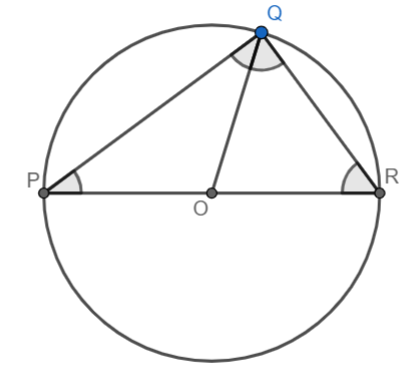
We need to show that $\angle PQR={{90}^{\circ }}$.
For this, we use the following theorem
The angles facing equal sides in a triangle have the same value………………………… (1.1)
In the figure, we find that as P, Q and R are points on a circle
\[\begin{align}
& \text{In }\Delta OPQ, \\
& OP=OQ=\text{radius of the circle} \\
& \Rightarrow \angle \text{OPQ=}\angle \text{PQO (from equation 1}\text{.1)}...........\text{(1}\text{.2)} \\
\end{align}\]
And
\[\begin{align}
& \text{In }\Delta ORQ, \\
& OR=OQ=\text{radius of the circle} \\
& \Rightarrow \angle \text{ORQ=}\angle R\text{QO (from equation 1}\text{.1)}............\text{(1}\text{.3)} \\
\end{align}\]
Now, from the figure, we see that
$\begin{align}
& \angle PQR=\angle PQO+\angle RQO \\
& \Rightarrow \angle PQR=\angle OPQ+\angle ORQ\text{ (from equations 1}\text{.2 and 1}\text{.3)}................(1.4) \\
\end{align}$
Now, we can use the angle sum property of a triangle which states that
The sum of the three interior angles of a triangle is equal to ${{180}^{\circ }}$…………………..(1.5)
Now, using equation (1.5) in $\Delta PQR$,
$\begin{align}
& \angle PQR+\angle OPQ+\angle ORQ={{180}^{\circ }} \\
& \Rightarrow \angle PQR+\angle PQR={{180}^{\circ }}\Rightarrow \angle PQR=\dfrac{{{180}^{\circ }}}{2}={{90}^{\circ }} \\
\end{align}$
Thus, we have proved that $\angle PQR={{90}^{\circ }}$ as stated in the Thales theorem and thus have proved it.
Note: We should note that the proof would not be valid if PR is not the diameter, as then PR would not pass through the center of the circle O and thus equations (1.2) and (1.3) will not be valid.
Complete step-by-step answer:
Thales theorem can be stated as
If P, Q and R are three distinct points on a circle, and if the line segment joining P and R forms a diameter of the circle (i.e. it passes through the center of the circle), then $\angle PQR={{90}^{\circ }}$.
To prove this theorem, we can construct the figure as shown below in which P, Q, R are three points on the circle with center O and PR is the diameter.
We need to show that $\angle PQR={{90}^{\circ }}$.
For this, we use the following theorem
The angles facing equal sides in a triangle have the same value………………………… (1.1)
In the figure, we find that as P, Q and R are points on a circle
\[\begin{align}
& \text{In }\Delta OPQ, \\
& OP=OQ=\text{radius of the circle} \\
& \Rightarrow \angle \text{OPQ=}\angle \text{PQO (from equation 1}\text{.1)}...........\text{(1}\text{.2)} \\
\end{align}\]
And
\[\begin{align}
& \text{In }\Delta ORQ, \\
& OR=OQ=\text{radius of the circle} \\
& \Rightarrow \angle \text{ORQ=}\angle R\text{QO (from equation 1}\text{.1)}............\text{(1}\text{.3)} \\
\end{align}\]
Now, from the figure, we see that
$\begin{align}
& \angle PQR=\angle PQO+\angle RQO \\
& \Rightarrow \angle PQR=\angle OPQ+\angle ORQ\text{ (from equations 1}\text{.2 and 1}\text{.3)}................(1.4) \\
\end{align}$
Now, we can use the angle sum property of a triangle which states that
The sum of the three interior angles of a triangle is equal to ${{180}^{\circ }}$…………………..(1.5)
Now, using equation (1.5) in $\Delta PQR$,
$\begin{align}
& \angle PQR+\angle OPQ+\angle ORQ={{180}^{\circ }} \\
& \Rightarrow \angle PQR+\angle PQR={{180}^{\circ }}\Rightarrow \angle PQR=\dfrac{{{180}^{\circ }}}{2}={{90}^{\circ }} \\
\end{align}$
Thus, we have proved that $\angle PQR={{90}^{\circ }}$ as stated in the Thales theorem and thus have proved it.
Note: We should note that the proof would not be valid if PR is not the diameter, as then PR would not pass through the center of the circle O and thus equations (1.2) and (1.3) will not be valid.
Recently Updated Pages
Master Class 11 English: Engaging Questions & Answers for Success

Master Class 11 Social Science: Engaging Questions & Answers for Success
Master Class 11 Maths: Engaging Questions & Answers for Success
Master Class 11 Biology: Engaging Questions & Answers for Success
Master Class 11 Physics: Engaging Questions & Answers for Success
Master Class 11 Chemistry: Engaging Questions & Answers for Success
Trending doubts
Explain the Treaty of Vienna of 1815 class 10 social science CBSE
What is the full form of POSCO class 10 social science CBSE
Define Potential, Developed, Stock and Reserved resources
The diagonals of a rhombus are 10cm and 24cm Find the class 10 maths CBSE
Fill the blanks with proper collective nouns 1 A of class 10 english CBSE
What planets have no moons Which one has only one moon class 10 physics CBSE