




Stand in front of a mirror and look closely at your tongue. How does the surface look? Can you see tiny bumps on the surface? Explain.
Answer
 Verified
614.1k+ views
Hint: These bump- like structures increase the surface area of the tongue, increasing the area of contact with the tongue and food. It also aids in increasing the friction of the tongue and helps in recognizing taste.
Complete Step by Step Answer:
- The tiny bumps on the surface of the tongue are papillae. The four major types of papillae are fungiform papillae (mushroom-like), filiform papillae (filum - thread- like), foliate papillae, and circumvallate papillae.
- Except filiform papillae, all the other papillae contain taste buds.
Fungiform papillae: Fungiform papillae are wide flat structures that contain taste buds and sensory cells in the middle portion of the dorsum of the tongue.
- These papillae have a similar shape to mushrooms due to which they are called the fungiform (fungus – mushroom) papillae.
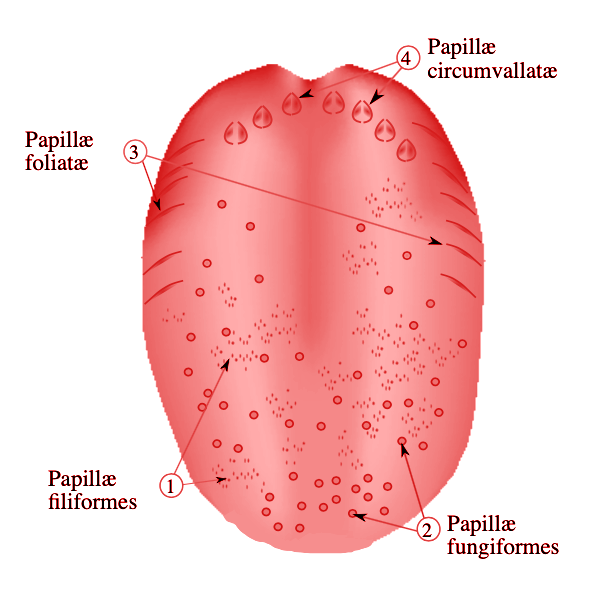
Filiform papillae: Filiform papillae form a rough, prickly texture that helps in chewing and speaking. These tiny bumps on the tongue surface provide grips and ripples.
- These conical- shaped papillae (resembles thread) are the most common papillae and aids in cleaning the mouth surface.
Foliate papillae: These leaf- shaped papillae are present at the posterolateral margins of the tongue surface and contain taste buds.
Circumvallate papillae: These papillae are unique due to its structure, location, and properties.
- These papillae are in V-shape, located at the back of the tongue and only 7 to 12 of these papillae will be present in an adult’s mouth.
- An average adult has 2,000 to 4,000 taste buds and these taste buds are not visible to naked eyes.
Note:
- There is a common misconception that different parts of the tongue are sensitive to different tastes such as sweet, sour, salty, and bitter. All these tastes are sensitive to all parts of the tongue and do not depend on any particular region of the tongue.
- The average length of a man’s tongues is 8.5 cm and the average length of a woman’s tongue is 7.9cm.
- Tongue is made up of 8 different muscles which provide flexibility and strength to the tongue.
Complete Step by Step Answer:
- The tiny bumps on the surface of the tongue are papillae. The four major types of papillae are fungiform papillae (mushroom-like), filiform papillae (filum - thread- like), foliate papillae, and circumvallate papillae.
- Except filiform papillae, all the other papillae contain taste buds.
Fungiform papillae: Fungiform papillae are wide flat structures that contain taste buds and sensory cells in the middle portion of the dorsum of the tongue.
- These papillae have a similar shape to mushrooms due to which they are called the fungiform (fungus – mushroom) papillae.
Filiform papillae: Filiform papillae form a rough, prickly texture that helps in chewing and speaking. These tiny bumps on the tongue surface provide grips and ripples.
- These conical- shaped papillae (resembles thread) are the most common papillae and aids in cleaning the mouth surface.
Foliate papillae: These leaf- shaped papillae are present at the posterolateral margins of the tongue surface and contain taste buds.
Circumvallate papillae: These papillae are unique due to its structure, location, and properties.
- These papillae are in V-shape, located at the back of the tongue and only 7 to 12 of these papillae will be present in an adult’s mouth.
- An average adult has 2,000 to 4,000 taste buds and these taste buds are not visible to naked eyes.
Note:
- There is a common misconception that different parts of the tongue are sensitive to different tastes such as sweet, sour, salty, and bitter. All these tastes are sensitive to all parts of the tongue and do not depend on any particular region of the tongue.
- The average length of a man’s tongues is 8.5 cm and the average length of a woman’s tongue is 7.9cm.
- Tongue is made up of 8 different muscles which provide flexibility and strength to the tongue.
Recently Updated Pages
Master Class 12 Economics: Engaging Questions & Answers for Success

Master Class 12 English: Engaging Questions & Answers for Success
Master Class 12 Social Science: Engaging Questions & Answers for Success
Master Class 12 Maths: Engaging Questions & Answers for Success
Master Class 12 Physics: Engaging Questions & Answers for Success
Master Class 11 Social Science: Engaging Questions & Answers for Success
Trending doubts
One Metric ton is equal to kg A 10000 B 1000 C 100 class 11 physics CBSE
Difference Between Prokaryotic Cells and Eukaryotic Cells
Find the value of the expression given below sin 30circ class 11 maths CBSE
Two of the body parts which do not appear in MRI are class 11 biology CBSE
1 ton equals to A 100 kg B 1000 kg C 10 kg D 10000 class 11 physics CBSE
Draw a diagram of nephron and explain its structur class 11 biology CBSE