




What is the spinal cord? How is it protected?
Answer
 Verified
624k+ views
Hint: The spinal cord forms the part of the spine. Since the cord itself is made up of very delicate tissue, it has to be protected by the skeleton and ligaments in the body. The spinal cord needs to be protected as it is an extension of the brain and has nerves that reach out to all the parts of the body.
Complete answer:
- The spinal cord is the distinguishing feature of chordates. It is a long, thin, and tubular structure composed of nervous tissue. The spinal cord in humans is found to be extended from the medulla oblongata of the brainstem to the lumbar region of the vertebral column.
- The brain and spinal cord form the central nervous system (CNS) in human beings.
- The spinal cord is protected by meninges, bones, discs, ligaments, and muscles. The cord passes through the cavities of the bones of the spinal column or vertebra.
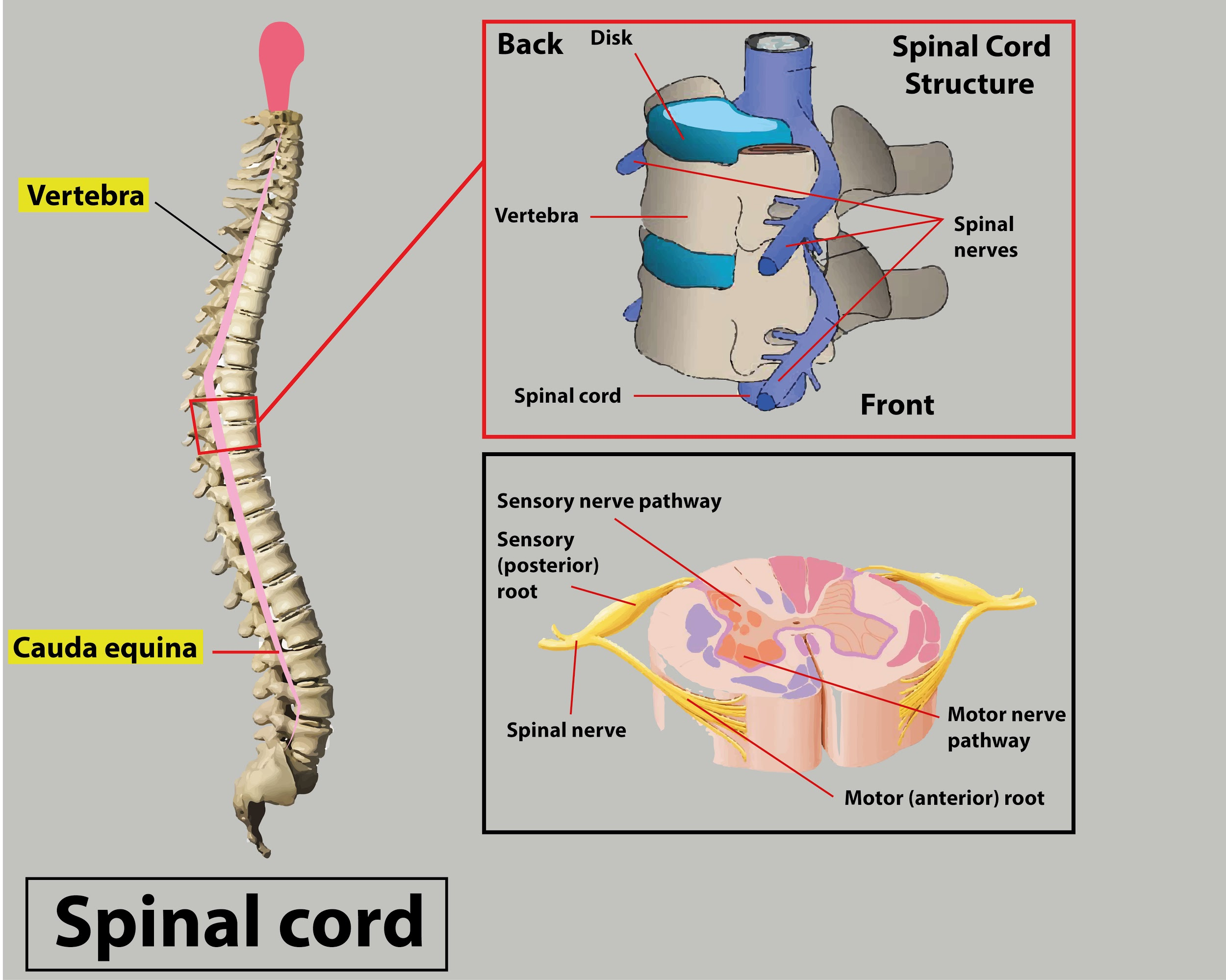
- The spinal cord is protected in three ways: 1. Bone: The vertebral column protects the cord. 2. Meninges: The cord is covered by three thin layers called meninges. The dura mater is the outermost layer, the arachnoid mater is the middle layer that has a spider web-like appearance, and the pia mater is the innermost layer. 3. The cerebrospinal fluid (CSF) is a fluid that circulates between the brain and spinal cord. CSF is also present in the space between the arachnoid matter and the pia mater, the subarachnoid space.
Additional Information:
- The spinal column is made of 33 vertebrae or the bones.
- The space between the outermost dura mater and the vertebral columns is known as the epidural space. It is filled with adipose tissue and has a network of blood vessels.
- The spinal nerves that develop from the cord form a component of the peripheral nervous system (PNS).
Note:
- The spinal cord is formed from part of the neural tube during embryonic development.
- The cerebrospinal fluid from the body can be sampled for diagnosis by the process known as lumbar puncture or spinal tap.
Complete answer:
- The spinal cord is the distinguishing feature of chordates. It is a long, thin, and tubular structure composed of nervous tissue. The spinal cord in humans is found to be extended from the medulla oblongata of the brainstem to the lumbar region of the vertebral column.
- The brain and spinal cord form the central nervous system (CNS) in human beings.
- The spinal cord is protected by meninges, bones, discs, ligaments, and muscles. The cord passes through the cavities of the bones of the spinal column or vertebra.
- The spinal cord is protected in three ways: 1. Bone: The vertebral column protects the cord. 2. Meninges: The cord is covered by three thin layers called meninges. The dura mater is the outermost layer, the arachnoid mater is the middle layer that has a spider web-like appearance, and the pia mater is the innermost layer. 3. The cerebrospinal fluid (CSF) is a fluid that circulates between the brain and spinal cord. CSF is also present in the space between the arachnoid matter and the pia mater, the subarachnoid space.
Additional Information:
- The spinal column is made of 33 vertebrae or the bones.
- The space between the outermost dura mater and the vertebral columns is known as the epidural space. It is filled with adipose tissue and has a network of blood vessels.
- The spinal nerves that develop from the cord form a component of the peripheral nervous system (PNS).
Note:
- The spinal cord is formed from part of the neural tube during embryonic development.
- The cerebrospinal fluid from the body can be sampled for diagnosis by the process known as lumbar puncture or spinal tap.
Recently Updated Pages
Basicity of sulphurous acid and sulphuric acid are

Master Class 11 English: Engaging Questions & Answers for Success
Master Class 11 Physics: Engaging Questions & Answers for Success
Master Class 11 Computer Science: Engaging Questions & Answers for Success
Master Class 11 Chemistry: Engaging Questions & Answers for Success
Master Class 11 Social Science: Engaging Questions & Answers for Success
Trending doubts
Difference Between Prokaryotic Cells and Eukaryotic Cells
Two of the body parts which do not appear in MRI are class 11 biology CBSE
One Metric ton is equal to kg A 10000 B 1000 C 100 class 11 physics CBSE
10 examples of friction in our daily life
Draw a diagram of nephron and explain its structur class 11 biology CBSE
What will happen if the mucus is not secreted by the class 11 biology CBSE