




Spherical wave fronts, emanating from a point source, strike a plane reflecting surface. What will happen to these wave fronts, immediately after reflection?
Answer
 Verified
540.6k+ views
Hint: The locus of all points of the medium that vibrate in the same phase is known as a wave front. Wave fronts may be one of three styles, depending on the shape of the light source. A wave front is a line or surface in the direction of wave motion that has the same phase of disturbances at all points. If a wave front diverges, the energy conveyed by the wave spreads over a bigger and bigger region, and thus, the intensity decreases. The force of a plane wave is steady since plane wave fronts neither converge or diverge.
Complete answer:
Depending on the source of light, wave fronts may be one of three types: cylindrical wave front, spherical wave front, and plane wavefront are the three types of wave fronts.
Spherical Wave Front: When a point source emits waves in three dimensions in an isotropic medium, the wave fronts are spheres centred on the source. A spherical wave front is one such wave front.
Cylindrical wave front: When the source of light is linear, all the points equidistant from the linear source lie on the surface of a cylinder. This type of wave front is called a cylindrical wave front.
Plane wave front: The wave front obtained when a fraction of a spherical or cylindrical wave front originates from a distant source such as infinity is known as a plane wave front.
Spherical Wave Front diagram:
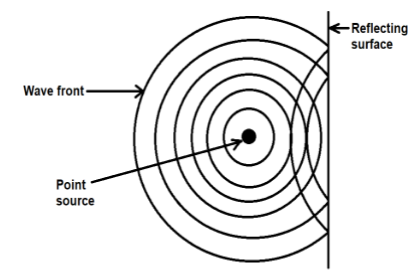
When light is emerging from a point source, the wave fronts are observed to be spherical in shape. In spherical wave front, amplitude of light waves, \[A \propto \dfrac{1}{{{r_1}}}\]. And Intensity of light waves, $I \propto \dfrac{1}{{{r_1}^2}}$. The wave front will remain spherical after reflection from the surface but their direction of propagation will be revered.
Note: The term "wave regular" refers to a perpendicular drawn to the surface of a wave front at any point in the direction of light propagation. A ray of light is the direction in which light travels. As a result, a wave normal is the same as a light beam. The appearance of wave fronts can be altered with the use of a lens.
Complete answer:
Depending on the source of light, wave fronts may be one of three types: cylindrical wave front, spherical wave front, and plane wavefront are the three types of wave fronts.
Spherical Wave Front: When a point source emits waves in three dimensions in an isotropic medium, the wave fronts are spheres centred on the source. A spherical wave front is one such wave front.
Cylindrical wave front: When the source of light is linear, all the points equidistant from the linear source lie on the surface of a cylinder. This type of wave front is called a cylindrical wave front.
Plane wave front: The wave front obtained when a fraction of a spherical or cylindrical wave front originates from a distant source such as infinity is known as a plane wave front.
Spherical Wave Front diagram:
When light is emerging from a point source, the wave fronts are observed to be spherical in shape. In spherical wave front, amplitude of light waves, \[A \propto \dfrac{1}{{{r_1}}}\]. And Intensity of light waves, $I \propto \dfrac{1}{{{r_1}^2}}$. The wave front will remain spherical after reflection from the surface but their direction of propagation will be revered.
Note: The term "wave regular" refers to a perpendicular drawn to the surface of a wave front at any point in the direction of light propagation. A ray of light is the direction in which light travels. As a result, a wave normal is the same as a light beam. The appearance of wave fronts can be altered with the use of a lens.
Recently Updated Pages
Master Class 11 English: Engaging Questions & Answers for Success

Master Class 11 Social Science: Engaging Questions & Answers for Success
Master Class 11 Maths: Engaging Questions & Answers for Success
Master Class 11 Chemistry: Engaging Questions & Answers for Success
Master Class 11 Biology: Engaging Questions & Answers for Success
Master Class 11 Physics: Engaging Questions & Answers for Success
Trending doubts
One Metric ton is equal to kg A 10000 B 1000 C 100 class 11 physics CBSE
Difference Between Prokaryotic Cells and Eukaryotic Cells
Find the value of the expression given below sin 30circ class 11 maths CBSE
1 ton equals to A 100 kg B 1000 kg C 10 kg D 10000 class 11 physics CBSE
Two of the body parts which do not appear in MRI are class 11 biology CBSE
Draw a diagram of nephron and explain its structur class 11 biology CBSE