




Spermatids are formed after the second meiotic division from secondary spermatocytes. The ploidy of the secondary spermatocytes is
(a) n
(b) 2n
(c) 3n
(d) 4n
Answer
 Verified
643.8k+ views
Hint: Meiosis (meiosis-I) is a reduction division that reduces the number of chromosomes into half and converts diploid cells into haploid. meiosis-II is the same as mitosis. Secondary spermatocytes that are haploid undergo meiosis-II.
Complete answer:
Each spermatogonial cell of humans is diploid and contains 46 chromosomes. Diploid spermatogonial cells develop into primary spermatogonial cells that undergo meiosis-I leading to the formation of haploid secondary spermatocytes. They undergo meiosis-II and produce spermatids that are haploid.
Additional Information:
- The process of formation of male germ cells called spermatids is called spermatogenesis.
- Spermatogenesis begins at puberty due to an increase in the secretion of gonadotropin-releasing hormone(GnRH).
- The spermatogonial cells present in the seminiferous tubules multiply by mitotic divisions and increase in number.
- 23 pairs of chromosomes are present in the spermatogonial stem cell.
- Spermatogonial stem cells develop into primary spermatocytes.
- Primary spermatocytes undergo meiosis-I leading to the formation of secondary spermatocytes. In meiosis-I, the chromosome number will be reduced to half of the preceding cell. Here primary spermatocytes are diploid cells with 46 chromosomes, after meiosis-I, they turned into haploid cells with 23 chromosomes.
- The haploid secondary spermatogonial undergoes meiosis-II to produce four equal-sized haploid spermatids.
- By the process of spermiogenesis these spermatids get converted into sperms.
- Release of sperms from the seminiferous tubules whose heads are embedded in the Sertoli cells is released out by the process called spermiation.
So, the correct answer is ‘n’
Note: -The increased levels of GnRH act on the pituitary gland which stimulates the release of two hormones namely luteinizing hormone (LH) and follicle-stimulating (FSH) hormone.
-LH acts on the interstitial cells of Leydig and stimulates the secretion of androgens which in turn stimulates the process of spermatogenesis. FSH acts on Sertoli cells that release some factors that help in spermatogenesis.
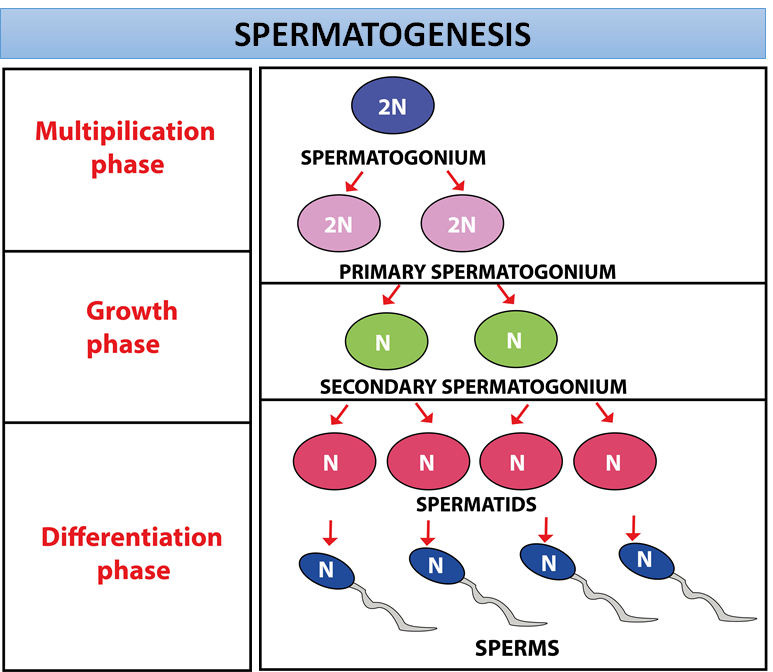
Complete answer:
Each spermatogonial cell of humans is diploid and contains 46 chromosomes. Diploid spermatogonial cells develop into primary spermatogonial cells that undergo meiosis-I leading to the formation of haploid secondary spermatocytes. They undergo meiosis-II and produce spermatids that are haploid.
Additional Information:
- The process of formation of male germ cells called spermatids is called spermatogenesis.
- Spermatogenesis begins at puberty due to an increase in the secretion of gonadotropin-releasing hormone(GnRH).
- The spermatogonial cells present in the seminiferous tubules multiply by mitotic divisions and increase in number.
- 23 pairs of chromosomes are present in the spermatogonial stem cell.
- Spermatogonial stem cells develop into primary spermatocytes.
- Primary spermatocytes undergo meiosis-I leading to the formation of secondary spermatocytes. In meiosis-I, the chromosome number will be reduced to half of the preceding cell. Here primary spermatocytes are diploid cells with 46 chromosomes, after meiosis-I, they turned into haploid cells with 23 chromosomes.
- The haploid secondary spermatogonial undergoes meiosis-II to produce four equal-sized haploid spermatids.
- By the process of spermiogenesis these spermatids get converted into sperms.
- Release of sperms from the seminiferous tubules whose heads are embedded in the Sertoli cells is released out by the process called spermiation.
So, the correct answer is ‘n’
Note: -The increased levels of GnRH act on the pituitary gland which stimulates the release of two hormones namely luteinizing hormone (LH) and follicle-stimulating (FSH) hormone.
-LH acts on the interstitial cells of Leydig and stimulates the secretion of androgens which in turn stimulates the process of spermatogenesis. FSH acts on Sertoli cells that release some factors that help in spermatogenesis.
Recently Updated Pages
Which of the following graphs shows the variation of class 12 physics CBSE

Draw a labelled diagram of the human male reproductive class 12 biology CBSE
Describe the experiment to compare the emf of two cells class 12 physics CBSE
What is standard hydrogen electrode
What is conventional current and electric current class 12 physics CBSE
2Bromopentane is treated with an alcoholic KOH solution class 12 chemistry CBSE
Trending doubts
Draw a labelled sketch of the human eye class 12 physics CBSE
Which are the Top 10 Largest Countries of the World?
Differentiate between homogeneous and heterogeneous class 12 chemistry CBSE
Draw ray diagrams each showing i myopic eye and ii class 12 physics CBSE
Which is the correct genotypic ratio of mendel dihybrid class 12 biology CBSE
What is the Full Form of PVC, PET, HDPE, LDPE, PP and PS ?