




How do you solve ${x^2} + 4x + 4 \geqslant 9$ using a sign chart?
Answer
 Verified
606.6k+ views
Hint: We will first bring all the terms to the left hand side and then factorize the quadratic equation thus obtained. After that, we will just find the values where it takes positive values.
Complete step-by-step solution:
We are given that we are required to solve ${x^2} + 4x + 4 \geqslant 9$ using a sign chart.
We have the expression given by the equation: ${x^2} + 4x + 4 \geqslant 9$
Taking 9 from addition in the right hand side to subtraction in the left hand side, we will then obtain the following equation with us:-
$ \Rightarrow {x^2} + 4x + 4 - 9 \geqslant 0$
Simplifying the terms on the left hand side of the above expression, we will then obtain the following equation with us:-
$ \Rightarrow {x^2} + 4x - 5 \geqslant 0$
Now, we can also write this as:-
$ \Rightarrow {x^2} - x + 5x - 5 \geqslant 0$
Taking x common from the first two terms in the left hand side of the above expression, we will then obtain the following equation with us:-
$ \Rightarrow x(x - 1) + 5x - 5 \geqslant 0$
Taking 5 common from the last two terms in the left hand side of the above expression, we will then obtain the following equation with us:-
$ \Rightarrow x(x - 1) + 5(x - 1) \geqslant 0$
Now, since (x – 1) is common in both of the terms, we can take it common and will obtain the following expression with us:-
$ \Rightarrow (x - 1)(x + 5) \geqslant 0$
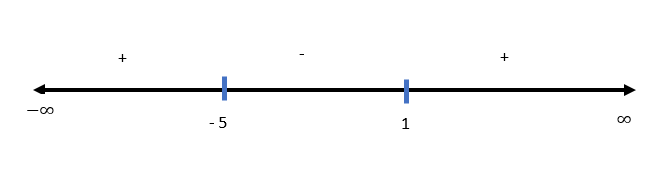
Now, we see that the points where the expression takes the value 0 will be 1 and – 5.
Now, we see that sign chart as follows:-
Now, we need to see what value the function takes.
Case 1: We have the first interval as $\left( { - \infty , - 5} \right)$.
Let us for instance put x = - 6 and see that the function turns out to be:-
$ \Rightarrow (x - 1)(x + 5) = ( - 6 - 1)( - 6 + 5)$
$ \Rightarrow (x - 1)(x + 5) = 7$ which is greater than zero.
Therefore, this interval is in the answer.
Case 2: We have the first interval as $\left( { - 5,1} \right)$.
Let us for instance put x = 0 and see that the function turns out to be:-
$ \Rightarrow (x - 1)(x + 5) = (0 - 1)(0 + 5)$
$ \Rightarrow (x - 1)(x + 5) = - 5$ which is less than zero.
Therefore, this interval cannot be in the answer.
Case 3: We have the first interval as $\left( {1,\infty } \right)$.
Let us for instance put x = 2 and see that the function turns out to be:-
$ \Rightarrow (x - 1)(x + 5) = (2 - 1)(2 + 5)$
$ \Rightarrow (x - 1)(x + 5) = 7$ which is greater than zero.
Therefore, this interval is in the answer.
Hence, the required answer is $x \in \left( { - \infty , - 5} \right) \cup \left( {1,\infty } \right)$.
Note: The students must note that while pursuing the sign chart, we have used a hidden theorem which states that: If $a.b \geqslant 0$, then there are two possible cases given as follows:-
$a \geqslant 0$ and $b \geqslant 0$
$a \leqslant 0$ and $b \leqslant 0$
We eventually got the following sign chart as the answer:-
Complete step-by-step solution:
We are given that we are required to solve ${x^2} + 4x + 4 \geqslant 9$ using a sign chart.
We have the expression given by the equation: ${x^2} + 4x + 4 \geqslant 9$
Taking 9 from addition in the right hand side to subtraction in the left hand side, we will then obtain the following equation with us:-
$ \Rightarrow {x^2} + 4x + 4 - 9 \geqslant 0$
Simplifying the terms on the left hand side of the above expression, we will then obtain the following equation with us:-
$ \Rightarrow {x^2} + 4x - 5 \geqslant 0$
Now, we can also write this as:-
$ \Rightarrow {x^2} - x + 5x - 5 \geqslant 0$
Taking x common from the first two terms in the left hand side of the above expression, we will then obtain the following equation with us:-
$ \Rightarrow x(x - 1) + 5x - 5 \geqslant 0$
Taking 5 common from the last two terms in the left hand side of the above expression, we will then obtain the following equation with us:-
$ \Rightarrow x(x - 1) + 5(x - 1) \geqslant 0$
Now, since (x – 1) is common in both of the terms, we can take it common and will obtain the following expression with us:-
$ \Rightarrow (x - 1)(x + 5) \geqslant 0$
Now, we see that the points where the expression takes the value 0 will be 1 and – 5.
Now, we see that sign chart as follows:-
Now, we need to see what value the function takes.
Case 1: We have the first interval as $\left( { - \infty , - 5} \right)$.
Let us for instance put x = - 6 and see that the function turns out to be:-
$ \Rightarrow (x - 1)(x + 5) = ( - 6 - 1)( - 6 + 5)$
$ \Rightarrow (x - 1)(x + 5) = 7$ which is greater than zero.
Therefore, this interval is in the answer.
Case 2: We have the first interval as $\left( { - 5,1} \right)$.
Let us for instance put x = 0 and see that the function turns out to be:-
$ \Rightarrow (x - 1)(x + 5) = (0 - 1)(0 + 5)$
$ \Rightarrow (x - 1)(x + 5) = - 5$ which is less than zero.
Therefore, this interval cannot be in the answer.
Case 3: We have the first interval as $\left( {1,\infty } \right)$.
Let us for instance put x = 2 and see that the function turns out to be:-
$ \Rightarrow (x - 1)(x + 5) = (2 - 1)(2 + 5)$
$ \Rightarrow (x - 1)(x + 5) = 7$ which is greater than zero.
Therefore, this interval is in the answer.
Hence, the required answer is $x \in \left( { - \infty , - 5} \right) \cup \left( {1,\infty } \right)$.
Note: The students must note that while pursuing the sign chart, we have used a hidden theorem which states that: If $a.b \geqslant 0$, then there are two possible cases given as follows:-
$a \geqslant 0$ and $b \geqslant 0$
$a \leqslant 0$ and $b \leqslant 0$
We eventually got the following sign chart as the answer:-
Recently Updated Pages
Basicity of sulphurous acid and sulphuric acid are

Master Class 12 Economics: Engaging Questions & Answers for Success
Master Class 12 Biology: Engaging Questions & Answers for Success
Master Class 11 English: Engaging Questions & Answers for Success
Master Class 11 Physics: Engaging Questions & Answers for Success
Master Class 11 Computer Science: Engaging Questions & Answers for Success
Trending doubts
What is the Total Duration of Football Match?
Explain the Treaty of Vienna of 1815 class 10 social science CBSE
In football, which nation is called "La Roja"?
Why is there a time difference of about 5 hours between class 10 social science CBSE
10 examples of evaporation in daily life with explanations
What is the full form of POSCO class 10 social science CBSE