




How do you solve the triangle given $A={{110}^{\circ }}$ , $a=125$ , $b=100$ ?
Answer
 Verified
581.7k+ views
Hint: Problems on determining the triangle can be solved either by using the Law of cosines or by using the Law of Sines. As, we are given two sides of the triangle along with the angle opposite of the side $a$ we use the Law of Sines. Using the Law of Sines, we first consider the two terms only related to $a\text{ and }b$ . From there we get the value of the angle $B$which in turn gives the value of angle $C$ . Further, using the sine law we obtain the side $c$ .
Complete step by step solution:
We are given that $A={{110}^{\circ }}$ , $a=125$ , $b=100$
For this case we must use the Law of sines as we are given two sides of the triangle along with the angle opposite of the side $a$ .
According to the Law of sines
$\dfrac{\sin A}{a}=\dfrac{\sin B}{b}=\dfrac{\sin C}{c}$
Foe now we only consider the part $\dfrac{\sin A}{a}=\dfrac{\sin B}{b}$
Substituting the values in the above equation we get
$\Rightarrow \dfrac{\sin {{110}^{\circ }}}{125}=\dfrac{\sin B}{100}$
Further simplifying we get
$\Rightarrow \sin B=\dfrac{\sin {{110}^{\circ }}}{125}\times 100$
$\Rightarrow \sin B=0.7518$
Taking sin inverse on both the sides of the above equation we get
$\Rightarrow B={{\sin }^{-1}}\left( 0.7518 \right)$
$\Rightarrow B={{48.74}^{\circ }}$
Now, we have values of two angles and we know that the summation of all the internal angle of a triangle is ${{180}^{\circ }}$
Hence, we subtract the summation of the two angles from $180$ which gives us the value of the other angle $C$ as
$\Rightarrow C=180-\left( B+A \right)$
Substituting the values in the above formula, we get
$\Rightarrow C=180-\left( 48.74+110 \right)$
$\Rightarrow C={{21.26}^{\circ }}$
Now, we again consider the law of sines as
$\Rightarrow \dfrac{\sin A}{a}=\dfrac{\sin C}{c}$
Substituting the values in the above equation, we get
$\Rightarrow \dfrac{\sin {{110}^{\circ }}}{125}=\dfrac{\sin {{21.26}^{\circ }}}{c}$
Simplifying the above equation, we get
\[\Rightarrow c=\sin {{21.26}^{\circ }}\times \dfrac{125}{sin{{110}^{\circ }}}\]
\[\Rightarrow c=0.362\times \dfrac{125}{0.939}\]
\[\Rightarrow c=48.189\]
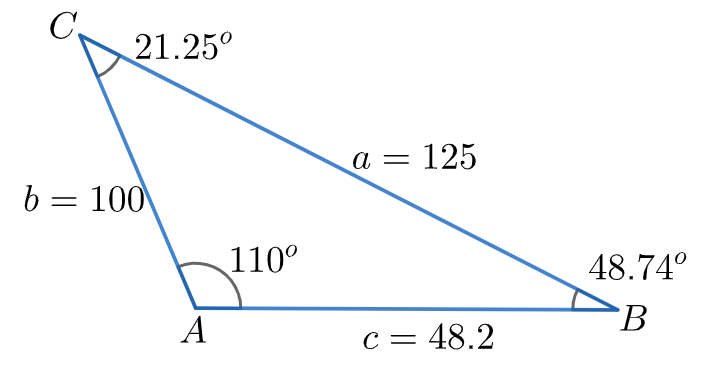
Therefore, in the triangle \[A={{110}^{\circ }},B={{48.74}^{\circ }},C={{21.25}^{\circ }}\] , and \[a=125,b=100,c=48.2\].
Note: While doing a problem we must decide properly where to use the Laws of cosines and where to use the Laws of sines so that no mistakes remain in the solution. Also, for doing the calculations we must carefully calculate the values of sines so that we reach an accurate solution.
Complete step by step solution:
We are given that $A={{110}^{\circ }}$ , $a=125$ , $b=100$
For this case we must use the Law of sines as we are given two sides of the triangle along with the angle opposite of the side $a$ .
According to the Law of sines
$\dfrac{\sin A}{a}=\dfrac{\sin B}{b}=\dfrac{\sin C}{c}$
Foe now we only consider the part $\dfrac{\sin A}{a}=\dfrac{\sin B}{b}$
Substituting the values in the above equation we get
$\Rightarrow \dfrac{\sin {{110}^{\circ }}}{125}=\dfrac{\sin B}{100}$
Further simplifying we get
$\Rightarrow \sin B=\dfrac{\sin {{110}^{\circ }}}{125}\times 100$
$\Rightarrow \sin B=0.7518$
Taking sin inverse on both the sides of the above equation we get
$\Rightarrow B={{\sin }^{-1}}\left( 0.7518 \right)$
$\Rightarrow B={{48.74}^{\circ }}$
Now, we have values of two angles and we know that the summation of all the internal angle of a triangle is ${{180}^{\circ }}$
Hence, we subtract the summation of the two angles from $180$ which gives us the value of the other angle $C$ as
$\Rightarrow C=180-\left( B+A \right)$
Substituting the values in the above formula, we get
$\Rightarrow C=180-\left( 48.74+110 \right)$
$\Rightarrow C={{21.26}^{\circ }}$
Now, we again consider the law of sines as
$\Rightarrow \dfrac{\sin A}{a}=\dfrac{\sin C}{c}$
Substituting the values in the above equation, we get
$\Rightarrow \dfrac{\sin {{110}^{\circ }}}{125}=\dfrac{\sin {{21.26}^{\circ }}}{c}$
Simplifying the above equation, we get
\[\Rightarrow c=\sin {{21.26}^{\circ }}\times \dfrac{125}{sin{{110}^{\circ }}}\]
\[\Rightarrow c=0.362\times \dfrac{125}{0.939}\]
\[\Rightarrow c=48.189\]
Therefore, in the triangle \[A={{110}^{\circ }},B={{48.74}^{\circ }},C={{21.25}^{\circ }}\] , and \[a=125,b=100,c=48.2\].
Note: While doing a problem we must decide properly where to use the Laws of cosines and where to use the Laws of sines so that no mistakes remain in the solution. Also, for doing the calculations we must carefully calculate the values of sines so that we reach an accurate solution.
Recently Updated Pages
Master Class 10 English: Engaging Questions & Answers for Success

Master Class 10 Social Science: Engaging Questions & Answers for Success
Master Class 10 Computer Science: Engaging Questions & Answers for Success
Class 10 Question and Answer - Your Ultimate Solutions Guide
Master Class 10 General Knowledge: Engaging Questions & Answers for Success
Master Class 10 Maths: Engaging Questions & Answers for Success
Trending doubts
Explain the Treaty of Vienna of 1815 class 10 social science CBSE
Who Won 36 Oscar Awards? Record Holder Revealed
What is the median of the first 10 natural numbers class 10 maths CBSE
Why is it 530 pm in india when it is 1200 afternoon class 10 social science CBSE
Make a sketch of the human nerve cell What function class 10 biology CBSE
Define Potential, Developed, Stock and Reserved resources