




Solve the system of inequalities graphically: $2x+y\ge 4$, $x+y\le 3$, $2x-3y\le 6$.
Answer
 Verified
590.7k+ views
Hint: For finding out the region that satisfies the inequalities $2x+y\ge 4$, $x+y\le 3$, $2x-3y\le 6$, we need to find the equality form. This gives the line graph. Change of form of the given equation will give the x-intercept and y-intercept of the lines. We change it to the form of $\dfrac{x}{p}+\dfrac{y}{q}=1$ to find the x intercept, and y intercept of the line as $p$ and $q$ respectively. Then we place the points on the axes and from there we draw the line on the graph. We find the required region based on the origin point’s validity.
Complete step by step solution:
We have to find the x-intercept, and y-intercept of the line $2x+y=4$, $x+y=3$, $2x-3y=6$.
For this we convert the given equation into the form of $\dfrac{x}{p}+\dfrac{y}{q}=1$. From the form we get that the x intercept, and y intercept of the line will be$p$ and $q$ respectively. The points will be $\left( p,0 \right),\left( 0,q \right)$.
The given equation is $2x+y=4$. Converting into the form of $\dfrac{x}{p}+\dfrac{y}{q}=1$, we get
\[\begin{align}
& 2x+y=4 \\
& \Rightarrow \dfrac{2x}{4}+\dfrac{y}{4}=1 \\
& \Rightarrow \dfrac{x}{2}+\dfrac{y}{4}=1 \\
\end{align}\]
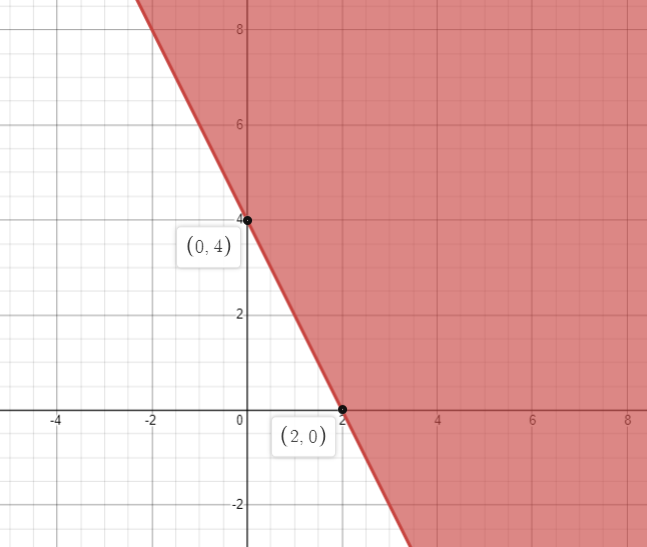
Therefore, the x intercept, and y intercept of the line $2x+y=4$ is 2 and 4 respectively. The axes intersecting points are $\left( 2,0 \right),\left( 0,4 \right)$.
The graph of the inequality $2x+y \ge 4$ is shown below.
The given equation is $x+y=3$. Converting into the form of $\dfrac{x}{p}+\dfrac{y}{q}=1$, we get
\[\begin{align}
& x+y=3 \\
& \Rightarrow \dfrac{x}{3}+\dfrac{y}{3}=1 \\
\end{align}\]
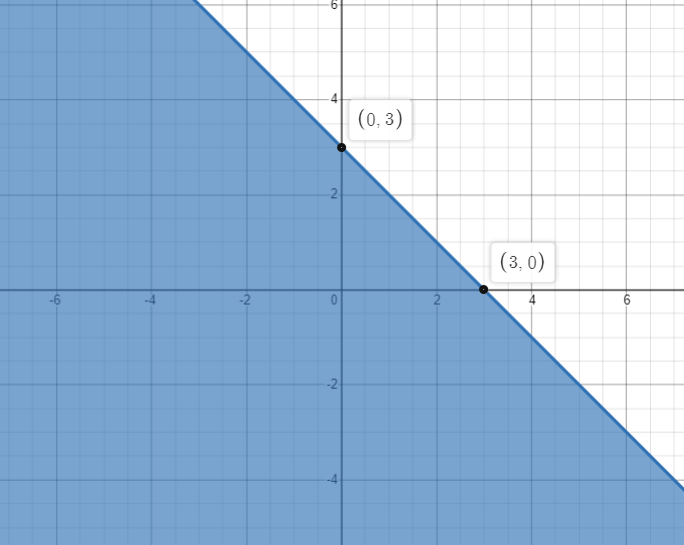
Therefore, the x intercept, and y intercept of the line $x+y=3$ is 3 and 3 respectively. The axes intersecting points are $\left( 3,0 \right),\left( 0,3 \right)$.
The graph of $x+y \le 3$ is shown below.
The given equation is $2x-3y=6$. Converting into the form of $\dfrac{x}{p}+\dfrac{y}{q}=1$, we get
\[\begin{align}
& 2x-3y=6 \\
& \Rightarrow \dfrac{2x}{6}+\dfrac{\left( -3 \right)y}{6}=1 \\
& \Rightarrow \dfrac{x}{3}+\dfrac{y}{-2}=1 \\
\end{align}\]
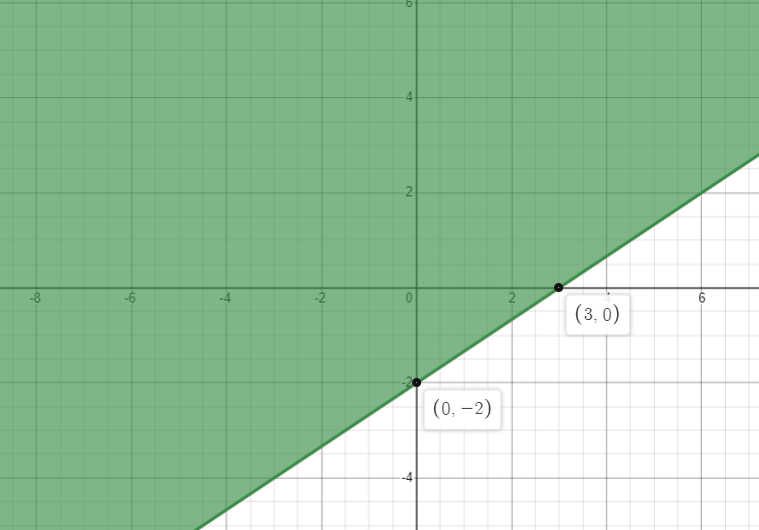
Therefore, the x intercept, and y intercept of the line $2x-3y=6$ is 3 and 2 respectively. The axes intersecting points are $\left( 3,0 \right),\left( 0,-2 \right)$.
The graph of the inequality $2x-3y \le 6$ is shown below
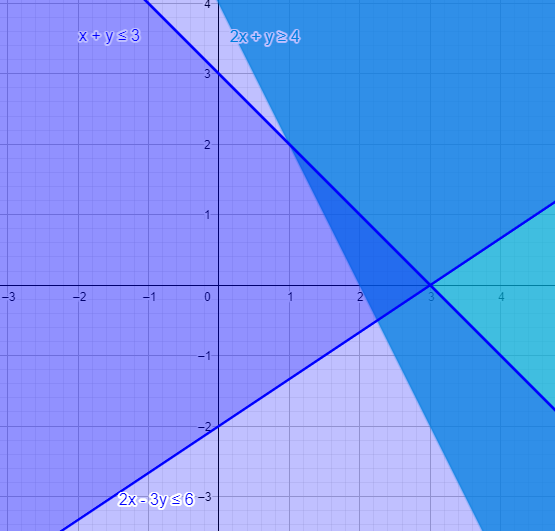
The lines divide the region in two parts. We find the required one based on the credibility of the origin point.
Note:
We take the origin point as that helps in multiplications. We can use any point other than the ones that are on the line itself to find out the required region.
For example, we take the point $\left( -1,-1 \right)$ instead of $\left( 0,0 \right)$.
This means we can take any arbitrary point and that will indicate the area accordingly.
Complete step by step solution:
We have to find the x-intercept, and y-intercept of the line $2x+y=4$, $x+y=3$, $2x-3y=6$.
For this we convert the given equation into the form of $\dfrac{x}{p}+\dfrac{y}{q}=1$. From the form we get that the x intercept, and y intercept of the line will be$p$ and $q$ respectively. The points will be $\left( p,0 \right),\left( 0,q \right)$.
The given equation is $2x+y=4$. Converting into the form of $\dfrac{x}{p}+\dfrac{y}{q}=1$, we get
\[\begin{align}
& 2x+y=4 \\
& \Rightarrow \dfrac{2x}{4}+\dfrac{y}{4}=1 \\
& \Rightarrow \dfrac{x}{2}+\dfrac{y}{4}=1 \\
\end{align}\]
Therefore, the x intercept, and y intercept of the line $2x+y=4$ is 2 and 4 respectively. The axes intersecting points are $\left( 2,0 \right),\left( 0,4 \right)$.
The graph of the inequality $2x+y \ge 4$ is shown below.
The given equation is $x+y=3$. Converting into the form of $\dfrac{x}{p}+\dfrac{y}{q}=1$, we get
\[\begin{align}
& x+y=3 \\
& \Rightarrow \dfrac{x}{3}+\dfrac{y}{3}=1 \\
\end{align}\]
Therefore, the x intercept, and y intercept of the line $x+y=3$ is 3 and 3 respectively. The axes intersecting points are $\left( 3,0 \right),\left( 0,3 \right)$.
The graph of $x+y \le 3$ is shown below.
The given equation is $2x-3y=6$. Converting into the form of $\dfrac{x}{p}+\dfrac{y}{q}=1$, we get
\[\begin{align}
& 2x-3y=6 \\
& \Rightarrow \dfrac{2x}{6}+\dfrac{\left( -3 \right)y}{6}=1 \\
& \Rightarrow \dfrac{x}{3}+\dfrac{y}{-2}=1 \\
\end{align}\]
Therefore, the x intercept, and y intercept of the line $2x-3y=6$ is 3 and 2 respectively. The axes intersecting points are $\left( 3,0 \right),\left( 0,-2 \right)$.
The graph of the inequality $2x-3y \le 6$ is shown below
The lines divide the region in two parts. We find the required one based on the credibility of the origin point.
Note:
We take the origin point as that helps in multiplications. We can use any point other than the ones that are on the line itself to find out the required region.
For example, we take the point $\left( -1,-1 \right)$ instead of $\left( 0,0 \right)$.
This means we can take any arbitrary point and that will indicate the area accordingly.

Recently Updated Pages
How are maps more helpful than globes class 6 social science CBSE

Who was not allowed to study the Vedas a Brahmin b class 6 social science CBSE
Where was Kalpana Chawla born Why is she called an class 6 english CBSE
Give two examples each of modes of transport used on class 6 physics CBSE
Why is the Earth called blue planet class 6 social science CBSE
Africa is a hot continent because A There are many class 6 social science CBSE
Trending doubts
Give 10 examples for herbs , shrubs , climbers , creepers
Check whether the given numbers are divisible by 11 class 6 maths CBSE
Which is the westernmost state of India A Maharashtra class 6 social science CBSE
What is the opposite gender of Gander class 6 english CBSE
What is the smallest onedigit number that is 0 or class 6 maths CBSE
The planet nearest to earth is A Mercury B Venus C class 6 social science CBSE