




Solve the riddle: I am a polygon. I have two right angles. I have only one pair of parallel sides. What am I?
Answer
 Verified
497.1k+ views
Hint: In the above problem, we are given a riddle of geometry in which there are three clues given. We have to determine a geometrical shape which is a polygon, which has exactly two right angles, and which also has only one pair of parallel sides. In order to approach the answer, we have to move step by step considering each clue.
Complete step-by-step answer:
We have to determine the geometrical shape using the three clues given in the riddle.
1) Given that, the geometrical shape is a polygon. Therefore it must have at least three closed sides or more than three sides. Examples - triangle, parallelogram, pentagon, etc.
2) Now in the second clue, it is given that the polygon has exactly two right angles. Therefore, it cannot be a triangle, and any parallelogram. But it can be another polygon having two right angles between any of their two adjacent sides. Example - A quadrilateral with diagonally opposite angles being right angles.
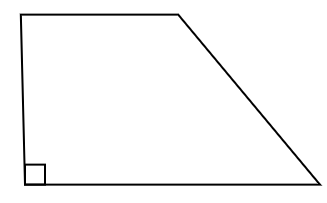
3) In the third and last clue, it is given that the polygon has only one pair of parallel sides. Since we know that a trapezoid has only one pair of parallel sides and is a polygon, therefore if we consider two adjacent angles of a trapezium being right angles then it will satisfy the three criterions.
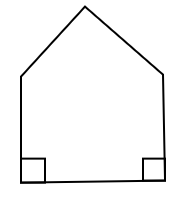
Therefore, the shape can be a trapezoid or a pentagon or any other bigger polygon with two adjacent sides being right angles.
However, there are infinitely many figures which can satisfy the three given criterions but a trapezoid is the smallest polygon which satisfies all the three conditions of the riddle.
These examples are shown below.
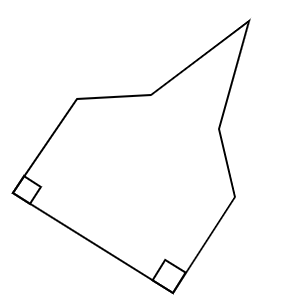
Similarly, many more polygons can be drawn.
Note: A trapezoid is also known as a trapezium which is a flat 2D shape, with four straight sides. It has one pair of parallel sides which are usually the top and bottom sides. The parallel sides are called the bases, while the non-parallel sides are called the legs.
Complete step-by-step answer:
We have to determine the geometrical shape using the three clues given in the riddle.
1) Given that, the geometrical shape is a polygon. Therefore it must have at least three closed sides or more than three sides. Examples - triangle, parallelogram, pentagon, etc.
2) Now in the second clue, it is given that the polygon has exactly two right angles. Therefore, it cannot be a triangle, and any parallelogram. But it can be another polygon having two right angles between any of their two adjacent sides. Example - A quadrilateral with diagonally opposite angles being right angles.
3) In the third and last clue, it is given that the polygon has only one pair of parallel sides. Since we know that a trapezoid has only one pair of parallel sides and is a polygon, therefore if we consider two adjacent angles of a trapezium being right angles then it will satisfy the three criterions.
Therefore, the shape can be a trapezoid or a pentagon or any other bigger polygon with two adjacent sides being right angles.
However, there are infinitely many figures which can satisfy the three given criterions but a trapezoid is the smallest polygon which satisfies all the three conditions of the riddle.
These examples are shown below.
Similarly, many more polygons can be drawn.
Note: A trapezoid is also known as a trapezium which is a flat 2D shape, with four straight sides. It has one pair of parallel sides which are usually the top and bottom sides. The parallel sides are called the bases, while the non-parallel sides are called the legs.
Recently Updated Pages
Master Class 10 Social Science: Engaging Questions & Answers for Success

Master Class 10 Science: Engaging Questions & Answers for Success
Master Class 10 Maths: Engaging Questions & Answers for Success
Master Class 10 General Knowledge: Engaging Questions & Answers for Success
Master Class 10 Computer Science: Engaging Questions & Answers for Success
Class 10 Question and Answer - Your Ultimate Solutions Guide
Trending doubts
What is the full form of PNG A Petrol Natural Gas B class 10 chemistry CBSE
Explain the Treaty of Vienna of 1815 class 10 social science CBSE
In cricket, how many legal balls are there in a standard over?
Why is there a time difference of about 5 hours between class 10 social science CBSE
Who Won 36 Oscar Awards? Record Holder Revealed
What is the median of the first 10 natural numbers class 10 maths CBSE