




How do you solve \[\log x+\log \left( x+9 \right)=1\]?
Answer
 Verified
561k+ views
Hint: Convert the R.H.S of the given expression into logarithmic form by using the conversion \[1={{\log }_{10}}10\]. Now, in the L.H.S use the sum to product rule of logarithm given as: - \[\log m+\log n=\log \left( mn \right)\], to simplify. In the next step, form a quadratic equation by removing the logarithmic function. Solve this quadratic equation using the middle term split method to find the equation using the middle term split method to find two values of x. Reject the value of x that is invalid by using the information that “argument of the logarithmic function must be greater than 0”.
Complete step by step answer:
Here, we have been provided with the equation: - \[\log x+\log \left( x+9 \right)=1\] and we are asked to simplify it, that means we have to find the value of x.
Now, since we have natural log on both the sides, i.e., log to the base 10, so we can write the given expression as: -
\[\Rightarrow \log x+\log \left( x+9 \right)={{\log }_{10}}10\]
Applying the sum to product conversion formula of log given as: -
\[\Rightarrow \log m+\log n=\log \left( mn \right)\], we get,
\[\begin{align}
& \Rightarrow \log \left( x\left( x+9 \right) \right)={{\log }_{10}}10 \\
& \Rightarrow \log \left( {{x}^{2}}+9x \right)={{\log }_{10}}10 \\
\end{align}\]
Now, comparing the arguments of log on both the sides by removing the logarithmic function, we get,
\[\begin{align}
& \Rightarrow {{x}^{2}}+9x=10 \\
& \Rightarrow {{x}^{2}}+9x-10=0 \\
\end{align}\]
Using the middle term split method to factorize the above quadratic equation, we get,
\[\begin{align}
& \Rightarrow {{x}^{2}}+10x-x-10=0 \\
& \Rightarrow x\left( x+10 \right)-1\left( x+10 \right)=0 \\
\end{align}\]
Taking \[\left( x+10 \right)\] common, we get,
\[\Rightarrow \left( x+10 \right)\left( x-1 \right)=0\]
Substituting each term equal to 0, one – by – one, we get,
\[\Rightarrow x+10=0\] or \[x-1=0\]
\[\Rightarrow x=-10\] and \[x=1\]
Here, we have obtained two values of x. Now, let us check if any of the two values is invalid or not.
We know that a logarithmic function is only defined when its argument is greater than 0 and base is greater than 0 but unequal to 1. In the above question we have log to the base 10 which is greater than 0 and also unequal to 1. So, the base is defined. Now, let us define the argument. In the L.H.S we have (x + 9) and x as the arguments. So, we must have,
(i) \[x>0\Rightarrow x\in \left( 0,\infty \right)\]
(ii) \[x+9>0\Rightarrow x>-9\Rightarrow x\in \left( -9,\infty \right)\]
Since, we need to satisfy both the conditions, therefore we must consider the intersection of the two sets of values of x obtained. So, we have,
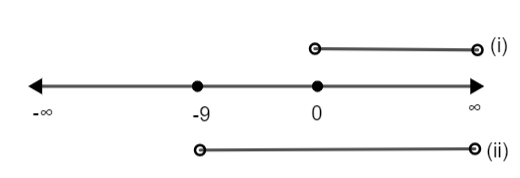
Therefore, \[x\in \left( 0,\infty \right)\] is the final condition.
Clearly, we can see that x = -10 does not satisfy the above condition, therefore x = -10 must be rejected.
Hence, x = 1 is our answer.
Note:
One may note that we cannot remove the logarithmic function directly from the initial expression: - \[\log x+\log \left( x+9 \right)={{\log }_{10}}10\] as it will be a wrong approach. First, we need to convert the two logarithmic terms in the L.H.S. into a single logarithmic term by using the sum to product rule and then only we can remove the function. Remember that we do not just have to calculate the value of x but we must check if it satisfies the domain or not. We must reject the invalid value as it makes the function undefined.
Complete step by step answer:
Here, we have been provided with the equation: - \[\log x+\log \left( x+9 \right)=1\] and we are asked to simplify it, that means we have to find the value of x.
Now, since we have natural log on both the sides, i.e., log to the base 10, so we can write the given expression as: -
\[\Rightarrow \log x+\log \left( x+9 \right)={{\log }_{10}}10\]
Applying the sum to product conversion formula of log given as: -
\[\Rightarrow \log m+\log n=\log \left( mn \right)\], we get,
\[\begin{align}
& \Rightarrow \log \left( x\left( x+9 \right) \right)={{\log }_{10}}10 \\
& \Rightarrow \log \left( {{x}^{2}}+9x \right)={{\log }_{10}}10 \\
\end{align}\]
Now, comparing the arguments of log on both the sides by removing the logarithmic function, we get,
\[\begin{align}
& \Rightarrow {{x}^{2}}+9x=10 \\
& \Rightarrow {{x}^{2}}+9x-10=0 \\
\end{align}\]
Using the middle term split method to factorize the above quadratic equation, we get,
\[\begin{align}
& \Rightarrow {{x}^{2}}+10x-x-10=0 \\
& \Rightarrow x\left( x+10 \right)-1\left( x+10 \right)=0 \\
\end{align}\]
Taking \[\left( x+10 \right)\] common, we get,
\[\Rightarrow \left( x+10 \right)\left( x-1 \right)=0\]
Substituting each term equal to 0, one – by – one, we get,
\[\Rightarrow x+10=0\] or \[x-1=0\]
\[\Rightarrow x=-10\] and \[x=1\]
Here, we have obtained two values of x. Now, let us check if any of the two values is invalid or not.
We know that a logarithmic function is only defined when its argument is greater than 0 and base is greater than 0 but unequal to 1. In the above question we have log to the base 10 which is greater than 0 and also unequal to 1. So, the base is defined. Now, let us define the argument. In the L.H.S we have (x + 9) and x as the arguments. So, we must have,
(i) \[x>0\Rightarrow x\in \left( 0,\infty \right)\]
(ii) \[x+9>0\Rightarrow x>-9\Rightarrow x\in \left( -9,\infty \right)\]
Since, we need to satisfy both the conditions, therefore we must consider the intersection of the two sets of values of x obtained. So, we have,
Therefore, \[x\in \left( 0,\infty \right)\] is the final condition.
Clearly, we can see that x = -10 does not satisfy the above condition, therefore x = -10 must be rejected.
Hence, x = 1 is our answer.
Note:
One may note that we cannot remove the logarithmic function directly from the initial expression: - \[\log x+\log \left( x+9 \right)={{\log }_{10}}10\] as it will be a wrong approach. First, we need to convert the two logarithmic terms in the L.H.S. into a single logarithmic term by using the sum to product rule and then only we can remove the function. Remember that we do not just have to calculate the value of x but we must check if it satisfies the domain or not. We must reject the invalid value as it makes the function undefined.
Recently Updated Pages
Master Class 10 Computer Science: Engaging Questions & Answers for Success

Master Class 10 General Knowledge: Engaging Questions & Answers for Success
Master Class 10 English: Engaging Questions & Answers for Success
Master Class 10 Social Science: Engaging Questions & Answers for Success
Master Class 10 Maths: Engaging Questions & Answers for Success
Master Class 10 Science: Engaging Questions & Answers for Success
Trending doubts
What is the median of the first 10 natural numbers class 10 maths CBSE
Which women's tennis player has 24 Grand Slam singles titles?
Who is the Brand Ambassador of Incredible India?
Why is there a time difference of about 5 hours between class 10 social science CBSE
Write a letter to the principal requesting him to grant class 10 english CBSE
State and prove converse of BPT Basic Proportionality class 10 maths CBSE