




How do you solve $\dfrac{1}{3}{{x}^{2}}-3=0$ by graphing?
Answer
 Verified
595.8k+ views
Hint: We can find the roots of the equation $y=f\left( x \right)$ by drawing the graph of $f\left( x \right)$ in the Cartesian plane and check where the graph will cut x axis. If the graph never cuts the x axis then there will be no possible real root for the equation $y=f\left( x \right)$. The graph of the quadratic equation is a parabola. It may be an upward or downward parabola depending on the leading coefficient. If the leading coefficient is greater than 0 then it is an upward parabola otherwise it is a downward parabola.
Complete step by step answer:
The given equation is $\dfrac{1}{3}{{x}^{2}}-3=0$ by solving further, we get ${{x}^{2}}-9=0$ .
One method is by solving it graphically is drawing the graph ${{x}^{2}}-9=0$ and check the x intercept and another method is drawing the graph $y={{x}^{2}}$ and $y=9$ check the intersecting point of the 2 graphs .
Let’s try the second method. So drawing $y={{x}^{2}}$ and $y=9$ .
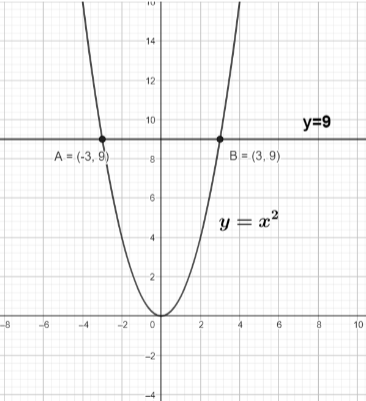
We can clearly see two curve one is $y={{x}^{2}}$ and another is $y=9$ and we can see the intersecting point A and B where $A=\left( -3,9 \right)$ and $B=\left( 3,9 \right)$ so the solution to the equation $\dfrac{1}{3}{{x}^{2}}-3=0$ is -3 or 3.
Let’s try the first method which involves directly drawing the graph $y={{x}^{2}}-9$ and checking the x intercept.
The graph $y={{x}^{2}}-9$ is 9 units down of the graph $y={{x}^{2}}$ .
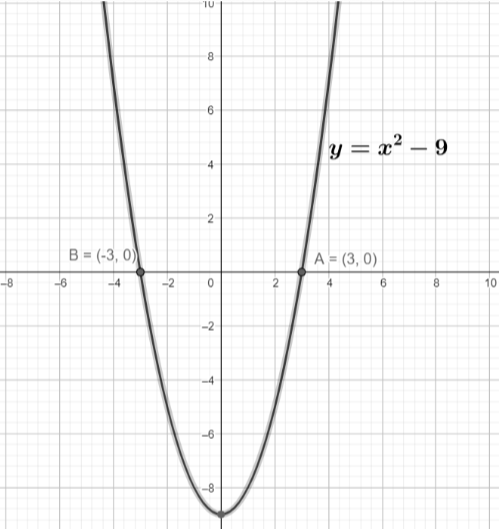
Now we can check the x intercept is -3 and 3. So the roots of the equation are -3 and 3.
Note: When solving graphically sometimes we can’t draw the graph of a function. In that case do apply the second method that we have used earlier in the above question. For example if you have a question like this “How many real roots of are possible for the equation $x-\tan x=0$ in between 0 to $2\pi $ “ .it is very difficult to draw the graph $x-\tan x$ so first draw the graph $y=x$ and then $y=\tan x$ check the number of intersecting point between 0 and $2\pi $ .
Complete step by step answer:
The given equation is $\dfrac{1}{3}{{x}^{2}}-3=0$ by solving further, we get ${{x}^{2}}-9=0$ .
One method is by solving it graphically is drawing the graph ${{x}^{2}}-9=0$ and check the x intercept and another method is drawing the graph $y={{x}^{2}}$ and $y=9$ check the intersecting point of the 2 graphs .
Let’s try the second method. So drawing $y={{x}^{2}}$ and $y=9$ .
We can clearly see two curve one is $y={{x}^{2}}$ and another is $y=9$ and we can see the intersecting point A and B where $A=\left( -3,9 \right)$ and $B=\left( 3,9 \right)$ so the solution to the equation $\dfrac{1}{3}{{x}^{2}}-3=0$ is -3 or 3.
Let’s try the first method which involves directly drawing the graph $y={{x}^{2}}-9$ and checking the x intercept.
The graph $y={{x}^{2}}-9$ is 9 units down of the graph $y={{x}^{2}}$ .
Now we can check the x intercept is -3 and 3. So the roots of the equation are -3 and 3.
Note: When solving graphically sometimes we can’t draw the graph of a function. In that case do apply the second method that we have used earlier in the above question. For example if you have a question like this “How many real roots of are possible for the equation $x-\tan x=0$ in between 0 to $2\pi $ “ .it is very difficult to draw the graph $x-\tan x$ so first draw the graph $y=x$ and then $y=\tan x$ check the number of intersecting point between 0 and $2\pi $ .
Recently Updated Pages
Master Class 12 Economics: Engaging Questions & Answers for Success

Master Class 12 English: Engaging Questions & Answers for Success
Master Class 12 Social Science: Engaging Questions & Answers for Success
Master Class 12 Maths: Engaging Questions & Answers for Success
Master Class 12 Physics: Engaging Questions & Answers for Success
Master Class 9 General Knowledge: Engaging Questions & Answers for Success
Trending doubts
Explain the Treaty of Vienna of 1815 class 10 social science CBSE
Who Won 36 Oscar Awards? Record Holder Revealed
Why is it 530 pm in india when it is 1200 afternoon class 10 social science CBSE
Make a sketch of the human nerve cell What function class 10 biology CBSE
What is the full form of POSCO class 10 social science CBSE
Define Potential, Developed, Stock and Reserved resources