




How do you solve \[2\log x=\log 2+\log \left( 3x-4 \right)\]?
Answer
 Verified
567.3k+ views
Hint: Use the formula \[a\log m=\log {{m}^{a}}\] to simplify the term in L.H.S. Now, consider the expression in the R.H.S. and use the sum to product rule of logarithm given as: - \[\log m+\log n=\log \left( mn \right)\], to simplify the R.H.S. Remove the log function from both the sides and form a quadratic equation in x. Solve this quadratic equation using the middle term split method and find the two values of x. Reject the invalid value of x, if present, by using the information that ‘argument of the logarithmic function must be greater than 0’.
Complete step by step solution:
Here, we have been provided with the logarithmic equation: \[2\log x=\log 2+\log \left( 3x-4 \right)\] and we are asked to solve it. That means we need to find the values of x.
Now, using the identity: - \[a\log m=\log {{m}^{a}}\] in the L.H.S. of the given expression, we get,
\[\Rightarrow \log \left( {{x}^{2}} \right)=\log 2+\log \left( 3x-4 \right)\]
Using the sum to product rule of log given as: - \[\log m+\log n=\log \left( mn \right)\] in the R.H.S., we get,
\[\begin{align}
& \Rightarrow \log \left( {{x}^{2}} \right)=\log \left( 2\times \left( 3x-4 \right) \right) \\
& \Rightarrow \log \left( {{x}^{2}} \right)=\log \left( 6x-8 \right) \\
\end{align}\]
As we can see that we have not been provided with the base of the logarithm, so we will assume that it is a common log expression, that means log to the base 10. So, we have,
\[\Rightarrow {{\log }_{10}}\left( {{x}^{2}} \right)={{\log }_{10}}\left( 6x-8 \right)\]
Clearly, we can see that we have log with the same base on both sides, so we can remove the log function and equate their argument. So, we get,
\[\begin{align}
& \Rightarrow {{x}^{2}}=6x-8 \\
& \Rightarrow {{x}^{2}}-6x+8=0 \\
\end{align}\]
Clearly, we can see that the above equation is a quadratic equation in x, so using the middle term split method, we have,
\[\begin{align}
& \Rightarrow {{x}^{2}}-4x-2x+8=0 \\
& \Rightarrow x\left( x-4 \right)-2\left( x-4 \right)=0 \\
& \Rightarrow \left( x-4 \right)\left( x-2 \right)=0 \\
\end{align}\]
Substituting each term equal to 0, we get,
\[\Rightarrow x=4\] or x = 2
Here, we have obtained two solutions, let us check if both the values of x are valid or not. Since, we know that for a log function to be defined we must have its argument greater than 0, so from the given logarithmic equation we must have,
(i) \[x>0\Rightarrow x\in \left( 0,\infty \right)\]
(ii) \[3x-4>0\Rightarrow x>\dfrac{4}{3}\Rightarrow x\in \left( \dfrac{4}{3},\infty \right)\]
Since, we need to satisfy both the conditions (i) and (ii), so we need to consider the intersection of the two sets of values of x. Therefore, we have,
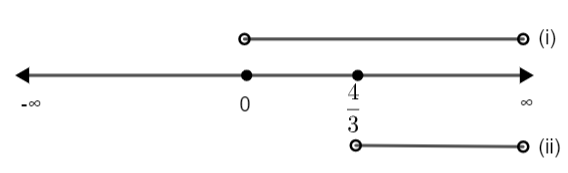
So, we can say that \[x\in \left( \dfrac{4}{3},\infty \right)\] is the final condition. Clearly, we can see that both the obtained values of x, i.e., 2 and 4, satisfy the conditions obtained.
Hence, the solutions of the given logarithmic equation are: - x = 2 or x = 4.
Note: One may make a mistake by thinking that the L.H.S. expression \[2\log x\] is already defined since we have used the conversion \[2\log x=\log \left( {{x}^{2}} \right)\]. But this is not true, actually we have to consider the initial equation and not its simplified form and that is the reason we have considered inequality (i). Remember some basic formulas of logarithm given as: - \[\log m+\log n=\log \left( mn \right)\], \[\log m-\log n=\log \left( \dfrac{m}{n} \right)\], \[\log {{m}^{a}}=a\log m\] etc. Always check if the obtained values of x are valid or not.
Complete step by step solution:
Here, we have been provided with the logarithmic equation: \[2\log x=\log 2+\log \left( 3x-4 \right)\] and we are asked to solve it. That means we need to find the values of x.
Now, using the identity: - \[a\log m=\log {{m}^{a}}\] in the L.H.S. of the given expression, we get,
\[\Rightarrow \log \left( {{x}^{2}} \right)=\log 2+\log \left( 3x-4 \right)\]
Using the sum to product rule of log given as: - \[\log m+\log n=\log \left( mn \right)\] in the R.H.S., we get,
\[\begin{align}
& \Rightarrow \log \left( {{x}^{2}} \right)=\log \left( 2\times \left( 3x-4 \right) \right) \\
& \Rightarrow \log \left( {{x}^{2}} \right)=\log \left( 6x-8 \right) \\
\end{align}\]
As we can see that we have not been provided with the base of the logarithm, so we will assume that it is a common log expression, that means log to the base 10. So, we have,
\[\Rightarrow {{\log }_{10}}\left( {{x}^{2}} \right)={{\log }_{10}}\left( 6x-8 \right)\]
Clearly, we can see that we have log with the same base on both sides, so we can remove the log function and equate their argument. So, we get,
\[\begin{align}
& \Rightarrow {{x}^{2}}=6x-8 \\
& \Rightarrow {{x}^{2}}-6x+8=0 \\
\end{align}\]
Clearly, we can see that the above equation is a quadratic equation in x, so using the middle term split method, we have,
\[\begin{align}
& \Rightarrow {{x}^{2}}-4x-2x+8=0 \\
& \Rightarrow x\left( x-4 \right)-2\left( x-4 \right)=0 \\
& \Rightarrow \left( x-4 \right)\left( x-2 \right)=0 \\
\end{align}\]
Substituting each term equal to 0, we get,
\[\Rightarrow x=4\] or x = 2
Here, we have obtained two solutions, let us check if both the values of x are valid or not. Since, we know that for a log function to be defined we must have its argument greater than 0, so from the given logarithmic equation we must have,
(i) \[x>0\Rightarrow x\in \left( 0,\infty \right)\]
(ii) \[3x-4>0\Rightarrow x>\dfrac{4}{3}\Rightarrow x\in \left( \dfrac{4}{3},\infty \right)\]
Since, we need to satisfy both the conditions (i) and (ii), so we need to consider the intersection of the two sets of values of x. Therefore, we have,
So, we can say that \[x\in \left( \dfrac{4}{3},\infty \right)\] is the final condition. Clearly, we can see that both the obtained values of x, i.e., 2 and 4, satisfy the conditions obtained.
Hence, the solutions of the given logarithmic equation are: - x = 2 or x = 4.
Note: One may make a mistake by thinking that the L.H.S. expression \[2\log x\] is already defined since we have used the conversion \[2\log x=\log \left( {{x}^{2}} \right)\]. But this is not true, actually we have to consider the initial equation and not its simplified form and that is the reason we have considered inequality (i). Remember some basic formulas of logarithm given as: - \[\log m+\log n=\log \left( mn \right)\], \[\log m-\log n=\log \left( \dfrac{m}{n} \right)\], \[\log {{m}^{a}}=a\log m\] etc. Always check if the obtained values of x are valid or not.
Recently Updated Pages
Master Class 12 Business Studies: Engaging Questions & Answers for Success

Master Class 12 Biology: Engaging Questions & Answers for Success
Master Class 12 Chemistry: Engaging Questions & Answers for Success
Class 12 Question and Answer - Your Ultimate Solutions Guide
Master Class 11 Social Science: Engaging Questions & Answers for Success
Master Class 11 English: Engaging Questions & Answers for Success
Trending doubts
Explain the Treaty of Vienna of 1815 class 10 social science CBSE
Who Won 36 Oscar Awards? Record Holder Revealed
What is the median of the first 10 natural numbers class 10 maths CBSE
Why is it 530 pm in india when it is 1200 afternoon class 10 social science CBSE
Why is there a time difference of about 5 hours between class 10 social science CBSE
What is the full form of POSCO class 10 social science CBSE