




Smallest parasitic flowering plant is?
(a) Arceuthobium
(b) Rafflesia
(c) Balanophora
(d) Cistanche
Answer
 Verified
615.9k+ views
Hint: This is a heterotrophic angiosperm which is also known as dwarf mistletoes having simple or branched and leafless thus, shows very low photosynthetic activity and depends on the host for water and shelter. This is a very common conifer and damaging tree disease in the Western US.
Complete step by step answer:
Arceuthobium is a highly specialized and genus of aerial dicotyledonous parasite that occurs on Pinaceae or Cupressaceae. Arceuthobium has characteristic yellow to orange or green to brown leafless aerial shoots on the host plant. The infection causes branch swelling, reduced growth, dieback and abnormal proliferation of host tissue known as ‘witches brooms’. Arceuthobium is flowering plants with no true roots and is parasitic on host tissue for nutrients and water and infection causes a reduction in host vigour and growth. Arceuthobium develops inside the bark and sapwood of the host for about two to three years and as the host tissue grows the Arceuthobium also continues to form a new shoot.
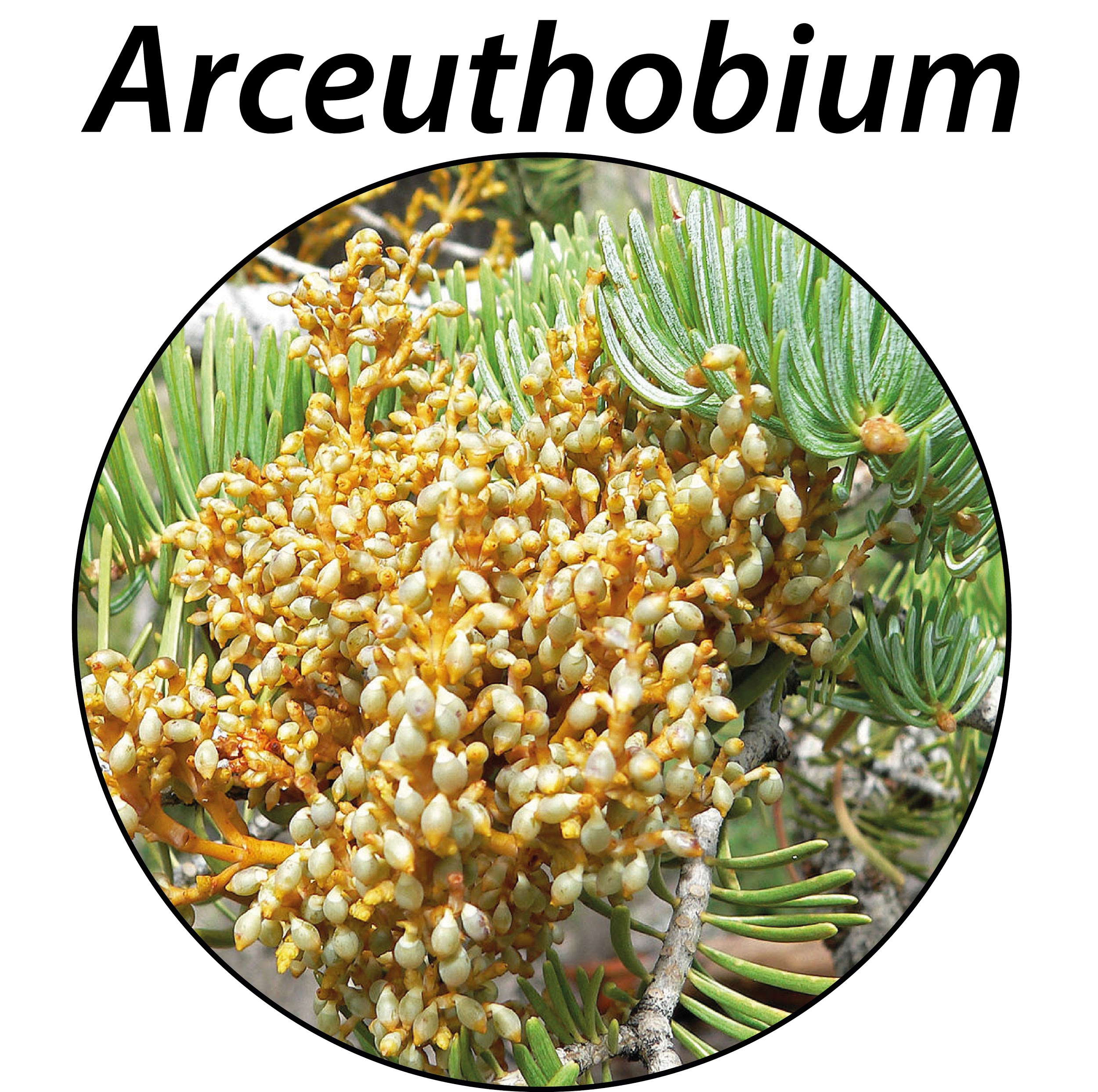
- Arceuthobium name was proposed by Marschall von Bieberstein in 1819.
- Arceuthobium also reported as root parasite instead of a stem, in Pinus sabiniana by Arceuthobium Occidentale in California acts as a root parasite.
- Arceuthobium unusual features are explosive, bicoloured fruit, having ring- like archesporium, chlorophyllous endosperm, germinating radical that contains stomata and stems with no central vascular sieve tube elements.
- Arceuthobium was initially included in sub- family Viscideae of the Loranthaceae.
- The smaller, uninfected trees were able to continue growing and attain sizes similar to the infected trees before many of these also became infected.
- The chance of infection in pine trees is high when the seedlings of those pine trees reach at a certain size before they provide sufficient target area for dwarf mistletoe seeds to hit.
- The leaves of Arceuthobium are inconspicuous, scale- like, in opposite pairs and of the same colour as stem and the plant also produces a complex system of haustoria.
- The sticky seeds of Arceuthobium are explosively discharged adhering where they land and cause infection.
- Arceuthobium normally contains fruit containing a single seed with one embryo but in the rare case, they may have two seeds or one seed with two embryos.
- All Arceuthobium are dioecious with pistillate and staminate plants occurring approximately equal in numbers.
So, the correct answer is, ‘(a) Arceuthobium.’
Note:
- Arceuthobium or Western Dwarf mistletoe is a damaging parasite of ponderosa pines and Jeffrey pine throughout much of southern California.
- As these pine trees growing in partial sunlight were more readily infected than those growing under full or continuous sunlight.
- The Arceuthobium plants are either male or female and produce flowers when they are four to six years old.
Complete step by step answer:
Arceuthobium is a highly specialized and genus of aerial dicotyledonous parasite that occurs on Pinaceae or Cupressaceae. Arceuthobium has characteristic yellow to orange or green to brown leafless aerial shoots on the host plant. The infection causes branch swelling, reduced growth, dieback and abnormal proliferation of host tissue known as ‘witches brooms’. Arceuthobium is flowering plants with no true roots and is parasitic on host tissue for nutrients and water and infection causes a reduction in host vigour and growth. Arceuthobium develops inside the bark and sapwood of the host for about two to three years and as the host tissue grows the Arceuthobium also continues to form a new shoot.
- Arceuthobium name was proposed by Marschall von Bieberstein in 1819.
- Arceuthobium also reported as root parasite instead of a stem, in Pinus sabiniana by Arceuthobium Occidentale in California acts as a root parasite.
- Arceuthobium unusual features are explosive, bicoloured fruit, having ring- like archesporium, chlorophyllous endosperm, germinating radical that contains stomata and stems with no central vascular sieve tube elements.
- Arceuthobium was initially included in sub- family Viscideae of the Loranthaceae.
- The smaller, uninfected trees were able to continue growing and attain sizes similar to the infected trees before many of these also became infected.
- The chance of infection in pine trees is high when the seedlings of those pine trees reach at a certain size before they provide sufficient target area for dwarf mistletoe seeds to hit.
- The leaves of Arceuthobium are inconspicuous, scale- like, in opposite pairs and of the same colour as stem and the plant also produces a complex system of haustoria.
- The sticky seeds of Arceuthobium are explosively discharged adhering where they land and cause infection.
- Arceuthobium normally contains fruit containing a single seed with one embryo but in the rare case, they may have two seeds or one seed with two embryos.
- All Arceuthobium are dioecious with pistillate and staminate plants occurring approximately equal in numbers.
So, the correct answer is, ‘(a) Arceuthobium.’
Note:
- Arceuthobium or Western Dwarf mistletoe is a damaging parasite of ponderosa pines and Jeffrey pine throughout much of southern California.
- As these pine trees growing in partial sunlight were more readily infected than those growing under full or continuous sunlight.
- The Arceuthobium plants are either male or female and produce flowers when they are four to six years old.
Recently Updated Pages
Master Class 12 Economics: Engaging Questions & Answers for Success

Master Class 12 English: Engaging Questions & Answers for Success
Master Class 12 Social Science: Engaging Questions & Answers for Success
Master Class 12 Maths: Engaging Questions & Answers for Success
Master Class 12 Physics: Engaging Questions & Answers for Success
Master Class 11 Social Science: Engaging Questions & Answers for Success
Trending doubts
One Metric ton is equal to kg A 10000 B 1000 C 100 class 11 physics CBSE
Difference Between Prokaryotic Cells and Eukaryotic Cells
Two of the body parts which do not appear in MRI are class 11 biology CBSE
1 ton equals to A 100 kg B 1000 kg C 10 kg D 10000 class 11 physics CBSE
Draw a diagram of nephron and explain its structur class 11 biology CBSE
10 examples of friction in our daily life