




What is the smallest and the nearest planet to the Sun of the solar system?
Answer
 Verified
594.6k+ views
Hint: We will know how many planets are actually there in our solar system. Then we need to know the diameters of the different planets. Then, compare the diameters with each other and then find the smallest and the nearest planet to the sun. Therefore, we will answer this question.
Complete answer:
Presently there are eight planets in our solar system. They are Mercury, Venus, Earth, Mars, Jupiter, Saturn, Uranus and Neptune. This is the actual order of their presence in the solar system with increasing distance. Hence, plainly Mercury is the nearest planet to the Sun. Now, to know the smallest planet, we will have to know the diameters of the different planets of the solar system. There diameters are given as, Mercury = 4878 km; Venus = 12,104 km ; Earth = 12,760 km ; Mars = 6,787 km; Jupiter = 139,822 km; Saturn = 120,500 km; Uranus = 51,120 km; Neptune = 49,530 km
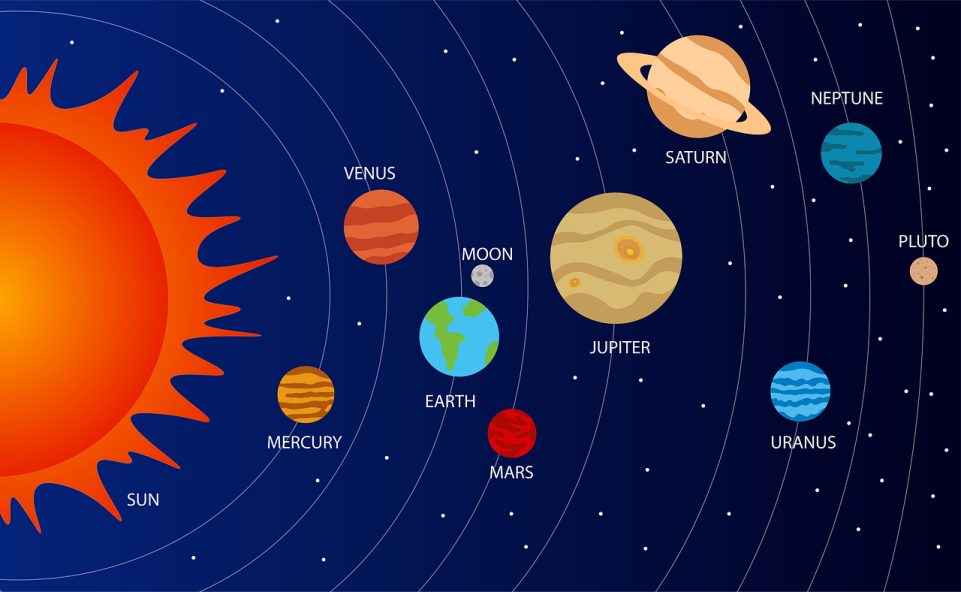
Hence by comparing the diameters, we can see that Mercury is the smallest planet of the solar system. Also from the above figure we can clearly see that mercury is the closest to the sun. So, the answer is Mercury.
Additional information:
A planet is defined as an astronomical object or body that is orbiting around a star and has enough gravity to be rounded in shape but can’t start a nuclear fusion reaction, and is able to remove other objects from its orbit. Planets usually have elliptical orbit. The planets of our solar system obey the laws of Kepler’s planetary model which has three laws. The first law states, the orbit of the planets has to be elliptical, the Sun stays at one of the foci of the orbits. The second law states the line joining the planet with the Sun covers equal area in equal time intervals for a particular planet. The third law states, the square of the time period of one complete revolution is proportional to the cube of the semi-major axis of the elliptical orbit.
Note:
Keep in mind that the diameter of Pluto is 2301 km. But it’s not the smallest planet since it is called a dwarf planet. This is so because it doesn’t fulfil the definition to be a planet. There are many more dwarf planets in our solar system.
Complete answer:
Presently there are eight planets in our solar system. They are Mercury, Venus, Earth, Mars, Jupiter, Saturn, Uranus and Neptune. This is the actual order of their presence in the solar system with increasing distance. Hence, plainly Mercury is the nearest planet to the Sun. Now, to know the smallest planet, we will have to know the diameters of the different planets of the solar system. There diameters are given as, Mercury = 4878 km; Venus = 12,104 km ; Earth = 12,760 km ; Mars = 6,787 km; Jupiter = 139,822 km; Saturn = 120,500 km; Uranus = 51,120 km; Neptune = 49,530 km
Hence by comparing the diameters, we can see that Mercury is the smallest planet of the solar system. Also from the above figure we can clearly see that mercury is the closest to the sun. So, the answer is Mercury.
Additional information:
A planet is defined as an astronomical object or body that is orbiting around a star and has enough gravity to be rounded in shape but can’t start a nuclear fusion reaction, and is able to remove other objects from its orbit. Planets usually have elliptical orbit. The planets of our solar system obey the laws of Kepler’s planetary model which has three laws. The first law states, the orbit of the planets has to be elliptical, the Sun stays at one of the foci of the orbits. The second law states the line joining the planet with the Sun covers equal area in equal time intervals for a particular planet. The third law states, the square of the time period of one complete revolution is proportional to the cube of the semi-major axis of the elliptical orbit.
Note:
Keep in mind that the diameter of Pluto is 2301 km. But it’s not the smallest planet since it is called a dwarf planet. This is so because it doesn’t fulfil the definition to be a planet. There are many more dwarf planets in our solar system.
Recently Updated Pages
Master Class 5 English: Engaging Questions & Answers for Success

Master Class 5 Maths: Engaging Questions & Answers for Success
Master Class 5 Social Science: Engaging Questions & Answers for Success
Master Class 5 Science: Engaging Questions & Answers for Success
Class 5 Question and Answer - Your Ultimate Solutions Guide
Master Class 9 General Knowledge: Engaging Questions & Answers for Success
Trending doubts
Explain the Treaty of Vienna of 1815 class 10 social science CBSE
What is the Total Duration of Football Match?
The shortest day of the year in India
10 examples of evaporation in daily life with explanations
Why is there a time difference of about 5 hours between class 10 social science CBSE
What is the full form of POSCO class 10 social science CBSE